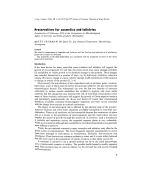
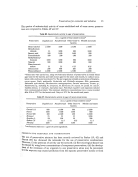
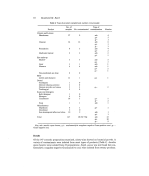
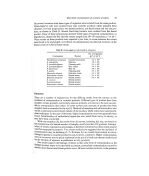
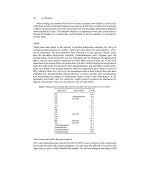
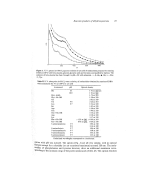
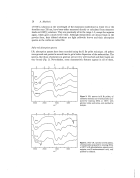
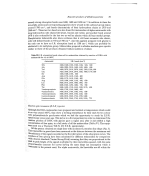
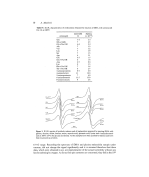
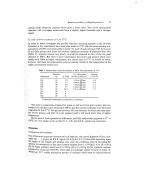
_Preservatives for cosmetics and toiletries 13 The spectra of antimicrobial activity of some established and of some newer preserva- tives are compared in Tables III and IV. Table HI. Bacteriostatic activity in agar of preservatives Preservative m.i.c. (txg/ml) of least sensitive strain* Staphylococci Pseudomona& Other Gram-re Moulds and yeasts bacteria Benzyl alcohol 3200 3200 3200 3200 Benzalkonium chloride 3'1 3200 800 1600 Benzoic acid 100 1600 1600 800 Formaldehyde 100 200 •100 200 Methylhydroxy- benzoate 3200 3200 800 1600 Nipastat 800 3200 800 800 Phenylmercuric acetate 3'1 25 6-25 6'25 Chlorocresol 200 400 200 200 Phenoxyethanol 3200 3200 3200 3200 * These tests were carried out, using two-fold serial dilution of preservatives in Oxoid blood agar base for the bacteria and malt extract agar for the yeasts and moulds, by surface inocu- lation with a multi-point inoculator (73). The test organisms included several strains of Staphylo- coccus aureus, Staph. epidermidis, Escherichia coli, Klebsiella aerogenes, Kleb. pneumoniae, Salmonella typhi-murium, Flavobacterium meningosepticum, Serratia marcescens, Proteus sp., t'seudomonas sp., including Ps. aeruginosa, t's. fluorescens, t's. cepacia, Ps. putida, Ps. stutzeri, Candida albicans, C. tropicalis, Aspergillus niger, t'enicillium roqueforti and organisms isolated from contaminated products. The minimum inhibitory concentrations (m.i.c.) were recorded after 48 h at 32øC for the bacteria and 5 days at 30øC for the moulds and yeasts. Table IV. Bacteriostatic activity in agar of newer preservatives Preservative m.i.c. (•g/ml) of least sensitive strain* Stalvhylococci Pseudomonads Other Gram-re Moulds and yeasts bacteria Germall 115 800 1600 800 3200 Dioxin 1600 1600 1600 800 Dowicil 200 200 1600 400 1600 Bronopol 25 25 25 3200 Bronidox L 501` 100 50 200 Kathon CG 12'51' 12-5 6'25 12'5 Phenonip 1600 3200 3200 1600 * see footnote Table HI. l' lzg/ml of active ingredients. PRESERVATIVE MIXTURES AND COMBINATIONS The use of preservative mixtures has been recently reviewed by Parker (19, 62) and :.• Garrett (63) has discussed the rationales for the use of preservative combinations. ß •: These are (i) the spectrum of activity can be increased (ii) the toxicological hazard can be reduced by using lower concentrations of component preservatives (iii) the develop- ment of the resistance of an organism to one preservative alone may be prevented : (iv) the response may exceed prediction from the separate preservative action or from ß

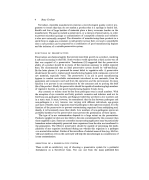
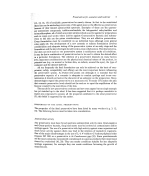
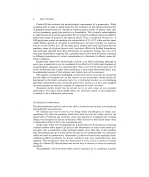
14 Betty Croshaw any concentration of one preservative alone (v) convenience of use of smaller pre- servative amounts or economic savings may result. The author suggests that the combination of a highly active labile preservative with a less active but more stable one to control prolonged in-use contamination is a further justification for preservative combinations. Mixtures of parabens in place of a single ester have been used for a long time (64) claims for these mixtures, which are available commercially e.g. 2Vipasept, Nipastat, have varied from simple additive effects to potentiation (see 12). Probably the main advantage is that the solubilities of the individual esters in the mixture are independent of each other so that a higher total concentration can be used. More recently, t'henonip, a combination of parabens and t'henoxetol (phenoxy- ethanol), has been evaluated and found to be a potent, wide-spectrum liquid preservative effective in the presence of anionic surfactants and proteins. There is some loss of activity in nonionic surfactants, in which Phenonip is very soluble, but this can be offset by utilizing the solubilization to create higher concentrations of the preservative in the product (65, 66, 67). Examples of extension of the microbial spectrum are the combinations of parabens with compounds showing low antifungal activity such as Dowicil 200 and Bronopol. From our own experience a mixture of Bronopol and parabens can also be useful in some alkaline formulations where the Bronopol is effective as a labile preservative and the paraben will combat in-use contamination. Germall 115 is reported to act synergistically with other preservatives (51) it is certainly useful in combination with parabens but true synergy is a rare occurrence. The use of mercurials with parabens to reduce the toxicity of the former may be useful in some formulations (19). Parker suggested in 1973 that the use of multicomponent preservative systems on a rational basis was probably the only way to preserve the complex formulations in use (62). This is still true today and may well be for some time to come since our knowledge of preservatives and their mode of action is still largely empirical. We cannot, therefore, hope to design an individual preservative or combination of preservatives that will match up to the ideal. References 1 De Navarre, M. G. The Chemistry and Manufacture of Cosmetics, p. 145 (1941) (D. Van Nostrand Co. Inc., New York). 2 Smart, R. and Spooner, D. F. Microbiological spoilage in pharmaceuticals and cosmetics. J. Soc. Cosmet. Chem. 23 721 (1972). 3 Wedderburn, D. L. Preservation of emulsions against microbial attack. Adv. Pharm. Sci. 1 195 (1964). 4 Woodward, C. R. and McNamara, T. F. Microbiological considerations of cosmetic emulsions. Am. Perfum. Cosmet. 85 No. 3 73 (1970). 5 Yablonski, J. I. and Goldman, C. L. Microbiology of shampoos. Cosmet. t'erfum. 90 No. 3 45 (1975). 6 Bean, H. S., Heman-Ackah, S. M. and Thomas, J. The activity of antibacterials in two-phase systems. J. Soc. Cosmet. Chem. 16 15 (1965). 7 Bryce, D. M. and Smart, R. The preservation of shampoos. J. $oc. Cosmet. Chem. 16 187 (1965). 8 Tice, L. F. and Barr, M. Factors to be considered in the preservation of cosmetic emulsions. J. $oc. Cosmet. Chem. 9 171 (1958). 9 Malcolm, S. A. and Woodroffe, R. C. S. The relationship between water-borne bacteria and shampoo spoilage. J. Soc. Cosmet. Chem. 26 277 (1975). 10 Tenenbaum, S. Pseudomonads in cosmetics. J. Soc. Cosmet. Chem. 18 797 (1967).
Purchased for the exclusive use of nofirst nolast (unknown)
From: SCC Media Library & Resource Center (library.scconline.org)