J. Soc. Cosmet. Chem. 28 17-20 (1977)¸ 1977 Society of Cosmetic Chemists of Great Britain Microbial contamination of cosmetic products Presented on 23 February 1976 at the Symposium on Microbiological Safety in Cosmetic and Toiletry products, Birmingham .:• ROSAMUND M. BAIRD Department of Medical Microbiology, ß The Medical College of St Bartholomew's Hospital, West Smithfield, London ECIA 7BE Synopsis !11 i:•:,.i I One hundred and forty seven cosmetic products purchased from five retail shops in 1974 were examined microbiologically. Viable bacteria were not recovered from ninety-nine products. Gram-negative rods ?.?..: were isolated from 6.1% of products and f'seudomonas spp. from 4'1% of products. ::. ß •:• i:: ..• Introduction '?.:' In recent years increasing interest has been shown in the susceptibility of cosmetics and i•:•:'i•i toiletry products to microbial contamination and the potential risk of infection to the user of those products. A number of workers have attempted to determine the incidence :.. i?•:of contamination the results from these surveys are conflicting and contamination rates ::i.:•-i•.i i? have been found to vary from 2'5•o to 43•o (1-8). There is even less information on the :::ilia:' possible health risk to the user of contaminated products. Two cases are often quoted from experience in hospitals (9, 10). This paper presents the results of an investigation into the microbial contamination of :i:'•i' unused cosmetic and toiletry products at the point of sale. ::•:•: •'Materials and methods :.:i': :::..A'total of 147 unused cosmetic products were purchased from five retail shops near this •: i•:?? hospital in July 1974. These comprised a wide range of preparations as shown in Table I. ..:Where possible aqueous products were bought in preference to oily products. One gram or 1 ml of product was homogenized in 20 ml of 4•o Lubrol W in Nutrient •:•!717 Broth (Oxoid) using a Stomacher 80 (Seward). Products containing halogen compounds ?/ .were homogenized in Nutrient Broth (Oxoid) containing 1•o sodium thiosulphate. !!'!i:?Phenolic products were diluted in 100 ml Nutrient Broth (Oxoid). All broths were ?: •ineubated aerobically at 37øC overnight, then sub-cultured to Horse Blood Agar (Oxoid), -I MacConkey Agar and Cetrimide Agar 0-03•o and incubated overnight at 37øC. Resulting ??/!:eølonies were identified some of the Gram-negative rods were sent to the Computer :i:.! Laboratory at Colindale for confirmation. Colony counts were only carried out on those •.::-: '.products from which Gram-negative rods were isolated. 17

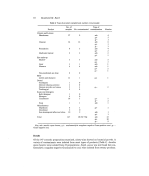
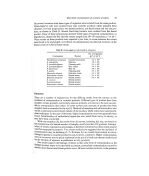
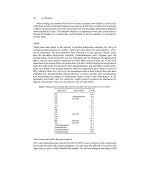
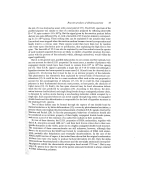
18 Rosamund M. Baird Table I. Type of products sampled and number contaminated No. of Type of Product samples No. contaminated contamination Number Creams and Lotions Handcream 27 9 Cleanser 24 12 Foundation 8 5 Medicated topical 8 2 Eye make-up Shadow 5 5 Liner 3 1 Mascara 6 4 Non-medicated eye drop 8 0 Baby Lotion and shampoo 12 1 Dental Toothpaste 1 0 Denture cleaning solution 2 0 Denture powder and cream 2 2 Teething gel 2 0 Soaps and detergents Bath detergent 1 0 Shampoo 9 0 Conditioner 10 3 Soap 1 1 Miscellaneous Depilatory 6 1 Deodorant 2 0 Sun-tanning and after-sun lotion 10 2 Total 147 48 (32-7 asb 4 g+ 5 g-- 1 asb 6 g+ 3 g- 3 asb 4 g+ 2 asb 2 g+ 1 asb 3 g+ 3 asb 1 asb 1 g+ 2 g-- 1 g+ 1 g- 2 g+ 1 g- 2 asb 1 g+ 1 asb 1 g+ 1 asb 23 g+ 20 g-- 9 Key, asb: aerobic spore bearer g+: non-haemolytic coagulase negative Gram-positive cocci g--: Gram-negative rod. Results Of the 147 cosmetic preparations examined, ninety-nine showed no bacterial growth. A variety of contaminants were isolated from most types of products (Table I). Aerobic spore bearers were isolated from 23 preparations Staoeh. aureus was not found but non- haemolytic coagulase negative Gram-positive cocci were isolated from twenty products.
Purchased for the exclusive use of nofirst nolast (unknown)
From: SCC Media Library & Resource Center (library.scconline.org)