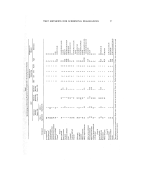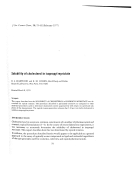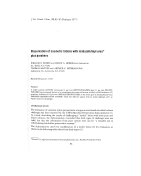

j. Soc. Cosmet. Chem., 28, 53-64 (February 1977) Screening of fragrance materials for allergenicity in the guinea pig I. Comparison of four testing methods G. KLECAK, H. GELEICK, and J. R. F1LEY. * Pharmaceutical Research Department, F. Hoffmann-La-Roche & Co. Ltd., CH 4002 Basel, Switzerland. Received November I O, ] 975 •::: Synopsis ::':" An OPEN EPICUTANEOUS TEST (OET) is proposed for the detection of SKIN IRRITATION and CONTACT HYPERSENSITIVITY induced in GUINEA PIGS. Thirty-two compounds described in the :::: " literature as being ALLERGENIC for man were tested in the guinea pig by the OET technique, and for the ':i!' : purpose of comparison, by three other techniques, namely the DRAIZE TEST (DT), the MAXIMIZA- : ß • TION TEST (MT) and a test with FKEUND'S COMPLETE ADJUVANT (FCAT). In the OET, a high degree of correlation was found between the allergenicity of the tested compounds for the guinea pig and for :: :•:i• man. :.. : ß I. INTRODUCTION A considerable amount of work has been done over many years developing pro- cedures for detecting skin-irritating and/or sensitizing effects of chemicals on labora- tory animals, in order to preselect compounds likely to be well tolerated by man. As in general toxicology and pharmacology, the results of such tests on animals cannot be fully valid for humans because of interspecies differences in the absorption, me- tabolism, and excretion of the compounds concerned. Furthermore, in the case of topical medication and of cosmetics, the conditions of exposrtre, such as concentration, frequency of application, and site of contact, can never be identical in human use and in animal experiments. The problem of identifying contact allergens, in humans as well as in laboratory ani- mals, was first approached critically and on a scientific basis by Kligman (1, 2, 3) and by Magnusson and Kligman (4, 5). These authors carried out comparative tests of nu- merous drugs, industrial contactants and cosmetics with well-known sensitizing properties, by various so-called predictive procedures commonly used on humans (6- 21), and have shown conclusively that these procedures often fail to identify even known sensitizers. These procedures are, therefore, also likely to be inadequate for the recognition of the allergenicity of new synthetic compounds. By carefully analyzing all .•:
Purchased for the exclusive use of nofirst nolast (unknown)
From: SCC Media Library & Resource Center (library.scconline.org)