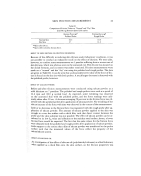
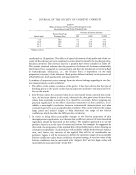
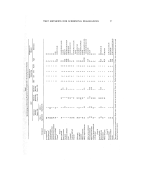
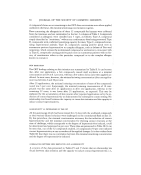
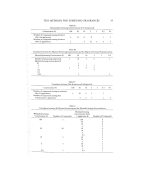
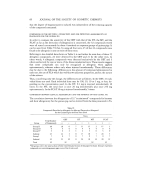
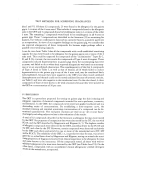
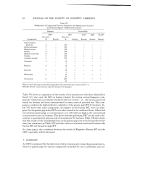
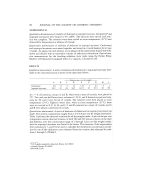
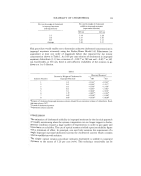
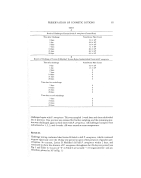
62 JOURNAL OF THE SOCIETY OF COSMETIC CHEMISTS Table VII Allergenicity of Compounds Tested in Humans by the Maximization Test (47) and in Guinea Pigs by 4 Different Procedures Humans Guinea Pigs MT a OET DT b MT b FCAT • Test cone, Test cone. Compounds % Results % Results Results Results Results Amyl-cinnam•c aidehyde 3 - 100 .... Diethyl phthalate 5 - 100 .... Methyl-ionone 5 - 100 .... Ionone 4 - 100 .... Hydroxycitronella[ 6 - 100 .... Vanillin 1 - 100 + + + + Cinnamic alcohol 2 - 100 - - + + Coumarin 4 - 10 + - - - 3 - Euge nol 4 - 10 + + + + 3 - Geraniol 3 - 10 + - + + 3 - Heliotropin 3 - 30 + - + + 10 - d-Limonene 4 - 100 + - + + 30 - aThe occlusive ehciting concentration application was only at the user concentration x 2. •DT, MT, FCAT: concentrations used see Section II of this paper. Table VII shows a comparison of the results of our animal tests with those obtained by Greif (47) who used the MT on human subjects for testing several fragrance com- pounds "which had successfully weathered the test of time," i.e., the innocuoushess of which for humans had been demonstrated by many years of practical use. This com- parison confirms the high predictive reliability of the guinea pig OET for humans. Ta- ble VII shows that some compounds, all negative in the human MT, were not aller- genic for the guinea pig in the OET even when tested in the undiluted form. Others did not sensitize guinea pigs at concentrations 2 to 100 times as high as the conventional concentrations used on humans. This shows that the guinea pig OET can be used to de- termine a quantitatively precise risk of sensitization for humans. Table VII also shows that the results of the intradermal tests on the guinea pig seem to be less predictive for man (see comments on Table VII) and that a better correlation was found between the human MT and the guinea pig OET. In a later paper, the correlation between the results of Kligman's Human MT and the OET, especially, will be discussed. V. SUMMARY An OET is proposed for the detection of skin irritation and contact hypersensitivity in- duced in guinea pigs by various compounds intended for use in perfumes and cos-

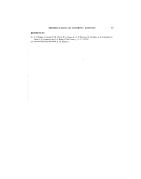
TEST METHODS FOR SCREENING FRAGRANCES 63 roetics. A dose-response curve was plotted for each compound tested, and the irritant and/or allergenic activity of each compound was established in terms of concentration in percent. The proposed procedure is simple, yields quantitative data, minimizes sub- jective factors when evaluating the results, and simulates the conditions in human use. A total of 32 compounds described in the literature as being allergenic for man were tested by the OET technique and, for the purpose of comparison, by three intradermal techniques, namely, the DT, the MT and the FCAT. Most of the compounds described as being allergenic for man were found to be allergenic for the guinea pig in the OET and in ! or more of the 3 intradermal tests. A few of the compounds tested, however, were found to be allergenic only in the OET, and a few others only in the DT, MT and/or FCAT. In' the OET, a high degree of correlation was found between the aller- genicity of the tested compounds for the guinea pig and their allergenicity for man. REFERENCES (1) (2) (3) (4) (5) (6) (7) (8) (9) (lO) (11) ß . (12) (13) .: (14) '::' (15) (16) (17) :.: (18) :' (19) (20) ': (21) (22) A.M. Kligman, The identification of contact allergens by human assay, J. Invest. Dermatol., 47,369-74 (1966). A.M. t(digman, The identification of contact allergens by human assay. II. Factors influencing the in- duction and measurement of allergic contact dermatitis, ibid., 47, 375-92 (1966). A.M. t(digman, The identification of contact allergens by human assay. III. The maximization-test: a procedure for screening and rating con tact sensitizers, ibid., 47, 393- 409 (1966). B. Magnusson and A.M. Kligman, The identification of contact allergens by animal assay. The guinea pig maximization-test, ibid., 52,268-76 (1969). B. Magnusson and A.M. Kligman, Allergic contact dermatitis in the guinea pig, Charles C. Thomas, Springfield, Illinois, 1970. K. Landsteiner and J. Jacobs, Studies on the sensitization of animals with simple chemical compounds, II, J. Exp. Med., 64,625-39 (1936). L. Schwartz and S. M. Peck, The patch test in contact dermatitis, Pub. Health Rep., 59,546-57 (1944). M. J. Brunner and A. Smilj anic, Procedure for evaluation skin sensitizing power of new materials, Arch. Dermatol. Syphilol., 66, 703-9 (1952). H. A. Shelanski and M. V. Shelanski, A new technique of human patch tests, Proc. Sci. Sect. Toilet Goods Ass., 19, 46 (1953). E. F. Traub, T. W. Tusing, and H. J. Spoor, Evaluating of derreal sensitivity, Arch. Dermatol. Syphilol., 69, 399-409 (1954). J. H. Draize, Appraisal of the safety of chemicals in foods, drugs and cosmetics. Dermal toxicity, The Assoc. of Food and Drug Officials of the United States, Texas State Dept. of Health, Austin, 1959, Pp. 46- 59. A. Rostenberg, Predictive procedures for eczematous hypersensitivity, Arch. Ind. Health, 20, 181-93 (1959). A. Rostenberg, Methods for the appraisal for the safety of cosmetics, Drug Cosmetic Ind., 88, 552-4, 592-4,681-6 (1961). FederalRegisterAmendment, Sept. 17, 29 F.R. 13009 (1964). R. Dohr-Lux and G. Lietz, Pharmakologisch-toxikologische und dermatologische Untersuchungs- methoden, Parfiim. Kosmet., 46, 1.Teil 256-9, 2.Teil 289-93, 3.Teil 323-6 (1965). Ch. Gloxhuber, Toxikologische Pr•i(ung yon Kosmetika, J. Soc. Cosmet. Chem., 18, 737-50 (1967). D. Kastner, ParfLim und Allergie, ibid., 19,807 (1968). B. Idson, Topical toxicity and testing, J. Pharm. Sci., 57, 1-1 ! (1968). N. Hunziker, Experimental studies on guinea pig's eczema, Springer-Verlag, Berlin-Heidelberg, 1969. G. Agrup and E. Cronin, Contact Dermatitits X, Brit. J. Dermatol., 83,516-7 (1970). G. Hopf, Empfehlungen f•ir Hautvertr•gl[chkeitsprLifungen von K6rperpfiegemitteln (kosmetische Er- zeugnisse), Fette, Seifen, Anstrichm., 73,467-8 (1971). L. A. Greenberg and D. Lester, Handbook of Cosmetic Materials, Interscience Publications, Inc. New York, 1954.
Purchased for the exclusive use of nofirst nolast (unknown)
From: SCC Media Library & Resource Center (library.scconline.org)