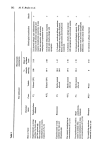
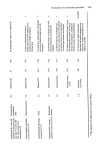
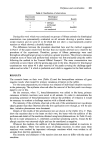
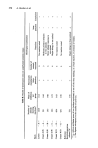
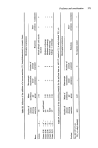
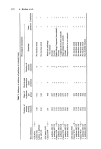
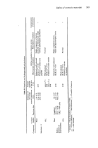
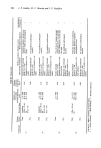
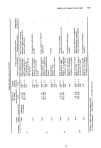
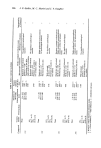
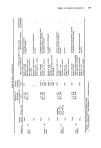
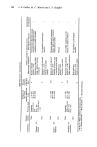
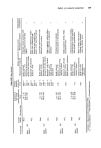
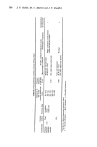
Perfumes and sensitisation 373 DISCUSSION The results of these experiments with six excipients which were used as bases for four different aromatic components show that whatever the excipient used the number of animals showing reactions was always very small. In addition, the mean erythema scores were comparable and always inferior to 1 (1 = erythema barely visible). Only one result seemed difficult to interpret - cream C: test positive with perfume and negative without perfume. It seems necessary to conduct a new series of tests for this cream. The cutaneous tolerance showed little or no modification due to the perfumes (basic composition or elaborated compositions) with relation to the excipient used. It should be emphasized however, that whenever a possible allergic type reaction was found for a base, or a perfume, or a mixture of the two this conclusion was based, in the majority of cases, on the effects found in one animal only. In addition, in all cases where there was an increase in the reaction score the mean of the erythema for the whole group always remained well below 1 whereas a test substance which is clearly irritant or sensitising is normally around 2.5 (erythema clearly visible). CONCLUSIONS This test seems sufficiently sensitive to demonstrate even slight cutaneous intolerance of the allergic type. Although only a limited number of perfumes were tested the results encourage the conclusion that there was no indication of producing a sensitising prep- aration from a base and a perfume which separately are non sensitisers. ACKNOWLEDGMENTS This study was instigated and supported by 'Les Laboratoires Vichy' and 'La Soci6t6 Firmenich'. We also thank Dr J. Guilaine, Pathologique H6pital Beauion, Paris, who carried out the histological examinations. RERERENCES 1 Brulos, M. F., Guillot, J.P., Martini, M. C. and Cotte, J. The Influence of perfumes on the sensitis- ing potential of cosmetic bases. I: A technique for evaluating sensitising potential. J. Soc. Cosmet. 28 357 (1977). 2 Magnusson, B. and Kligman, A. The identification of contact allergen by animal essay. The guinea- pig maximisation test. J. Invest. Derrnatol. 52 268-276 (1969). 3 Opdyke, D. L. J. Monographs on fragrance materials. Food Cosmet. ToMcol. 11 1021 (1973).

374 A. Rochas et al. APPENDIX I COSMETIC BASES EMULSION A fat phase: 37•o of a base consisting essentially of hydrogenated poly-butylene. emulsifier: polyoxyethylene sorbitol monostearate q- glycerol monostearate. preservatives: a mixture of parahydroxybenzoic acid esters. EMULSION B fat phase: 40•o of a base consisting of hydrogenated poly-isobutylene with the addition of a starch derivative. emulsifier: polyoxyethylene sorbitol monostearate q- glycerol monostearate. preservative: a mixture of parahydroxybenzoic acid esters. EMULSION C fat phase: approximately 50•o of a base consisting essentially of a mixture of synthetic esters (Pur Cellin) and mineral oil. emulsifier: polyoxyethylene sorbitol monostearate q- glycerol monostearate. preservative: a mixture of parahydrobenzoic acid esters. EMULSION D fatphase: approximately 50•o of a blend of lanolin derivatives, mineral oil and petroleum jelly. emulsifier: Magnesium lanolate. preservative: trichlorodiphenylether, imidazoline urea. EMULSION E fat phase: approximately 30•o of a blend of fatty acid esters and mineral oil. emulsifier: glycerol esters of fatty acids. preservative: blend of parahydroxybenzoic acid esters. LOTION A This formula containing no alcohol is based on 40 % of floral waters, glycerine and demineralized water. preservatives: blend of parahydroxybenzoic acid esters. Colours F.D.C.: C.I. 42090 C.I. 14700 Both perfumed and unperfumed emulsions were subjected to microbiological control tests which gave no growth in all cases.
Purchased for the exclusive use of nofirst nolast (unknown)
From: SCC Media Library & Resource Center (library.scconline.org)