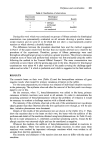
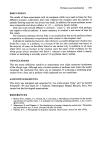
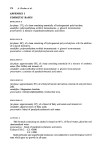
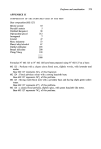
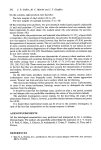
Perfumes and sensitisation 375 APPENDIX II COMPOSITION OF THE PERFUMES USED IN THE TEST Base composition (602 127) Benzyl acetate 65 Styralyll acetate 5 Distilled Bergamot 38 Dipropylene glycol 212 Isoeugenol 7 Linalol 47 Musc indanone 53 Phenyl ethyl alcohol 67 Diethyl phthalate 203 Benzyl salicylate 200 Ylang Ylang 103 1000 Formulae N ø 602 123 to N ø 602 126 have been prepared using N ø 602 127 as a base: 602 123 : Perfume with a chypre citrus floral note, slightly woody, with lavender and amber Base 602 127 represents 34•o of this fragrance. 602 124: Floral powdery odour with a strong hyacinth base. Base 602 127 represents 54•o of this perfume. 602 125: Strong violet floral note with a powdery base and having slight green under- tones. Base 602 127 represents 67•o of this perfume. 602 126: a classic floral perfume, slightly spicy, with green hyacinth side notes. Base 602 127 represents 74•o of this perfume.

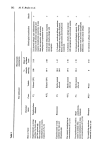
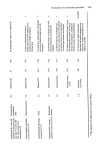
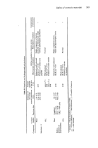
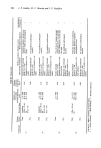
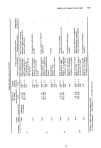
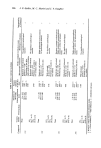
J. Soc. Cosmet. Chem. 28 377-393 (1977)¸ 1977 Society of Cosmetic Chemists of Great Britain Safety evaluation of cosmetic raw materials J.P. GUILLOT*, M. C. MARTINIt' and J. Y. GIAUFFRET+ + Presented at the Xlth European Week of Dermocosmetology on 21 January 1977 at Lyon, France. Synopsis Tests were carried out for safety evaluation using the rabbit on twenty-six cosmetic components. The ocular and cutaneous tolerance was evaluated using official French methods with some additions. The results show that thirteen samples gave adverse reactions after repeated skin exposures eight of them appeared to be significantly more irritant--four isopropyl myristates and four oleyl alcohols each from different sources. Eleven were well tolerated when applied undiluted during 60 days and two gave un- certain results. INTRODUCTION This work represents the first stage of a more ambitious programme, as it is proposed to test several series of products of various chemical compositions which form the basis of the majority of cosmetic formulations. The aim is three-fold: to allow the formulation chemists to know the tolerance to different categories of raw materials to try to under- stand the origin of phenomena observed in tolerance tests of finished products to establish 'skeleton' formulae for each type of product (milks, creams o/w and w/o etc.) composed of tested raw materials that have been qualified as non-irritant and to study in parallel the finished products based on the corresponding skeletons. It is believed these results are significant because, carried out by the same personnel, they permit reliable comparisons. Ocular and cutaneous tolerance to raw materials should be an essential consideration in the formulation of products intended for local use, whether they be cosmetic or pharmaceutical. Paradoxically, it would appear that this is a field which has not been extensively studied (10) (17). Often the formulatot relies on information gathered over the years, information which is often falsified by the presence of other materials in the formula. In other cases, certain products are accepted as favourable without taking into account the fact that impurities can exist. In short, the rare experiments related are often fragmentary and unmethodical: they concern only a small percentage of raw materials and seldom serve to enlighten the users. * Institut Fran9ais de Recherches et Essais Biologiques. Les Oncin 69210--L'Arbresle, France. ? Institut de Pharmacie Industrielle, 8 av. Rockefeller 69008--Lyon, France. :I: R. & D. Lancaster (Beecham Products), 7 av. d'Ostende•Monte-Carlo, Monaco. 377
Purchased for the exclusive use of nofirst nolast (unknown)
From: SCC Media Library & Resource Center (library.scconline.org)