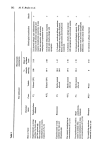
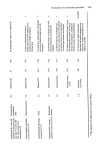
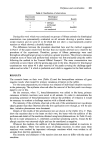
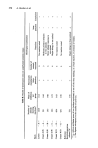
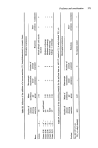
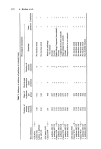
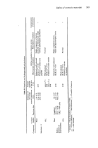
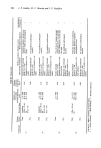
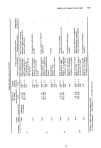
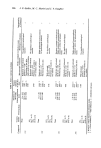
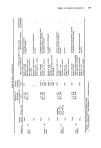
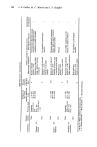
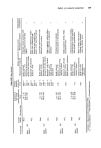
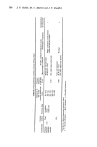
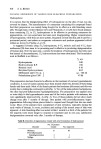
364 M. F. Brulos et al. Reliability Using the technique described above several compounds known to be sensitisers were tested. The results are given in Table I. DISCUSSION Of the twelve preparations tested (seven different substances) ten gave good correlation between the macroscopic and histological results. The 5•o hydroquinone monobenzyl ether made up in ethanol (70 ø) and the ben- zylideneacetone in an oil/water emulsion gave questionable results, as the macroscopic observations were not confirmed histologically. However, instead of being taken 7 h after the removal of the occlusive dressing, samples were taken 48 h after patch removal (i.e. 96 h after application of test substance). When one examines the macroscopic development of cutaneous reactions one notes a diminution in the intensity of the ery- thema between 24 and 48 h after the removal of the occlusive dressing. Perhaps in this case the biopsies were conducted too late. For benzylideneacetone the histological examinatiofi gave rather indeterminate results for similar reasons. Other studies conducted with other oil/water emulsions con- taining benzylideneacetone have demonstrated reactions which are of primary irritation in nature. It is therefore important to perform skin biopsies no later than 7 h after the removal of the patch to reduce the incidence of false negative results. Precautions were taken to avoid interference due to irritation. However, even in healthy areas, the skin of sensitised subjects is more susceptible to irritation than the skin of normal subjects. Furthermore the use of Freund's adjuvant may lead to the appearance of non-specific reactions. It must also be remembered that the margin between the maximum non-irritant concentration and the minimum necessary to cause a sensitisation reaction is much smaller in the guinea-pig than in man (16). This is why it seems necessary to consider only those macroscopic reactions scoring two or more which also reduces the need to conduct a histological examination. We abandoned the Magnusson and Kligman system for the expression of results. Cosmetic products ready for commercialization are unlikely to contain strong sen- sitisers since known sensitisers are eliminated from their composition. Unlike a phar- maceutical product where the therapeutic activity may be great enough to permit the use of a component with doubtful sensitising potential, uncertainty is never acceptable for a cosmetic product. Thus it is important to be clear about the expression of results during the animal test (the more so since extrapolation to man entails many approxi- mations). It is possible to use this technique for detecting the sensitizing potential of cosmetic bases (aqueous or oil solutions, and water/oil or oil/water emulsions) as well as the potential of the perfume content or the combined mixture (19). CONCLUSION The method described here gave good results for the detection of weak sensitizers. Since this test avoids the use of an increase in concentration to maximize the reaction nor

Evaluation of sensitisation potential 365 does it make use of intradermal injections as the route of administration it seems particularly well adapted to the testing of finished products whatever their form. ACKNOWLEDGMENT The histological examinations were performed and interpreted by Dr J. Guilaine. RE 3 4 5 6 7 8 9 10 11 12 13 14 15 16 17 18 19 20 FERENCES M6thodes officielles d'analyse des cosm6tiques et produits de beaut6. Annexes I, II, III. Arrgt6 du 5 avril 1971. Journal Officiel de la Rdpubliquefrancaise, 21 April 3862 (1971). Brulos, M. F. Mise au point d'une mdthode d'evaluation du pouvoir sensibilisant des produits cosmd- tiques (test proph6tique). Th•se de doctorat de l'Universit6 de Pharmacie. Lyon 14 September 1976. Buehler, E. V. Delayed contact hypersensitivity in the guinea-pig. Arch Dermatol. 91 171 (1965). Draize, J. H. Dermal Toxicity. Dans: Appraisal of the safety of chemicals in foods, drugs and cosmetics, 46-59 (1969). Fischer, A. A. Contact dermatitis. Lea et Febiger, 2nd edition. 1973 Philadelphia. Hardy, J. Allergy, hypersensitivity and cosmetics. J. Soc. Cosmet. Chem. 24 423-468 (1973). Hendeison, C. R. and Riley, E. C. Certain statistical considerations in patch testing. J. Invest. Derm. 6 226, 230 (1945). Knudsen, L. Note on statistical probabilit es of finding hypersensitive subjects in random samples. J. Invest. Dermatol. 6 231-232 (1945). Landsteiner, K. and Jacobs, J. Studies on the sensitisation of animals with simple chemical com- pounds. J. Exptl. Med. 61 643-656 (1935). Magnusson, B. and Hersle, K. Patch test methods III: Influence of adhesive tape on test response. Magnusson, B. and Kligman, A. The identification of contact allergens by animal assay. The maximisation test. J. Invest. Dermatol. 52 268-276 (1969). Magnusson, B. and Kligman, A. Allergic contact dermatitis in the guinea-pig. Identification of contact allergens. Charles C. Thomas, Springfield. 1970. Marzulli, F. N., Carson, T.R. and Maibach, H. I. Delayed contact hypersensitivity studies in man and animals. Proc. Joint. Confer. Cosmt. Sci. Washington D.C.p. 107-122 (1968). Marzulli, F. N. and Maibach, H. I. Antimicrobials experimental contact sensitisation in man. J. Soc. Cosmet. Chem. 24 385-421 (1973). Masters, E. J. Allergies to cosmetic products. N.Y. State. J. Med. 60 1934-1941 (1960). Nilzen, A. Some aspects of epidermal testing in guinea-pig sensitised and not sensitised to 2.4. dinitrochlorobenzene. Acta Dermato Venereol. 32 supplement 29 231-239 (1952). Opdyke, D. J. Monographs on Fragrant Raw Materials. Foods and Cosmet. Toxicology. 11 95- 115, 477-495, 855-876, 1011-1081, (1973) 12 385-405, 517-537, 703-736 (1974) 13 91-112, 449-458,545-554 (1975). Krafr, E. R., Hoch, S. G., Quisno, R. A. and Newcomb, E. A. Evaluating the safety of cosmetics by human patch-test methods. Symposium 'Peau et environnement' J. Soc. Cosmet. Chem. 23 383 (1972). Rochas, A., Guillot, J.P., Martini, M. C. and Cotte, J. Contribution M'6tude de l'influence des parfums sur le pouvoir sensibilisant de bases cosm6tiques. 2•me partie: role du parfum sur le pouvoir sensibilisant de bases cosm6tiques. J. Soc. Cosmet. Chem. This issue. Voss, J. G. Skin sensitisation by mercaptans of low molecular weight. J. Invest. Derm. 31 273 (1958).
Purchased for the exclusive use of nofirst nolast (unknown)
From: SCC Media Library & Resource Center (library.scconline.org)