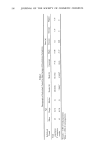
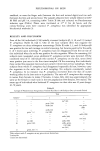
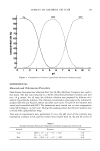
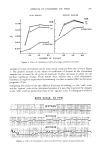
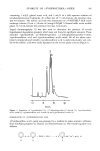
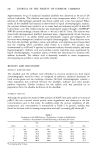
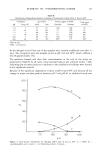
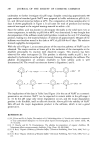
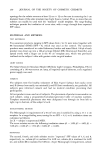
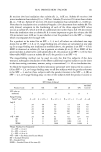
248 JOURNAL OF THE SOCIETY OF COSMETIC CHEMISTS undertaken to further investigate this pH range. Samples containing approximately 500 ppm analytical standard grade NaPT were prepared in buffer solutions at pH 6.9, $.1, 9.1, and 10.0 and stored as before at 40øC. The composition of these samples after 33 days is shown graphically in Figure 2. In all cases the total of products and starting material was equal to the original starting material to within _+ 5%. Since the sulfinic acid was known to decompose thermally in the solid state even at room temperature, its stability at pH 10.0 at 40øC was determined. It was thought that decomposition of the sulfinate would yield pyridine-l-oxide as the only UV absorbing product, leading to a low material balance. A solution of approximately 100 ppm of the sulfinate was therefore stored in the dark at 40øC a t pH 10.0 for 47 days. The solution showed negligible decomposition. With the aid of Figure 2, an accurate picture of the reaction pathway of NaPT can be obtained. The major reaction at lower pH is the oxidation of the mercaptide to the disulfide presumably by reaction with dissolved oxygen. This reaction has been observed for other mercaptans (3). This product is relatively stable at pH 7, but is attacked by hydroxide ion as the pH is increased, forming, ultimately, the sulfinate. The alkaline decomposition of aromatic disulfides to form sulfinic acids is well documented (4). The overall reactions are shown in Equations 2 and 3. 4 • S- + 02 + 2H20 I o I I + 4OH- (2) 0 0 0 0 The implications of the data in Table I and Figure 2 for the use of NaPT as a cosmetic preservative are obvious. NaPT can be expected to remain stable in the pH range 4 to -8. In this pH range only minor degradation occurs, and the major degradation product is the disulfide, itself an effective biocide. Above pH 8 the stability of NaPT •falls off and the major degradation product is the sulfinate, which is not a good preservative. REFERENCES (1) R..J. Fenn and D. A. Csejka, The analysis of 2,2'-dithiobispyridine-l,l'-dioxide and related compounds in clear antidandruff shampoos via reverse-phase liquid chromatography, J. Soc. Cosmet. Chem., 30, 73-79 (1979). (2) J.P. Danehy and K. N. Parameswaran, The alkaline decomposition of organic disulfides. III. Substituent effects among aromatic disulfides,J. Org. Chem., 33, 568 (1968). (3) E. E. Reid, "Organic Chemistry of Bivalent Sulfur," (Chemical Publishing, New York, 1958), Vol. 1, p 118. (4) E. E. Reid, "Organic Chemistry of Bivalent Sulfur," (Chemical Publishing, New York, 1960), Vol. 3, p 375.

j. Soc. Cosmet. Chem., 33, 249-258 August 1982 Adverse reactions to eye area cosmetics and their management FRANCES PASCHER, M.D., 1715 Nottingham Road, Raleigh, NC 27607. Received January 25, 1982. Presented at the Carolina Chapter Society of Cosmetic Chemists meeting, September 15, 1981. Synopsis Adverse reactions to eye area cosmetics are discussed to acquaint the reader with their prevalence, cause(s) and manifestations. Stinging and burning (subjective irritation), "allergic" conjunctivitis, allergic and irritant contact dermatitis of the eye area, ocular infections, conjunctival pigmentation due to eyeliner and mascara, and eyeshadow mimicking orbital calcification are the potential side effects that may be encountered. Management of these undesirable effects and the preventive measures that may be taken by the cosmetic industry and the consumer are considered. Comprehensive care includes not only elimination of the cause and alleviation of symptoms, but the suggestion of an alternate product whenever feasible for those who wish to wear eye makeup. I. INTRODUCTION The true incidence of adverse reactions or injuries caused by eye area products is not readily assessable. Consumer perceived reactions usually remain unconfirmed and reactions observed by physicians often go unreported. Be that as it may, Mausner (1), in a worldwide study carried out over a period of two years to determine the safety in use of several cosmetic categories, found 0.50 reactions (irritation) to eye makeup per 1,000,000 units sold, a low incidence. The National Electronic Surveillance System (NEISS) report (2) by comparing the incidence of reactions to eye area products with other cosmetic-related injuries including skin care products and toiletries also provides some interesting statistics. Of 473 cases of cosmetic injury reported over a period of one year 39 (8.2%)were injuries due to mascara, 17 (3.6%)were due to other eye makeup preparations, a total of 56 injuries in the 473 cases, or 11.83%. These figures are almost mirrored by the Consumers' Association London report for the same period (3). Of 549 cases of adverse reactions to cosmetics reported, 33 (6%) were injuries due to mascara, 39 (7%) were injuries due to eye shadow, 3 (1%) were due to eye liners, a total of 75 adverse reactions in the 549 cases, or 13.66%. II. STINGING AND BURNING (SUBJECTIVE IRRITATION) Stinging and burning appear to be the most common side effects. Why these symptoms are elicited in some individu•:.als by products that are generally well tolerated 249
Purchased for the exclusive use of nofirst nolast (unknown)
From: SCC Media Library & Resource Center (library.scconline.org)