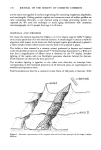
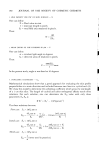
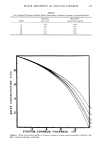
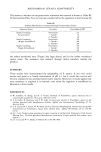
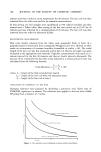
192 JOURNAL OF THE SOCIETY OF COSMETIC CHEMISTS is the position along the direction of diffusion (e.g., position along the thickness of the stratum corneum), and D is the diffusivity of water in the membrane. To understand TEWL, what we need is a picture (or graph) of the concentration, C, of water, across the stratum corneum, i.e., as a function of x. In principle, this can be obtained by integration of eq. 1. In practice, however, such integration is not straightforward because the diffusivity of water varies with the concentration of water, C, at different positions, x, in the tissue (4). This dependence of D on C is emphasized by writing D(C). Before we can integrate eq. 1, therefore, we must find an equation for D(C) in terms of C. Because water molecules bind to stratum corneum, the binding not only results in a concentration (water) dependent diffusivity, but also causes the swelling of the tissue. In a keratinous tissue, the increase in the tissue volume due to water uptake may not necessarily be equal to the volume of water absorbed, because the structure of water in the tissue is not the same as in bulk liquid (5). Therefore, to obtain an equation describing the diffusivity of water in the stratum corneum as a function of water concentration one needs methodology more complicated than that which suffices when the diffusivity is a constant. Recently, Wu (6) developed a permeation method to determine the penetrant diffusivity as a function of its concentration. The author was able to obtain an empirical equation describing the water diffusivity in fetal hog periderm. This report describes how this method of data analysis was used with TEWL data previously obtained by Goodman and Wolf (7) (from human volar forearm) to determine the diffusivity of water in human stratum corneum. With this equation, in conjunction with Fick's diffusion law, the water concentration profile in the stratum corneum under various relative humidities was determined. METHODS Assuming the stratum corneum at any position is uniform with respect to its water barrier properties, then at steady state, the rate of water transpiration (the flux, F) through the layers of tissue can be described by an integrated form of eq. 1 (3): F = • D(C)dC, (2) where H is the thickness of the stratum corneum, C h and Co are the water concentrations in the tissue at the surface and at the dermal side, respectively, D(C) is the water diffusivity (at each depth in the tissue) which can be a function of water concentration. __ __ The mean diffusivity D, at mean water concentration C, in the tissue can be defined as = Co [D(C)dC]/(Co - Ch). -- Substituting eq. 2 into eq. 3, D becomes: D = F H/(Co -- Ch). (3) (4)

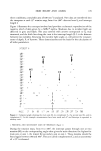
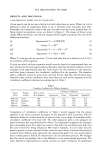
WATER DIFFUSIVITY IN STRATUM CORNEUM 193 By keeping the difference in water conc__entration between Co and C h small, at first approximation, the mean concentration, C, may be assumed to be -- C = (C O q- Ch)/2. (5) The thickness of the membrane, H, is also a function of the water content in the tissue. Because Co and Ch are very close, it is assumed that the thickness may be defined by H = (Ho + Hh)/2, (6) where Ho and n h are the membrane thicknesses when the water concentrations throughout the membrane are uniformly Co and Ch, respectively. This assumption can be verified after D(C) is determined by using eq. 2 to calculate the thickness. -- D obtained from eq. 4, that is, from the measurement of F, H, Co and Ch, is then plotted against C. An empirical equation, D(C), describing the diffusivity-concentration relationship may be obtained from the plot. The form of the empirical equation was found to be D(C) = D O q- A C B (7) for the fetal hog periderm, where Do, A and B are constant parameters. This empirical equation is then inserted into Fick's equation (eq. 1) which may be integrated to give C as a function of position, x, in the membrane. The curve for C vs. x, that is, the water distribution profile, is then integrated to give the area under the pro- file. This area divided by the membrane thickness, H, yields the mean concentration C, __ of water in the membrane. Such calculated values for C are then compared with the -- values used to obtain D(C). If they are not_equal_, the assumed values of C are adjusted and a new D(C) is obtained from the new D rs. C plot. The process is repeated until the calculated and assumed values are equal or converge. This method may be carried out in vitro, because appropriate steps can be taken to keep the difference between Co and Ch small. However, in an in vivo situation, no control can be exerted on water concentration (Co) on the dermal side of the stratum corneum. Nevertheless, it is essentially constant. In contrast, the surface of the skin experiences a wide range of water concentrations (Ch) which depend largely on the ambient relative humidity. The difference between Co and Ch would be large, and the effective thickness of the tissue under these conditions would be unknown. Therefore, to apply the analytical technique used in the in vitro experiments to an in vivo situation some modifications in the analytical procedure were made. First, values for the mean -- concentration, C, and membrane thickness, H, were assumed before the iteration. Then the procedure used to obtain D(C) in vitro was followed. In subsequent approxima- tions, convergence between assumed and calculated values for both mean concentra- -- tion (C) and thickness (n) could be established. A danger with this approach is that, depending on the initial selection of the assumed -- values for C and H, there may be more than one explicit equation for D(C) which fits the experimental data. To avoid this pitfall, some restrictions were imposed before the iteration of the data analysis. Since human stratum corneum and fetal hog periderm are keratinous membranes, the functional forms for D(C) were assumed to be the same for both tissues (see eq. 7). The water diffusivity in human stratum corneum was known to
Purchased for the exclusive use of nofirst nolast (unknown)
From: SCC Media Library & Resource Center (library.scconline.org)