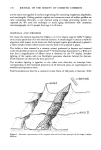
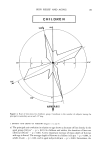
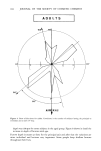
198 JOURNAL OF THE SOCIETY OF COSMETIC CHEMISTS MATERIALS AND METHODS 1. ENUMERATION OF PROTOTYPE CONTAMINANTS The Microbial Content/Sterility (MC/S) Test, routinely employed at Lever Research, was utilized to determine whether the formulation was contaminated. This method involves transfer of a 10 g sample into 90 ml of appropriate inactivating broth (Difco © Letheen Broth). This 1:10 dilution of the sample is used both for pour plating (Difco © Tryptic Soy Agar ) as well as a 10 g enrichment for sterility testing. Enrichments are incubated with pour plates provided no colonies develop on the 1:10 plate, the contents are swabbed onto test media for detection of either low level contamination or 10 g sterility. 2. IDENTIFYING THE CONTAMINANT Approximately 50 colonies, isolated from pour plates, were first Gram-stained, and then 17 were put through the API © 20E Enterobacteriaceae Identification System (Analytab Products). As set forth in the Analytical Profile Index, the number of positive biochemical reactions governs the incubation time. Test strips were incubated 36 to 48 hours. The API © Oxidase Test Kit was employed to determine cytochrome oxidase reactions. Colonies were also inoculated onto Difco © Pseudomonas Isolation Agar. 3. TREATMENT OF CONTAMINATED PRODUCT Approximately 100 g amounts of the contaminated formula were treated with formaldehyde and benzoic acid at levels of 50 ppm and 100 through 1,200 ppm (using 100 ppm increments). Preservative activity was measured by using the MC/S Test and evaluating the treated and control samples initially and after a storage period of 2 to 3 days, followed by weekly evaluations for approximately 1 month. The level of preservative which was considered as potentially effective yielded sterility of a 10 g sample in less than one week. 4. MINIMUM INHIBITORY CONCENTRATION BY GRADIENT PLATE The Gradient Plate procedure was employed in this study to determine the preservative resistance of the organism (4). In brief, a square phage-type Petri dish (90 ram) is placed on an inclined platform so that a base layer of agar is hardened in the form of a wedge. A second layer of agar containing preservative is hardened with the plate in a level position. The top layer of preservative is diluted by diffusing into the base layer. The end result is a concentration gradient at the surface. For the Gradient Plate procedure, preservatives were prepared in concentrations of 1,000, 500, 250, 100, 50, 25, 10, 5, and 1 ppm active. Difco © Tryptic Soy Agar was employed since it readily supported the contaminant's growth and does not contain inactivators of antibacterials. Twelve contaminated samples were streaked across the surface of the agar using an apparatus which holds 12 small brushes for simultaneous and multiple inoculations (5). The plates were incubated at 32øC for 3 to 4 days to enable the more antibacterial- resistant cells to develop into colonies. After incubation, resultant growth streaks were

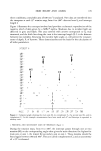
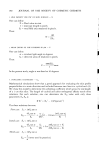
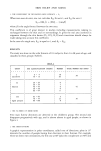
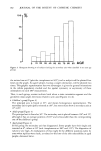
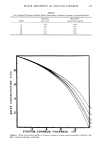
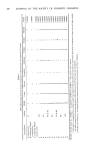
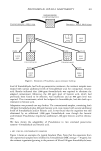
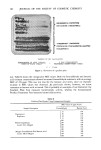
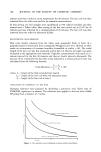
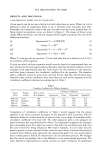
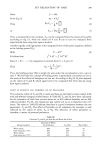
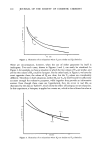
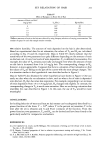
PSEUDOMONAS CEPACIA ADAPTABILITY 199 measured (in mm) to the point of inhibition. The Minimum Inhibitory Concentration, MIC value, for a particular preservative is determined by using the dilution plate which exhibits a measurable (30 to 50 mm) growth front. MIC values are obtained by a direct proportion of the Gradient Plate concentration of preservative to the growth front measurement (exemplified in Figure 2). RESULTS AND DISCUSSION 1. ENUMERATION OF PROTOTYPE CONTAMINANTS Plate counts had shown a contamination level of 105 cells/g product. 2. API EVALUATION The API © 20E biochemical reactions could be read accurately only after 36 to 48 hours incubation of the test strips. It is suggested that a 9 digit number be employed when biochemical reactions are determined after a 48 hour incubation of strips. However, only an 8 digit number was determined i.e., growth on MacConkey's and tests for the Oxidative/Fermentive Utilization of Glucose (tubes not available) were not completed. Colonies, which had been isolated from Tryptic Soy Agar plates, were evaluated from the unpreserved, and from the formaldehyde (100 ppm) and benzoic acid (200 ppm) containing formulas. To determine whether the organism's biochemical reactions would change after it had been isolated from its hostile environment, an API evaluation was completed after each of 10 consecutive transfers for both the unpreserved and the formaldehyde resistant organisms. As shown in Table I, the reactions were remarkably consistent. Positive reactions were ONPG (O-nitrophenyl-•-d-galactoside), citrate utilization, glucose fermentation, and nitrate reduction. Arabinose fermentation was frequently positive, and amygdalin fermentation was only occasionally positive. The organism appeared to be oxidase-positive, but the reaction took from 10 seconds to 5 minutes. Although an Oxidase Test is commonly read in 10 seconds, this organism gave atypical results (indicated as _+ in Table I). The organism was found to be motile and beige-yellow in color on both Tryptic Soy and Pseudomonas Isolation Agar plates. The profile index numbers identified the organism, from both the unpreserved and preserved formulations, as "acceptable" to "very good" identification for P. cepacia. 3. CONTAMINATED PRODUCT TREATMENT Replicate samples of contaminated product containing various concentrations of formaldehyde or benzoic acid were prepared. As shown in Figure 1, the organisms were eliminated (sterility in a 10 g sample) in less than a week, by 300 ppm formaldehyde, or 400 ppm benzoic acid concentration. The sample with 300 ppm benzoic acid continued to show bactericidal activity at a slower rate. In contrast, the sample with 200 ppm of formaldehyde exhibited initial activity (dropping the count to 10/g), but the organisms grew out to the original level within a relatively short time. To determine whether this organism, which had adapted rather quickly to a 100 ppm
Purchased for the exclusive use of nofirst nolast (unknown)
From: SCC Media Library & Resource Center (library.scconline.org)