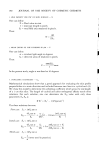
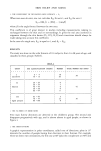
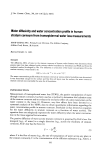
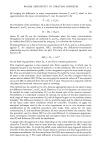
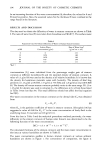
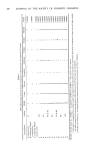
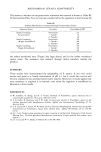
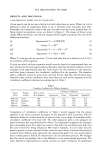
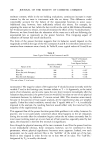
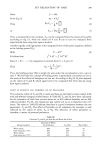
SET RELAXATION OF HAIR 209 Since Y = 50% From Eq. (2) 50 = AT,0 B (5) Then •n T,0 = • In (6) Thus, a characteristic time constant, T50, can be computed from the values of A and B, according to Eq. (7), while the values of A and B can in turn be evaluated from experimental data using least square analysis. Another equally useful parameter is the integrated form of the power equation, defined as the holding power (Hp). With Y = AT • (8) It follows that: f Y dT = f AT • dT Since 0 B -- 1, the integration is smooth from T = 0 up to T. Then Hp = (B-•) TB+I (9) Thus, the holding power (Hp) is simply the area under the set relaxation curve, up to a time T. We feel that this concept of holding power is particularly convenient to use in the study of the effects of hairsprays on hair set. According to Eq. (9), Hp also depends on the values of A and B, which again have to be computed first from data by using least square analysis. EFFECT OF HUMIDITY AND HAIRSPRAY ON SET RELAXATION The evaluative utility of T50 and Hp in water and heat set swatches has been tested, both with and without hairspray reinforcement. In Table III, T50 and Hp have been calculated for the relaxation of both heat set and water set, at 65% relative humidity and at 90% relative humidity. For Hp, the integration was carried out up to a relaxation time of 8 hours. The values in Table III indicate that there is a good correlation between the two parameters, T50 and Hp. The effect of humidity on set relaxation, for example, is well reflected by the values of either T50 or Hp. The selection of either parameter is, therefore, a matter of personal preference. Table III Calculated T50 and Hp for Heat Set and Water Set of Hair Humidity in Which Setting Condition Set is Relaxed T•0 (Hrs.) Hp (%/Hrs.) Water setting 90% 0.07 85 Heat setting (at 115øC) 90% 0.08 79 Water setting 65% 0.72 323 Heat setting (at 115øC) 65% 0.16 148

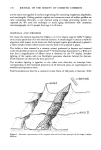
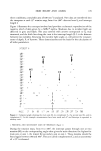
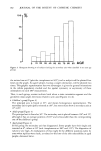
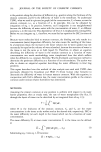
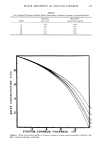
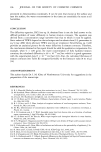
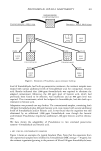
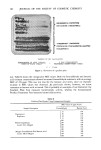
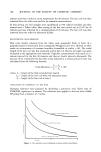
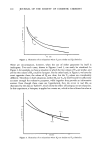
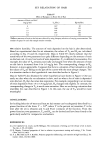
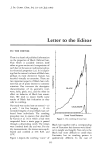
210 JOURNAL OF THE SOCIETY OF COSMETIC CHEMISTS Figure 2. Illustration of set relaxations where T5os are similar and Hps dissimilar. There are circumstances, however, when the use of either parameter by itself is inadequate. Two such cases, shown in Figures 2 and 3, can easily be visualized. In Figure 2, for example, we have a situation in which the two values of T50 are similar, and yet the two values of Hp could be far apart. On the other hand, in Figure 3, we have the exact opposite: there, the values of Hp are close, but the T50 values are considerably different. Therefore, in both situations, neither Hp nor T•0 by itself would be sufficiently accurate enough for evaluative purposes, while together they provide an informative answer. Even though these cases are hypothetical, they do occur in real life, as illustrated by the data in Table IV, which show the effect of hairspray on set relaxation. In this experiment, a hairspray is applied to a water set, which is then allowed to relax at (T50) 1 (T50) 2 •4 TIME (HRS) • Figure 3. Illustration of set relaxations where Hps are similar and T50s dissimilar.
Purchased for the exclusive use of nofirst nolast (unknown)
From: SCC Media Library & Resource Center (library.scconline.org)