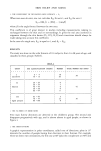
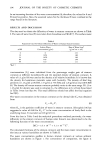
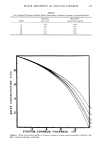
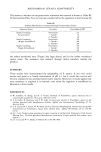
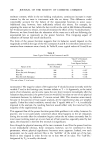
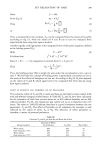
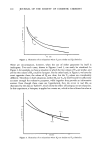
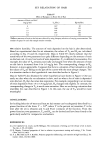
SET RELAXATION OF HAIR 211 Table IV Effect of Hairspray on Water Set of Hair Amount of Resin on Hair* (mg/g hair) T50 (Hrs.) Hp (%/Hrs.) 0 O.O7 85 1.6 O.O8 252 2.7 0.51 325 3.4 O.87 339 5.8 1.32 353 *Different amounts of resin on the hair are achieved by using hairspray solutions of varying concentrations. The number of sprays for each hair sample remains constant. 90% relative humidity. The amount of resin deposited on the hair is also determined. Based on experimental data for set relaxation, the values of T50 and Hp are calculated according to Eq. (7) and (9), respectively. Data in Table IV clearly indicate that the sensitivities of the two parameters are quite different depending on the amount of resin on the hair curl. At very low levels of resin deposition, T50 is definitely less sensitive. For example, the value of T50 remains practically unchanged even when the amount of resin on the hair is increased from 0 to 1.6 mg/g hair. The corresponding change in Hp, however, is more appreciable. It appears that here is a situation of fast relaxation so that the values of T•0 are falling on the part of the curves with the most abrupt changes. This is a situation similar to the hypothetical case described earlier in Figure 2. Data in Table IV also illustrate the other hypothetical case shown in Figure 3. One can easily see that when the set relaxation is slow, such as when a lot of resin is deposited onto the hair, Hp then becomes less responsive. For example, responding to an increase of resin deposition from 3.4 to 5.8 mg/g hair, Hp changes only slightly. In contrast, the corresponding change in T50 is much more extensive. Here we are facing a situation that resembles the case described in Figure 3. In this case, the use of T50 would be more meaningful. CONCLUSIONS Set holding behavior of water and heat set hair tresses can be adequately described by a power function of the form: Y = AT B, where Y is the percent set retention T is the time after the set is released and A and B are constants of the function. From this power function, two parameters, T50 and Hp, can be derived and have been found to be particularly useful for comparative evaluations. REFERENCES (1) J. R. Caldwell, S.J. Leach, and B. Milligan, The mechanism of setting and the release of set in water, Tex. Res. J, 35,245 (1965). (2) H. Bogaty, Torsional properties of hair in relation to permanent waving and setting, J. Soc. Cosmet. Chem., 18, 575 (1967). (3) A. L. Micchelli and F. T. Koehler, Polymer properties influencing curl retention at high humidity,J. Soc. Cosmet. Chem., 19, 863 (1968).

212 JOURNAL OF THE SOCIETY OF COSMETIC CHEMISTS (4) M. Feughelman, A. R. Haly, andJ. W. Snaith, Permanent set and keratin structure, Tex. Res. J, 32,913 (1962). (5) G. C. Wood, The relaxation of stretched animal fibers: the relaxation of human hair, J. Tex. Inst., 45, T462 (1954). (6) M. Feughelman and A. R. Haly, The physical properties of wool fibers at various regains: the mechanism of stress relaxation and length recovery, Tex. Res. J, 32, 227 (1962).
Purchased for the exclusive use of nofirst nolast (unknown)
From: SCC Media Library & Resource Center (library.scconline.org)