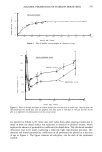
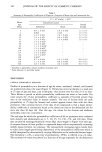
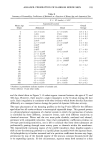
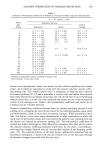
j. Soc. Cosmet. Chem., 35, 237-252 (August 1984) Age and anatomical site influences on alkanol permeation of skin of the male hairless mouse CHARANJIT R. BEHL, GORDON L. FLYNN, TAMIE KURIHARA, WARD M. SMITH, NANCY H. BELLANTONE, OLIVIA GATMAITAN, WILLIAM I. HIGUCHI, and NORMAN F. H. HO, College of Pharmacy, University of Michigan, Ann Arbor, MI 48109, and CARL L. PIERSON, Clinical Microbiology Laboratory, University of Michigan Hospital, Ann Arbor, MI 48109. Received April 2, 1982. Synopsis The permeation of water, methanol, ethanol, n-butanol, n-hexanol and n-octanol through dorsal and abdominal skin sections excised from the male hairless mouse was studied as a function of mouse age. There was a 3- to 5-fold increase in permeability of the skin to these compounds during the early weeks of life when the animal's singular coat of hair is formed. During this period dorsal skin was measurably more permeable than abdominal skin. After the hair was shed, permeability coefficients gradually declined with rates that appeared to be compound specific. At an age of about 50 days, permeability of the anatomical sites came into and remained in coincidence. For most of the compounds studied, permeability coefficients leveled out roughly at 100 days. Total skin thickness and animal weight have also been characterized as a function of age and compared with permeability. It is evident that skin is a tissue with a complex, integrated barrier function and that the overall mechanism of permeation bears no simple relationship to either the age or the thickness of strata of mouse skin. Nevertheless, a descriptive steady state model of permeation is presented which, in order to explain the data, includes two routes through or around the stratum corneum, one polar in nature and the other lipoidal. The model also takes diffusion through the strata beneath the horny layer into account. Permeability patterns were exhibited throughout the mouse's life which seem to fit this physical construction. INTRODUCTION There are few literature reports on the influences of age on the barrier properties of skin in either man or animal and, to a great extent, the little data which do exist here have been developed under circumstances where assessment of subtly changing barrier characteristics in the skin as a function of age is confounded by simultaneous variations in other physiological factors which affect measured levels of compounds in the whole organism (1-4). The influence of anatomical location on skin permeation is a better researched subject. Site-related variation in irritancy of human skin has been reported (5). Studies carried out in vivo and in vitro (6) indicate human scrotal skin is more permeable than abdominal skin to several test substances. Site-related variations in 237

238 JOURNAL OF THE SOCIETY OF COSMETIC CHEMISTS penetration rates of organic phosphates were demonstrated for cadaver skin (7). Regional variations in percutaneous absorption of hydrocortisone (8,9) and pesticides (10) have also been noted in humans. High densities of prominent hair have been linked with high permeability to some agents (9) but not others (11). Literature reports refuting site-to-site differences in percutaneous absorption (12, 13) may not be related to per- meation per se. The hairless mouse has been used extensively in drug efficacy and drug permeation studies. In the course of work in our laboratories it became necessary to assess what influences age, animal gender, and the anatomical location of the excised skin had on the mass transfer coefficients (permeability coefficients) we were obtaining. Such data reveal the age span over which valid comparisons in permeation for a given compound are possible. Also, if two sites as expansive and separate as the abdomen and dorsum can be shown to have identical permeabilities, then it becomes possible to use one site on an animal for treatment and the other as a control in permeation experiments, a strategy with obvious advantage with respect to management of animal variability. Therefore, the permeation of select alkanols through the excised skin of the male hairless mouse has been studied over the greater part of the life span of this animal. EXPERIMENTAL CHEMICALS The radioactive homologous n-alkanols and water used in these studies were obtained from NEN • (3H-H20 , 3H-CH3OH), and ICN 2 (•4C-C2H5OH, •4C-nC4H9OH, 14C- nC6H•3OH,14C-C8H•7OH). The chemicals were diluted into 0.9% sodium chloride irrigation 3 (normal saline) to make stock solutions of 10-4M or less concentration containing about 100 •tCi/ml. ANIMALS Male hairless mice, SKH hr-• strain 4, were obtained at age 40 days or as breeding pairs in order to raise even younger animals. The animals were housed individually and had free access to food and water. MEMBRANE PREPARATION AND PERMEATION STUDIES The membranes used were full thickness abdominal and dorsal skin sections taken immediately from mice sacrificed by spinal cord dislocation. For young mice with heavy coats of hair, hair was first closely cropped to the skin surface with surgical scissors (14). Detailed procedures for excising and placing the skins in the two com- partment diffusion cells were described in an earlier report (15). Briefly, oversized sections of skin were clamped between the half cells. The skin area available for diffusion New England Nuclear, Boston, MA 02118. International Chemical and Nuclear Corp., Irvine, CA 92664. Abbott Laboratories, North Chicago, IL 60064. Skin Cancer Hospital, Temple University, Philadelphia, PA 19140.
Purchased for the exclusive use of nofirst nolast (unknown)
From: SCC Media Library & Resource Center (library.scconline.org)