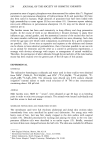
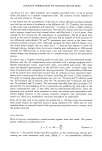
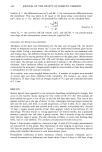
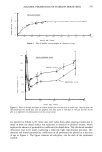
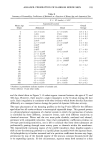
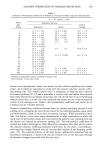
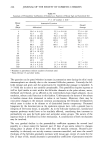
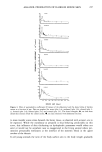
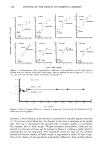
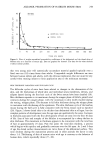
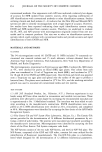
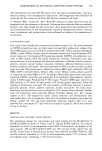
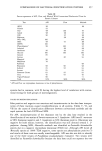
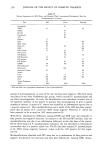
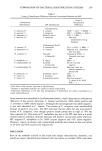
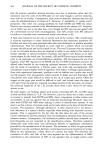
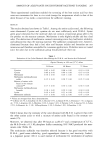
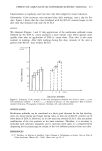
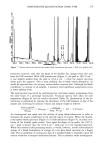
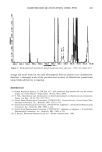
ALKANOL PERMEATION OF HAIRLESS MOUSE SKIN 245 Table V Summary of Permeability Coefficients of Hexanol as a Function of Mouse Age and Anatomical Site P x 10 3 (cm/hr) _+ S.D. a Mouse Anatomical Location Age Overall (Days) Abdominal Dorsal Average 4 5 20 25 39 46 50 51 53 55 56 57 68 71 76 79 88 210 270 360 17.5 -+ 1.7(3) 30.6 -+ 4.9(4) 24.7 _+ 2.6 20.5 (2) 40.3 (2) 30.9 -+ 6.3 38.3 -+ 6.4(4) 58.5 + 6.6(4) 48.5 _+ 4.4 54.1 _+ 7.5(5) 84.5 _+ 9.2(5) 69.3 -+ 5.9 36.9 (1) b 48.4 (1) b 42.6 40.8 (2) b 43.4 (1) • 42. ! 3!.8 -+ 6.6(5) b - - 32.8 -+ 6.4(13) • - - 38.3 (2) • 4!.7 (2) b 40.0 _+ 4.0 3!.6 -+ 3.6(5) • - - 33.8 -+ 6.6(5) • - - 33.3 -+ 3.2(4) b 42.4 _+ 15.8(4) • 38.! -+ 9.8 30.2 -+ 2.6(4) • - - 30.2 _+ 8.4(8) • - - 32.8 -+ 14.0(4) • - - 32.2 + 5.6(4) • - - 24.6 _+ 8.0(5) • - - !7.8 -+ 3.7(4) 23.2 + 4.6(4) 20.5 _+ 4.! 21.2 _+ 7.7(5) 24.2 + !!.2(5) 23.5 -+ 8.7 16.4 _+ 2.5(5) !9.1 + 4.4(5) !7.4 + 3.2 Numbers in parentheses indicate numbers of animals used. From reference 15 and other works. section (true hydrodynamic layers) and within the skin (cellular epidermal and dermal strata), all of which are positioned in series with the stratum corneum, assume a flux- determining role. The overall behavior here is analoguous to what has been reported for human epidermis (21,22) and is somewhat at variance with the earliest data reported from these laboratories on hairless mouse skin (23,24). In the face of an overwhelming amount of new data, it is now clear that methanol and ethanol are not on the exponential section of the homolog curve. Rather, their permeability coefficients and waters lie on a plateau and are virtually identical. Octanol's permeability coefficient deviates from the linearly ascending portion of each semilog curve, presaging the onset of rate control by the identified aqueous tissue strata and hydrodynamic layers in series with the stratum comeurn. While reasonably evident here, this feature is even more amply demonstrated in other experiments in which the horny layer of the hairless mouse skin was removed by adhesive tape stripping (24) and the dermis was isolated by protracted soaking (25). The permeability coefficients of octanol and higher homologs are little affected by treatments like these which remove the stratum comeurn. Differing hydration sensitivities for the short-, intermediate-, and long-chain length alkanols also set the specified regions of the homolog profile apart (15). The essential features of the skin barrier qualitatively described here are maintained throughout a mouse's life and are evident even as the skin goes through the dynamic changes associated with the hair cycle.

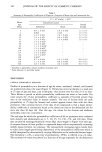
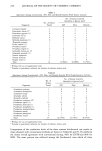
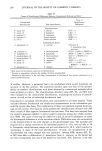
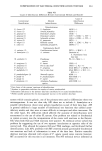
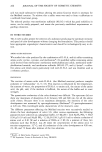
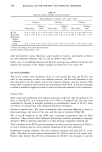
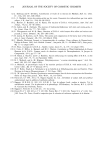
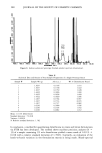
246 JOURNAL OF THE SOCIETY OF COSMETIC CHEMISTS Table VI Summary of Permeability Coefficients of Octanol as a Function of Mouse Age and Antomical Site P X 103 (cm/hr) _ S.D. a Mouse Anatomical Location Age Overall (Days) Abdominal Dorsal Average 4 29.6 ñ 4.4 (3) 23.3 - 6.4 (4) 27.4 ñ 4.8 5 52.5 (2) 47.2 (2) 49.8 ñ 6.3 20 58.9 ñ 16.5(4) 92.6 - 4.9 (4) 75.8 ñ 6.1 25 118.4 ñ 20.9(5) 128.4 ñ 32.5(5) 123.4 ñ 24.5 39 90.0 (1) b 102.8 (1) b 96.4 46 77.7 (2) b 67.2 (1) b 78.7 53 88.9 (2) b 105.6 (2) b 97.2 ñ 12.1 59 94.6 ñ 8.6 (3) b 85.5 ñ 4.1 (4) b 92.1 ñ 7.5 71 85.3 ñ 12.3(5) b - - 72 68.5 ñ 10.3(15) - - 85 51.4 (2) b - - 103 67.8 ñ 2.5 (3) - - 106 68.0 ñ 4.1 (3) - - 134 49.9 (1) b - - 210 14.0 ñ 0.9 (4) 11.7 ñ 0.9 (4) 12.7 ñ 0.8 270 18.3 ñ 4.2 (5) 21.3 ñ 4.0 (5) 19.7 ñ 2.5 360 24.6 ñ 7.4 (4) 20.2 ñ 10.4(4) 24.0 ñ 9.1 Numbers in parentheses indicate numbers of animals used. From reference 15 and other works. The question can be posed whether increases in permeation rates during the skin's early metamorphosis are directly due to the increased follicular presence. Certainly the fol- licles enlarge and grow and the opportunity for transfollicular passage is expanded. A 3-5-fold rise in rates is not entirely unreasonable. This possibility requires aqueous as well as lipid media to exist within the follicular channels as the polar solutes, water, methanol and ethanol, are as affected as the intermediate-chain length alkanols. As an emulsion, sebum could function in this fashion. Unfortunately the nature of the sebum in hairless mouse skin immersed in saline is not known. Moreover, there may be concurrent changes in the stratum corneum accompanying the follicular developments which cause it either to be thinner or of diminished barrier competency. Decreased lipogensis by the keratinocytes as the epidermis sprouts hair, with a general loss in integrity of the horny tissue, is plausible. As in the follicular explanation, lipoidal and aqueous pathways would have to be similarly affected, considering that increases in permeability are seen for both polar and semipolar solute groups. The nature of the aqueous shunt is ill-defined by either mechanism. A combination of both mechanisms may be involved. The very gradual decline in the permeability coefficient apparent for octanol (and possibly to a lesser extent for hexanol) past 25 days of age seems related to changes taking place in phases of the tissue other than the stratum corneum. Octanol's per- meability is obviously not strictly stratum corneum-controlled, and since the overall thickness of the full skin gradually increases with mouse age, except of course for the first 25 days of life, steady decreases in permeability coefficients of permeants sensitive
Purchased for the exclusive use of nofirst nolast (unknown)
From: SCC Media Library & Resource Center (library.scconline.org)