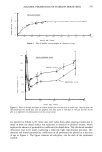
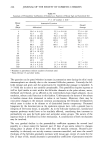
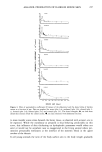
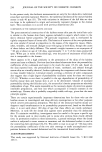
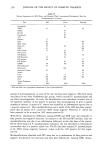
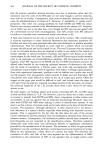
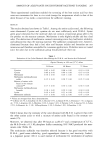
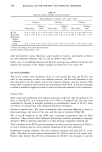
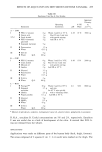
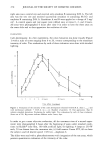
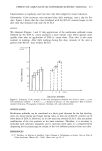
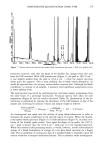
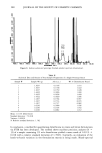
270 JOURNAL OF THE SOCIETY OF COSMETIC CHEMISTS right area was a control site and received only emulsion B containing D.H.A. The left area was the test site and received successively emulsion A containing M.S.O. and emulsion B containing D.H.A. Emulsions A and B were applied at a dosage of 5 mg/ cm 2. A control square and test square were rubbed once at times 0, 2, and 4 hours. All areas were photographed 6 hours after time 0 in order to have the three areas on the same slide and to thus appreciate the evolution of color. EVALUATION Co/or determination. In a first experiment, the color evaluation was done visually (Figure 1) with a scale of scores ranging from 0 to 20, twenty corresponding to the maximum intensity of color. Two evaluations by each of three evaluators were done with standard lighting. 20 15 1 2 3 4 5 6 hours 48 hours 5 days Time after treatment Figure 1. Evaluation of the intensity of the color development obtained with D.H.A. alone (.__.) and with methionine sulfoxide + D.H.A. (x x). Number of patients: 10. One application. Bars (I) indicate standard deviations. Evaluation by visible light. Two evaluations by each of three evaluators. (Score out of 20). Big arrows indicate different scales: hours, days. In order to get a more objective evaluation, all the treatment sites of a second exper- iment were photographed 6 hours after the beginning of assay under standard condi- tions: (a) Kodak © color film, 160 ASA artificial light (b) lighting: 4 lamps at 250 W each, 50 cm distant from the treatment site (c) field camera: Canon FTP, 60 cm from the subject and (d) shutter speed: 1/250 sec., diaphram 6. The slides were read with a photodensitometer with integration of the test areas, which permits quantitative evaluation of the intensity of the color.

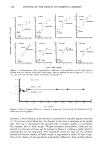
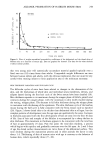
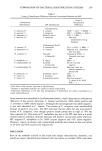
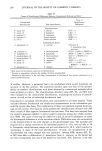
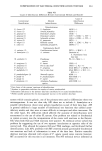
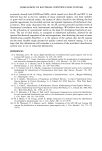
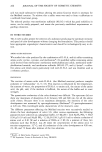
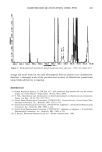
EFFECTS OF ADJUVANTS ON DIHYDROXYACETONE TANNING 271 Improvements in regularity and tone have only been judged by visual evaluation. Substantivity. Color resistance was evaluated after daily washings, once a day for five days. Figure 1 shows that the color developed with the M.S.O. remains longer on the skin than that obtained with only the D.H.A. RESULTS We observed (Figures 1 and 2) that applications of the methionine sulfoxide cream followed by the D.H.A. cream produced a more intense color which appears more quickly than after an application of D.H.A. cream alone. This color is also more resistant to washing. After daily washing during five days, intensity of the color is greater with M.S.O. than without M.S.O. Integrator Units 8O • 6O 10 2 4 6 2 4 6 hours Time after treatment Figure 2. Evaluation of the intensity of the color development obtained with D.H.A. alone (__) and with methionine sulfoxide + D.H.A. (_ _). Number of patients: 10. One application. Bars (I) indicate standard deviations. Photographic evaluation. Reading with a photodensitometer. CONCLUSIONS Methionine sulfoxide can be considered as a fairly good adjuvant for the fast develop- ment of a more intense and longer lasting color, so that use of M.S.O. permits use of lower doses of D.H.A. However, its in vitro reactivity towards D.H.A. does not permit combination of the two products in the same emulsion. Therefore, it is necessary to formulate each substance separately and to maintain them apart in a compartmented dispensing device permitting the release of the two different products from one tube. REFERENCES (1) P. Devillets, La Rgaction de Maillard. Aspect Chimique et Technologique en Sucrerie, Mise au Point de Chimie Analytique, (Masson Ed., 1969), 18brne s•rie, pp 29-47.
Purchased for the exclusive use of nofirst nolast (unknown)
From: SCC Media Library & Resource Center (library.scconline.org)