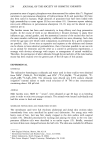
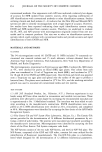
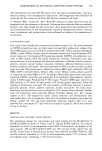
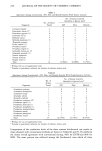
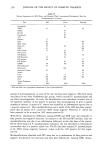
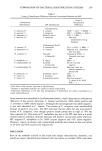
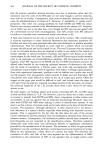
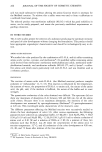
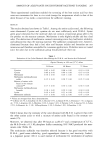
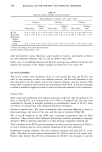
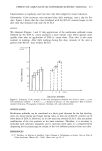
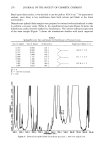
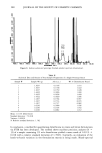
268 JOURNAL OF THE SOCIETY OF COSMETIC CHEMISTS Table II Influence of Ionic Strength on Color Intensity* Optical Density at 420 nm, 32 ø C, pH 7 After 24 Hours 48 Hours 72 Hours Without Without Without With NaC1 NaC1 With NaC1 NaC1 With NaC1 NaCI M.O.S. Methionine Methionine Methyl- sulfonium iodide 0.19 _-_ 0.01 0.17 _-_ 0.01 0.46 ___ 0.01 0.32 --- 0.01 0.51 --- 0.01 0.46 + 0.01 0.18 ___ 0.01 0.10 ___ 0.01 0.28 + 0.01 0.20 + 0.01 0.49 + 0.01 0.35 + 0.01 0.20 +_ 0.01 0.15 +_ 0.01 0.29 +- 0.01 0.28 ñ 0.01 0.45 +_ 0.01 0.35 +- 0.01 * Values are averages from three determinations. Sodium chloride concentration: 10%. milk and synthetic meat. Moreover, some studies of toxicity, particularly an Ame's test and cutaneous tolerance tests (17,18) on rabbits, were done. Lastly, due to its sulfoxide function the M.S.O. develops some affinity for keratin and permits the retention of the colored complex as shown by in vivo trials (19). IN VIVO STUDIES The in vivo studies were extensions of the in vitro studies but only the M.S.O. was used. It was necessary to select two different vehicles, the first well absorbed by the skin and able to fix the amino acid on the stratum corneum, and the second a film former able to regulate and facilitate easy spreading of the D.H.A. It was also necessary to define a method of application and to perfect an objective method of color evaluation. FORMULATION Some trials were performed with aqueous solutions of M.S.O. directly spread on the skin or with M.S.O. at a concentration of 0.1 M in a Carbopol © gel, but they were unsatisfactory because of irregular spreading or unsatisfactory release of M.S.O. from the vehicle. It seemed that only emulsions would be convenient. Selection of emulsion bases. We chose to formulate three emulsions differing in their oil phase percentage, the nature of the oils, and the type of emulsion (Table III). The A and B emulsions of the O/W type containing autoemulsive base are fluid emulsions. They contain either substances permitting cutaneous permeation (isopropyl myristate-PEG-4 isostearyl glyceride) or a film-forming component (mineral oil). The C emulsion of the W/O type was produced in order to test the reactivity of D.H.A. in such a medium and the water resistant properties of the color produced. Incorporation of specific substances. The direct mixture of amino acid with D.H.A. is not stable. Therefore we used separate formulations for D.H.A. and for the amino acid. Former trials showed that the best formulation for M.S.O. was emulsion A and for

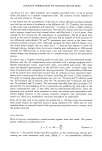
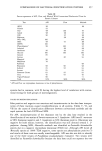
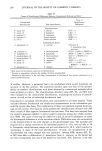
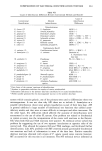
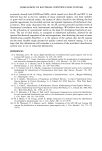
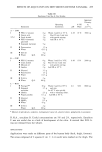
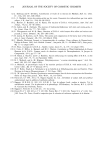
EFFECTS OF ADJUVANTS ON DIHYDROXYACETONE TANNING 269 Table III Emulsions Used for In Vivo Studies Apparent Viscosity Operating % Oil at Emulsions Conditions pH Phase 22.5 ø C A - O/W I ß 70 ø C ß II ß III ß B - O/W I ß II ß III ß C - W/O I ß II ß III ß PEG 12 stearate Stearic acid Cetyl alcohol PEG-4-isostearic glyceride Isopropyl myristate Preservatives Water M.S.O. Water Q.S. 6 g Warm I and II at 70 ø C. 1 g Pour II into I and mix 2 g with gentle stirring. 5 g Add III at 30 ø C. 5g 1.5 65.5 5g 100 g PEG- 12-stearate Cetyl alcohol Mineral oil Lanolin Glycerol 3.2 g Preservatives 1.5 g Water 61.3 g D.H.A. 2 g Water Q.S. 100 g Protegin ©* 30 g Isopropyl 3.5 g myristate Lanolin 2.5 g Propyl paraben 0.1 g Glycerol 5 g MgSO 4 0.5 g Water 45 g D.H.A 2 g Water Q.S. 100 g 8 g Warm I and II at 70øC. 1 g Pour II into I and mix 6 g with gentle stirring. 2 g Add III at 30 ø C. Warm I and II at 85 ø C and mix. At 60 ø C mix quickly with a vibrating mixer. Add III at 30 ø C. 6.49 19 % 3900 cp 6.48 17% 2000 cp 6.6 36% 9800 cp * Mixture of petrolatum, ozokerite, hydrogenated castor oil, glyceryl oleate, polyglyceryl-4-isostearate. D.H.A., emulsion B. Useful concentrations are 5% and 2%, respectively. Emulsion C was not useful due to a lack of development of the color. It seemed that D.H.A. was not released from the vehicle. APPLICATIONS Applications were made on different parts of the human body (back, thigh, forearm). Two areas composed of 3 squares (2 cm x 2 cm each) were marked on the thigh. The
Purchased for the exclusive use of nofirst nolast (unknown)
From: SCC Media Library & Resource Center (library.scconline.org)