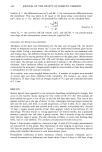
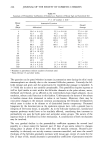
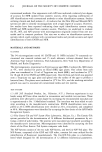
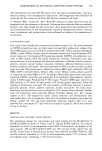
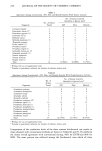
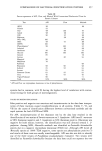
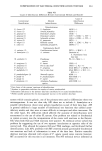
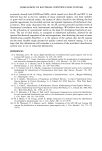
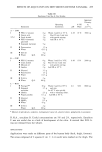
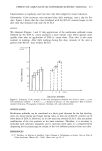
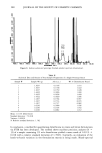
COMPARISON OF BACTERIAL IDENTIFICATION SYSTEMS 261 Table VII Causes of Identification Differences Between Conventional Methods and Minitek a Cause of Conventional Minitek Identification Identification Indentification Differences E nterobacteriaceae E. cloacae (1) b S. liquefaciens ADH ( - ) E. cloacae (1) Serratia plymuthica ADH ( - ) E. gergoviae (1) Enterobacter aerogenes URE ( - ) E. gergoviae (2) Enterobacter vulneris CIT(- ), ODC(- ), VP(- E. gergoviae (1) Salmonella arizonae H2S( + ), ODC( - ), VP( - K. oxytoca (2) K. pneumoniae IND (-) P. rettgeri (1) Klebsiella ozaenae IND( - ), LDC( - ), PA( - S. sonnei (1) Salmonella paratyphi-A ONPG ( - ) Nonfermentative Bacilli A. anitratus (1) Cardiobacterium hominis IND (-), MAC (-)c A. haemolyticus (1) A. anitratus Omission of A. Haemolyticus from data base PA (+), MAC (-) M. urethraIls (1) Pseudomonas species P. aeruginosa (1) P. stutzeri P. aeruginosa (1) Not in data base d P. fluorescens (1) P. aeruginosa P. maltophilia (1) Not in data base P. pseudoalcaligenes (3) Moraxella species P. putida (1) P. pseudoalcaligenes P. putida (1) P. stutzeri P. putrefaciens (1) A lcaligenes-Pseudomonas species URE (+)c URE (+), N2 (+)c ANADEX (+), ONPG(+) ANA DEX ( + ), SUC ( + ), XYL (+) ADH ( - ) AER DEX (-) STAR ( + ) AER DEX (-) First choice of the systems' spectrum of identifications. Number in parenthesis indicates the number of strains misidentified. Information deficiency in the systems' data base contributed to or caused misidentification. Profile number generated by the microorganism was not in the systems' data base. system which contains gelatin, one of the primary tests used to differentiate these two microorganisms. It was not clear why API chose not to include A. haemolyticus as a possible identification choice since gelatin liquefaction is part of their data base. API in general exhibited a large number of biochemical test reactions that yielded unsat- isfactory results and that were at times difficult to interpret and often inaccurate. On the other hand, few difficulties which affected the outcome of identifications were encountered in the use of either FL system. One problem not related to biochemical or system accuracy was the interpretation of the center well reactions in the Enteric- Tek when both H2S and TDA reactions were positive. FL technical service solved this problem by suggesting the use of two separate inoculations at opposite sides of the central well. This allowed for separate H2S and TDA readings, and facilitated further identifications. Like API, problems with MT centered around questionable biochemical test reactions and lack of information in areas of the data base. Positive anaerobic dextrose reactions obtained with strains of P. cepacia caused some concern however, MT accounted for this reaction in all instances. The MT technical service informed us

262 JOURNAL OF THE SOCIETY OF COSMETIC CHEMISTS that the positive anaerobic dextrose reactions were due to oxidation rather than fer- mentation since the wells of the MT plate are not deep enough to prevent oxidation, even with an oil overlay. Consequently, false positive anaerobic dextrose reactions did cause the misidentification of strains of P. fluorescens, P. maltophilia, P. putida, and P. putrefaciens. One other test causing problems for both ENTB and NFB was urease. Positive urea reations resulted in the identification error of two strains of P. aeruginosa, one of which was not in the data base, even though the MT urea reaction agreed with the conventional test for both microorganisms. Like APT, results with MT indicated its ability to correlate with conventional media was inferior to FL. A final area evaluated was the ease of use for each of the systems. This consideration is of prime importance to many industrial laboratories that experience manpower dif- ficulties and must rely upon personnel other than microbiologists to perform microbial identifications. This has developed an acute need for a system which can provide accurate identifications and yet be simple to use. The two FL systems were the simplest to use in our hands because they are supplied as ready-to-use products that require no further assembly or special incubation chambers and require only Kovacs as an addi- tional reagent for the indole test. In contrast, APT and MT both require further assembly prior to use and make use of humidification chambers. API also requires the use of six reagents, while MT requires six for ENTB and five for NFB biochemical reactions. FL offered other benefits by not requiring measured amounts of substrates in the wells, and the mode of inoculation, a Pasteur pipet, was quick and uncomplicated. API inoculations required higher levels of experience with respect to filling cupules properly. Even with experienced personnel, problems with air bubbles and cupules that would not fill properly were encountered, which resulted in delays and user frustration. MT inoculations were made difficult at times by the use of a pipet gun system. Often the trigger on the pipet gun would be difficult to pull, and several times the pipet tip came apart from the pipettor, resulting in spillage and loss of the inoculum. In contrast, the advanced simplicity of the 2 FL systems made them a clear choice for the easiest system to use. To some degree, our findings agreed with studies evaluating APT, FL, and MT using clinical and food isolates (2-4,8-10). However, since our intent was to select a system or systems to identify both ENTB and NFB, direct comparisons to other studies were not possible. It was our opinion that an industrial microbiology laboratory must con- sider both ENTB and NFB when making a choice of identification systems. It was clear to us that a choice of systems could not be made solely on the basis of identification accuracy. The parameter, although informative, is often misused and is not always a true indication of a system's ability, especially when dealing with industrial microor- ganisms. This is supported by the fact that the data bases for each of the systems contain information derived primarily from microorganisms obtained from clinical and reference sources. Consequently, the biochemical profiles derived from industrial iso- lates frequently are not contained in the identification scheme. Therefore, industrial laboratories must build their own information libraries to supplement information provided by the manufacturer of the system. The parameter to which we gave primary significance was the correlation between conventional and system biochemical testing. Based on this information, a final choice of a system was made. The relatively low correlation of APT, and lack of key tests required for the differentiation of NFB, contributed to the elimination of APT. It was apparent that no single system could
Purchased for the exclusive use of nofirst nolast (unknown)
From: SCC Media Library & Resource Center (library.scconline.org)