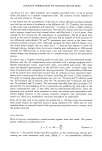
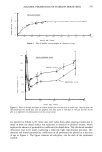
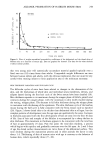
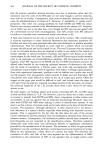
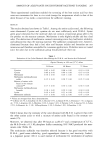
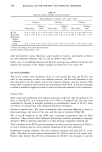
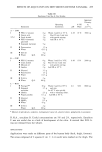
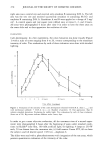
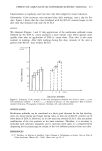
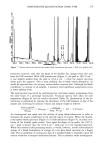
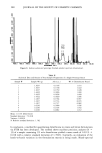
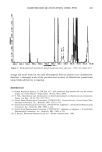
ALKANOL PERMEATION OF HAIRLESS MOUSE SKIN 249 40 BUTAi•0L • 32 v 24 x Q_ •) •.e •& . ABDOMINAL SKIN $ • 8 0 0 40 80 120 •60 200 240 280 320 360 400 ?QUSE ACE (DAYS) Figure 6. Plots of weight-normalized permeability coefficients of the abdominal and the dorsal skins of hairless mice as a function of mouse age. Data are graphed for butanol. The data for the other alcohols evidence similar profiles. that very young mice will systemically accumulate material applied topically over a fixed area ten (10) times faster than adults. Comparable weight differences are seen between human infants and adults, with the obvious implication that one must be very careful when treating infants to limit application area to the minimum necessary. SKIN THICKNESS VARIATION AND THE HAIR CYCLE The follicular cycles of mice have been related to changes in the dimensions of the skin, and the thicknesses of whole skin and individual strata (epidermis, dermis, and adipose layers) during the first hair cycle of the Swiss mouse have been detailed (26). Skin thickness expands to its maximum during the anagen phase of follicle growth and contracts during the catagen phase, with the minimum in skin width reached during the resting, telogen phase. The decrease in full skin thickness during the telogen phase is concurrent with thickening of the epidermis. The skin thickness cycle of the hairless mouse during the half cycle is fully consistent with the Swiss mouse cycle as reported (26). Figure 2 shows dorsal skin to be thicker than abdominal skin at all ages, but the complex patterns of development over the age span are qualitatively the same. Increases in thickness associated with the first development of hair are seen over the first 10 days of life. Loss of hair and atrophy of the follicles is accompanied by a sharp decline in skin thickness. The minimum in thickness appears to be concurrent with the total loss of hair at approximately 25 days. Past this point the total skin thickens, a process which begins with rapidity and gradually continues over the life span. At 2 and 5 days of age the dorsal surface measurements are twice those of the abdominal surface. This ratio declines during the maturation process and in older animals the factor is only about 1.4. Thickening of skin of mature mice with age is contrary to the behavior of human skin, which reportedly thins (27-30).

250 JOURNAL OF THE SOCIETY OF COSMETIC CHEMISTS In the present study the thickness measurements are only for the whole skin individual strata have not been examined. However, the epidermal thickness of the mature hairless mouse is only 40 [xm (31). The wide variations in thickness of the full skin are thus too large to be epidermal in origin and necessarily represent changes in the dermal layer. This conclusion is in accord with previous observations (26). COMPARISON OF THE HAIRLESS MOUSE AND MAN The gross anatomical construction of the hairless mouse skin past the initial hair cycle is similar to the human skin (hairy regions excluded) in aspects which relate to the skin's chemical barrier properties. Of particular importance, each is overlayered by tightly compacted layers of horny cells. The kinetics of turnover of the two epidermises are even similar if viewed in proportion to the masses of the respective tissues. Blem- ishes, wrinkles, and textural changes occur with aging in both skins, though the causes of these defects are likely different. The animal's weight increases to an asymptote of --40 gm at about an age of 140 days, approximately 1/3 tO 1/4 of the mean animal life span. When put in terms of fractional age, even the point of attainment of full adult size is comparable to the human. There appears to be a high similarity in the permeation of the skins of the hairless mouse and man to alkanols. Previous data from these laboratories show the permeability coefficients of the n-alkanols and water to be much the same (15,23) and, based on the data reported here, the permeabilities of water, methanol, and ethanol through mouse skin are virtually identical, further tightening the congruence with human tissue in mass transfer behavior. Literature reports covering a diversity of other compounds also suggest that a high degree of permeability similarity exists for these two tissues (32,33). Whether or not there is parallel in the age dependencies of permeability of hairless mouse skin and human skin is yet to be determined. Outside of increased permeability during the follicular cycle, the mouse skin's barrier properties are relatively independent of age. This seems reasonable as the necessary degree of protection against insensible perspiration, and heat loss which accompanies it remains constant as the animals age. Human skin is probably comparably stable with age, given that the same principle applies. There are certain experimentally important observations here for those who use the hairless mouse in toxicological and drug delivery investigations or for other purposes which involve percutaneous absorption. The skin of the immature hairless mouse un- dergoes a rapid transformation in its permeability properties and, based on the alkanol data, it is not until about 100 days of age that these effects are totally stabilized. Moreover, in early life the dorsal skin appears more permeable than the abdominal skin. To minimize variability, investigators must be careful to fix upon a specific age for the animals used in their studies and to excise skin sections from clearly defined sites. In permeation studies in these laboratories, a general technique where the dorsal surface is subjected to some trauma or treatment and the abdominal surface is used as the control has been developed (34,35). We prefer to wait to an age of--60 days when the permeability coefficients of the two sites converge to make uncomplicated com- parisons between the normal abdominal and the traumatized dorsal surfaces. ACKNOWLEDGEMENT This study was supported by National Institutes of Health Grant No. 5 R01 GM 24611.
Purchased for the exclusive use of nofirst nolast (unknown)
From: SCC Media Library & Resource Center (library.scconline.org)