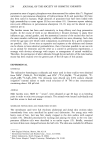
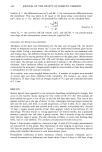
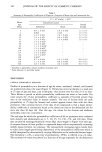
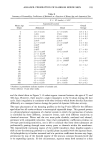
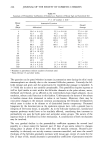
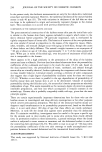
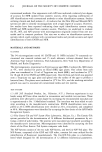
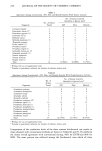
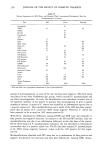
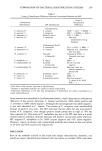
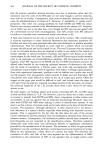
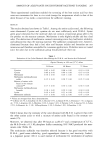
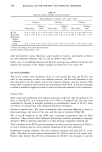
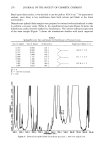
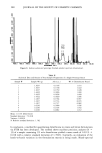
244 JOURNAL OF THE SOCIETY OF COSMETIC CHEMISTS Table III Summary of Permeability Coefficients of Ethanol as a Function of Mouse Age and Anatomical Site P X 103 (cm/hr) + S.D. a Mouse Anatomical Location Age Overall (Days) Abdominal Dorsal Average 4 0.9 m 0.1(3) 2.4 + 0.3(4) 1.6 + 0.1 5 0.9 (2) 2.9 (2) 1.90 + 0.4 20 2.5 + 0.7(4) 4.4 + 0.9(4) 3.3 m 0.3 25 3.5 + 0.6(5) 7.5 + 1.4(5) 5.5 + 0.9 39 2.2 (1) b 2.8 (1) b 2.5 51 2.0 + 0.5(4) b 2.4 + 0.7(4) b 2.2 m 0.6 52 2.4 m 0.4(5) b _ _ 53 2.1 (2) b 2.2 (2) b 2.1 + 0.2 59 2.2 m 0.5(9) b _ _ 68 2.1 -+ 0.3(10) b - -- 77 2.4 (2) b 1.8 (2) b 2.1 + 0.4 85 1.8 + 0.4(10) b - - 102 1.3 -+ 0.3(6) - - 110 1.7 m 0.3(10) b _ _ 114 1.3 -+ 0.4(3) b - - 134 1.1 + 0.2(6) b - - 158 0.8 (2) b -- -- 210 0.9 -+ 0.2(4) 1.4 + 0.4(4) 1.2 + 0.3 270 1.2 + 0.2(5) 1.2 m 0.3(5) 1.2 + 0.2 360 0.9 + 0.1(5) 1.0 -+ 0.2(5) 0.9 -+ 0.2 Numbers in parentheses indicate numbers of animals used. From reference 15 and other works. Table IV Summary of Permeability Coefficients of Butanol as a Function of Mouse Age and Anatomical Site P X 103 (cm/hr) m S.D. • Mouse Anatomical Location Age Overall (Days) Abdominal Dorsal Average 4 3.7 m 0.3(3) 8.7 m 0.7(4) 6.1 + 0.4 5 4.2 (2) 10.6 (2) 7.4 + 0.1 20 8.7 + 2.1(4) 16.7 (2) 12.7 + 2.5 25 12.7 m 1.6(5) 23.7 + 2.5(5) 18.2 m 1.6 41 12.8 (2) b 12.7 (2) • 12.7 + 3.0 46 10.7 (2) b 8.6 (1) b 9.7 53 8.6 (2) b 8.3 (2) • 8.4 m 1.3 59 6.6 + 1.5(5) • - - 140 5.4 (2) b - - 154 5.8 (1) b - - 210 4.1 m 1.2(4) 6.2 + 1.7(4) 5.1 m 1.4 270 6.5 m 1.1(5) 6.5 m 1.7(5) 6.5 + 1.2 360 4.0 m 0.6(5) 5.1 + 1.2(5) 4.5 -+ 0.8 Numbers in parentheses indicate numbers of animals used. From reference 15 and other works.

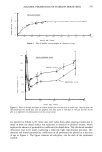
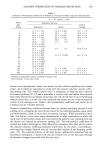
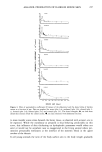
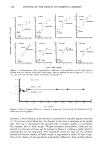
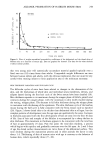
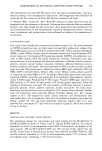
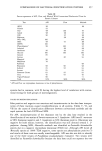
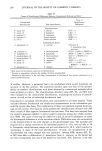
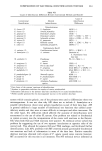
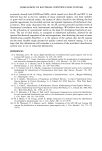
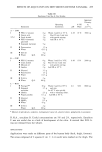
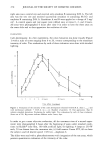
ALKANOL PERMEATION OF HAIRLESS MOUSE SKIN 245 Table V Summary of Permeability Coefficients of Hexanol as a Function of Mouse Age and Anatomical Site P x 10 3 (cm/hr) _+ S.D. a Mouse Anatomical Location Age Overall (Days) Abdominal Dorsal Average 4 5 20 25 39 46 50 51 53 55 56 57 68 71 76 79 88 210 270 360 17.5 -+ 1.7(3) 30.6 -+ 4.9(4) 24.7 _+ 2.6 20.5 (2) 40.3 (2) 30.9 -+ 6.3 38.3 -+ 6.4(4) 58.5 + 6.6(4) 48.5 _+ 4.4 54.1 _+ 7.5(5) 84.5 _+ 9.2(5) 69.3 -+ 5.9 36.9 (1) b 48.4 (1) b 42.6 40.8 (2) b 43.4 (1) • 42. ! 3!.8 -+ 6.6(5) b - - 32.8 -+ 6.4(13) • - - 38.3 (2) • 4!.7 (2) b 40.0 _+ 4.0 3!.6 -+ 3.6(5) • - - 33.8 -+ 6.6(5) • - - 33.3 -+ 3.2(4) b 42.4 _+ 15.8(4) • 38.! -+ 9.8 30.2 -+ 2.6(4) • - - 30.2 _+ 8.4(8) • - - 32.8 -+ 14.0(4) • - - 32.2 + 5.6(4) • - - 24.6 _+ 8.0(5) • - - !7.8 -+ 3.7(4) 23.2 + 4.6(4) 20.5 _+ 4.! 21.2 _+ 7.7(5) 24.2 + !!.2(5) 23.5 -+ 8.7 16.4 _+ 2.5(5) !9.1 + 4.4(5) !7.4 + 3.2 Numbers in parentheses indicate numbers of animals used. From reference 15 and other works. section (true hydrodynamic layers) and within the skin (cellular epidermal and dermal strata), all of which are positioned in series with the stratum corneum, assume a flux- determining role. The overall behavior here is analoguous to what has been reported for human epidermis (21,22) and is somewhat at variance with the earliest data reported from these laboratories on hairless mouse skin (23,24). In the face of an overwhelming amount of new data, it is now clear that methanol and ethanol are not on the exponential section of the homolog curve. Rather, their permeability coefficients and waters lie on a plateau and are virtually identical. Octanol's permeability coefficient deviates from the linearly ascending portion of each semilog curve, presaging the onset of rate control by the identified aqueous tissue strata and hydrodynamic layers in series with the stratum comeurn. While reasonably evident here, this feature is even more amply demonstrated in other experiments in which the horny layer of the hairless mouse skin was removed by adhesive tape stripping (24) and the dermis was isolated by protracted soaking (25). The permeability coefficients of octanol and higher homologs are little affected by treatments like these which remove the stratum comeurn. Differing hydration sensitivities for the short-, intermediate-, and long-chain length alkanols also set the specified regions of the homolog profile apart (15). The essential features of the skin barrier qualitatively described here are maintained throughout a mouse's life and are evident even as the skin goes through the dynamic changes associated with the hair cycle.
Purchased for the exclusive use of nofirst nolast (unknown)
From: SCC Media Library & Resource Center (library.scconline.org)