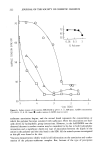
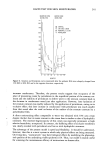
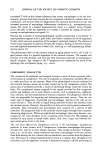
222 JOURNAL OF THE SOCIETY OF COSMETIC CHEMISTS 7O 6O 5O o 62 52 0.01 0,1 1 % Polymer 4O I I I I 30 5 4 3 2 1 -Log [SDS] Figure 6. Surface tension of the systems SDS/AADD at pH 11.5. O, SDS alone. AADD concentration: (,.•, 0.01%. [q, 0.1%. Inset: O, surface tension of AADD alone in water. surfactant association begins, and the second break represents the concentration at which the polymer becomes saturated with surfactant. Here the associations are basi- cally driven by hydrophobic group interactions. However, in the AADD/SDS case the observed decrease in surface tension may be considered to be due to both hydrophobic interaction and a significant dipole-ion type of association between the dipole of the amine in the polymer and the ionic head in the SDS. All the mixed systems investigated at this pH were found to be clear. Viscosity measurements ideally would yield information on the association and confor- mation of the polymer-surfactant complex. But, because of the type of precipitate

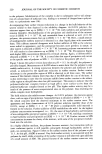
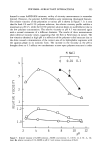
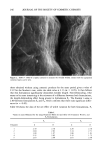
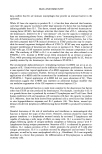
POLYMER- SURFACTANT INTERACTIONS 223 formed in some AADD-SDS mixtures, utility of viscosity measurements is somewhat limited. However, the polymer AADD exhibits some interesting rheological features. The relative viscosity of the polyamine at various pH is shown in Figure 7. It is seen that for both 1% and 0.1% polymer solutions, the relative viscosity profile exhibits a maximum at pH 4.5, while the 0.01% polymer solution shows no such behavior due to the low polymer concentration. The relative viscosity at pH 4.5 was measured again with a second viscometer of a different diameter. The results of these measurements show identical viscosity values, suggesting that the flow is Newtonian in nature. The low viscosity obtained at high pH is a reflection of the polymer-coiled structure due to the drive toward a minimization of the contact area of its hydrophobic segments with the aqueous phase in its nonionic form. The increase in the viscosity as the pH is brought down to 4.5 reflects two mechanisms: a more open polymer structure in order M NaC1 I I I 0 0.01 0,1 4 - 3 • 2 • 1 - •' 1,2- 1,0- 2 4 6 8 10 12 pH Figure 7. Relative viscosity of AADD solutions. AADD concentration: O, 0.01%. [-], 0.1%. A, 1%. Inset: •,, relative viscosity of 1% AADD at pH 4.5 and various concentration of NaCl.
Purchased for the exclusive use of nofirst nolast (unknown)
From: SCC Media Library & Resource Center (library.scconline.org)