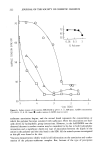
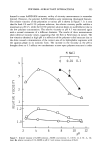
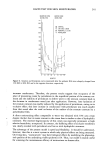
224 JOURNAL OF THE SOCIETY OF COSMETIC CHEMISTS to accommodate increased charge repulsion, resulting from an increase in ionization by adsorption of hydrogen ions on active sites, and the electroviscous effect. The latter is an interpolymer electrostatic repulsion of AADD resulting from its increased degree of protonation and the deformation of the diffuse double layer around the polyelectrolyte under shear (11,21). The observed maximum viscosity at pH 4.5 indicates that an optimal balance between both mechanisms is present here. The electroviscous effect is very sensitive to electrolyte concentration. Such dependency is also shown in Figure 7: addition of NaC1 to solutions of AADD at pH 4.5 causes the viscosity to break down in the presence of salt. The anion serves to screen the positive charges on the polymer, thus reducing the electrostatic repulsion experienced between polymers. Increasing the salt concentration in the system also compresses the diffuse double layer around the polymer. Both of these lead to a decrease in the contribution of the electroviscous effect to the viscosity of the system. From this result, it seems that the electroviscous effect is primarily responsible for the enhanced viscosity at pH 4.5. Further addition of HC1 also leads to a reduction in viscosity. Again, this change in viscosity can be understood in terms of a diminished electroviscous effect. The results in this work demonstrate that although precipitation can occur in solutions containing oppositely charged polymer and surfactant species, formulating these mate- rials into a single-phase, highly stable system is still possible. Mixing ratio and pH of the medium (especially with regard to polymer-possessing ionizable sites, such as AADD) are both important factors that strongly influence overall system stability. To prevent the formation of unwanted solid complex, particularly the gummy-rubbery type that would lead to manufacturing difficulties, the use of low-charge-density polymer seems to be more desirable, since the use of polymers of this type allows the formulator to operate in the resolubilization zone of the mixed system. REFERENCES (1) N. Takisawa, P. Brown, D. Bloor, D. G. Hall, and E. Wyn-Jones, Chemical relaxation and equilib- rium studies associated with the binding of anionic surfactants to neutral polymers, J. Chem. Soc. Faraday Trans., 85, 2099-2112 (1989). (2) J. Skerjanc and K. Kogej, Thermodynamic and transport properties of polyelectrolyte-surfactant complex solutions at various degrees of complexation, J. Phys. Chem., 93, 7913-7915 (1989). (3) A. Carlsson, B. Lindman, T. Watanabe, and K. Shirahama, Polymer-surfactant interactions. Binding of N-tetradecylpyridinium bromide to ethyl (hydroxyethyl) cellullose, Langmuir, 5, 1250-1252 (1989). (4) P. L. Dubin, C. H. Chew, and L. M. Gan, Complex formation between anionic polyelectrolytes and cationic/nonionic mixed micelles, J. Colloid Interface Sci. 128, 566-576 (1989). (5) E. D. Goddard, Polymer-surfactant interactions, Part I. Uncharged water-soluble polymers and charged surfactants, Colloids and Surfaces, 19, 255-300 (1986). (6) E. D. Goddard, Polymer-surfactant interactions, Part II. Polymer and surfactant of opposite charge, Colloids and Surfaces, 19, 301-329 (1986). (7) E. Ruckenstein, G. Huber, and H. Hoffmann, Surfactant aggregation in the presence of polymers, Langmuir 3, 382- 387 (1987). (8) E. D. Goddard and R. B. Hannan, Polymer/surfactant interactions, JAOCS 54, 561-566 (1977). (9) S. Y. Y. Chan, Adsorption of Surfactant at Solid/Liquid and Liquid/Liquid Interfaces for Dewetting Process, Thesis, City University of New York (1988). (10) K. E. Lewis and C. P. Robinson, The interaction of sodium dodecyl sulfate with methyl cellulose and polyvinyl alcohol, J. Colloid Interface Sci., 32, 539-546 (1970). (11) Th. F. Tadros, The interaction of cetyltrimethylammonium bromide and sodium dodecylbenzene

POLYMER- SURFACTANT INTERACTIONS 225 sulfate with polyvinyl alcohol. Adsorption of the polymer-surfactant complex on silica, J. Colloid Interface $ci., 46, 528-540 (1974). (12) E. D. Goddard and R. B. Hannan, "Anionic Surfactant Complexes With Charged and Uncharged Cellulose Ethers," in Micellization, Solubilization and Microemulsion, Vol. 2, K. L. Mittal Ed. (Plenum, New York, 1977), pp. 835-845. (13) B. Cabane, Structure of some polymer-detergent aggregates in water, J. Phys. Chem., 81, 1639-1645 (1977). (14) J. W. Park, J. G. Lee, and H. Lee, Surface tentiometric studies on the interaction of anionic poly- electrolytes with cationic surfactants, Bull. Korean Chem. Soc., 10, 339-343 (1989). (15) M. J. Schwuger, Mechanism of interaction between ionic surfactants and polyglycol ethers in water, J. Colloid Interface Sci., 43, 491-498 (1973). (16) E. D. Goddard and R. B. Hannan, Cationic polymer/anionic surfactant interactions, J. Colloid Inter- face Sci., 55, 73-79 (1976). (17) D. L. Chang, and H. L. Rosano, "Interaction of Long Chain Dimethylamine Oxide With Sodium Dodecylsulfate in Water," in Structure/Performance Relationships in $urfactants, M. J. Rosen Ed. (ACS Symposium Series, No. 253, 1984). (18) J. W. A. van den Berg and A. J. Staverman, The interaction between polyethyleneimine and sodium dodecyl sulfate in water, Rec. Trav, Chim. Pays-bas, 16, 1151-1162 (1979). (19) P.S. Leung, E. D. Goddard, C. Hah, and C. J. Glinka, A study of polycation-anionic surfactant systems, Colloids and Surfaces 13, 47-62 (1985). (20) K. P. Ananthapadmanabhan, P.S. Leung, and E. D. Goddard, Fluorescence and solubilization studies of polymer-surfactant systems, Colloids and Surfaces, 13, 63 -72 (1985). (21) S. Horin and H. Arai, The effect of added salt in the interaction between polymer and detergent in aqueous solution,J. Colloid Interface Sci., 32, 547-550 (1970).
Purchased for the exclusive use of nofirst nolast (unknown)
From: SCC Media Library & Resource Center (library.scconline.org)