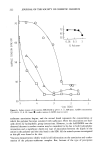
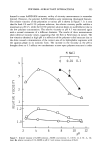
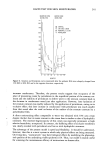
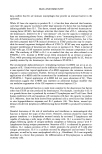
220 JOURNAL OF THE SOCIETY OF COSMETIC CHEMISTS in the polymer. Solubilization of the complex is due to subsequent tail-to-tail adsorp- tion of a second layer of surfactant ions, leading to a reversal of charges from a polycat- ionic to a polyanionic state (16). Accompanying these surface tension reductions is a change in the bulk behavior of the system similar to that depicted in the solubility diagram. At 0.01% polymer, the mixtures appear clear up to [SDS] = 5 x 10 -4 M, with turbidity and precipitation ensuing thereafter. Resolubilization of the precipitate and clarification of the mixture occur at [SDS] • 5 x 10 -3 M, and sustainable foam is achieved as well. At 0.1% polymer, the systems remain clear up to [SDS] = 5 x 10⁻³ M. Here, a small amount of nondispersible rubbery material is obtained in a clear liquid phase with sustainable foam. This rubbery material disappears with further addition of SDS as the solution turns turbid in appearance, and the precipitate becomes more powdery in nature. A clear system is obtained at [SDS] = 5 X 10⁻² M. Increasing polymer concentration to 1% still results in clear mixtures up to [SDS] = 5 x 10 -4 M. Precipitation begins with higher SDS concentration followed by eventual clearing. Again, a rubbery solid is obtained at [SDS] = 5 x 10 -2 M. It is noted that this type of precipitate only occurs at the specific ratio of polymer to SDS = 1:1.4 (w/w) at the present pH of 2.5. Figure 5 shows the surface tension data taken at pH = 9.5. At this pH, the polymer is partially charged. Measurements of AADD alone in water show that the polymer is only weakly surface-active. A strong interaction between the polymer and surfactant is ob- served, as indicated by the significant reduction in surface tension. Surface tension minimum in the premicellar region of SDS is observed in all three cases. The surface tension of the mixtures remains lower than that of the SDS above the cmc of the latter. It is also interesting to note that the mixtures exhibit lower surface tension in the submi- cellar region at this pH than their low pH counterpart. This seems to indicate that the polymer/surfactant complex formed at high pH is more surface-active than the polymer/surfactant complex formed at low pH. This higher surface activity may be a result of the presence of more nonprotonated sites on the polymer, thus rendering the whole complex more hydrophobic. The bulk solution also exhibits some changes. At 0.01% polymer, the mixtures appear clear, with no sign of precipitation. Sustainable foam is obtained at [SDS] = 1 X 10⁻³ M, which coincides with the observed minimum in the surface tension curve. The appearance and foam characteristics of 0.1% polymer solutions resemble those of the 0.01%, except at [SDS] = 1 x 10 -3 M where a nondispersible solid material is formed in the solution. Further addition of SDS resolubilizes the solid. At the highest polymer concentration investigated, i.e., 1%, the onset of haze/turbidity and formation of non-redispersible precipitate appears at [SDS] = 5 x 10 -4 M, reaching a maximum in haze/turbidity and precipitation at [SDS] = 5 X 10 -3 M. Further increase in SDS concentration increases the clarity of the mixture, with some of the precipitate resolubi- lized into the solution. In a highly alkaline medium, the polymer becomes nonionic, but interaction with an ionic surfactant species is still possible, principally through hydrophobic and/or di- pole-ion interactions. Figure 6 refers to the surface tension data of the polymer at pH 11.5. At this pH, AADD is neutral. Very little surface activity is encountered with the polymer by itself, while a lowering of the surface tension is still observed upon addition of a small amount of SDS. The general features of the surface tension curves are very

POLYMER- SURFACTANT INTERACTIONS 221 7O 6O 5O 72 62 52 i i I 0.01 0.1 I % Polymer 4O 3O 5 4 3 2 1 -Log [SDS] Figure 5. Surface tension of the systems SDS/AADD at pH 9.5. O, SDS alone. AADD concentration: O, 0.01%. U1, 0.1%. A, 1%. Inset: O, surface tension of AADD alone in water. different from those obtained with other nonionic polymers such as polyethelene oxides (13,15) and polyvinyl alcohol (11). In these cases, at a fixed polymer concentration and with an increasing amount of SDS, two breaks in the surface tension curve are observed. The first break occurs at a concentration of SDS that is below its cmc, while the second break occurs at the surfactant concentration that is above the cmc. The surface tension of the second break is lower than that of the first one, with a value equal to that at the cmc of SDS. The first break represents the concentration of SDS at which the polymer/
Purchased for the exclusive use of nofirst nolast (unknown)
From: SCC Media Library & Resource Center (library.scconline.org)