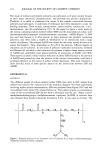
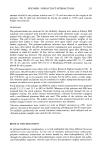
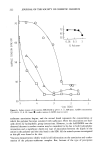
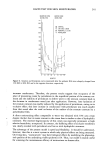
PENETRATION OF WATER AND SLS 229 ml/hr •) of fresh receptor medium assured sink condition throughout the diffusion experiment. The vials were mounted in a fraction collector that changed the position of the vials every 90 minutes. After 49.5 hours the experiments were terminated. CALCULATIONS OF THE RESULTS For each diffusion cell, the cumulative amount of compound penetrating per unit time was plotted against time. Permeability coefficients (Kp, •cm/min l) were determined by dividing the slope of the graph by the concentration of compound applied: J/C = Km D/h = Kp where J is the penetration rate of compound (g/cm2/minl), C is its concentration in the vehicle (g/cm3), Km is the stratum comeurn/vehicle partition coefficient for the drug (without unit), D is its diffusion coefficient in the stratum comeurn (cm2/minl), and h is the thickness of the stratum corneum (cm). RESULTS The time course of the penetration of three concentrations of SLS is shown in Figure 1. 5 • I o E x2 __o 1 E 6 12 18 24. 30 36 42 4.8 TIME (hours) Figure 1. Time course of penetration of 0.1% (A, n = 0) 1.0% ([•, n = 1) and 10.0% (Q, n = 2) SLS. Note the difference in magnification (I0 n) between the curves. Each point represents a mean value + SEM of five determinations (three donors).

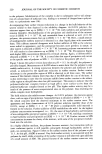
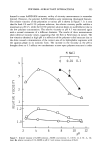
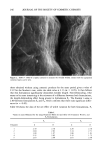
230 JOURNAL OF THE SOCIETY OF COSMETIC CHEMISTS Note the difference in magnification between the curves, which relates to the applied concentration. The amount of SLS penetrating the skin was dependent on the concen- tration, although not linearily. For 10% the amount penetrating was about ten times higher than for 1.0%, whereas for 0.1% the amount penetrating was 50-100 times lower than the amount penetrating from 1.0%. During the entire exposure, less than 3% of the applied amount of SLS penetrated the skin. The rate of penetration increased during the exposure, as reflected by the steepening slopes of the curves. This is more clearly shown in Table I, where the rate of penetration at different times is given. Since no true steady state was obtained, only pseudopermeability constants, p-Kp, at arbitrary times could be calculated. The p-Kp of SLS at 21-24 hr was 1.3, 1.0, and 0.! Ixcm/min • for 10, 1.0, and 0.1%, respectively. The penetration rate of water at 21-24 hr was almost the same when 10 and 1.0% SLS were present (p-Kp = 120 Ixcm/min•), but only half as much when 0.1% SLS was present (p-Kp = 55 Ixcm/min•). The time course of the penetration is shown in Figure 2, and the value at two times is given in Table II. The penetration rate seemed to decrease after a rather short time of exposure and to cease when approximately 250 mg/cm 2 had penetrated. This was not due to a real decrease in the penetration of water, but to a dilution of the radiolabeled water molecules in the donor solution by unlabeled water molecules. These unlabeled water molecules diffused from the receptor solution beneath the skin. The decrease was verified by measuring the radiochemical concentration in the donor solution after the exposure time, 49.5 hr. The radiochemical concentration of water was about 25 percent of that applied, whereas the radiochemical concentration of SLS was only a few percent lower than that applied. DISCUSSION The simultaneous penetration of SLS and water through human skin was studied. The experiments were performed under infinite conditions i.e., the amount of SLS that penetrated the skin was far below the amount applied. Hence the composition in the donor solution can be considered as constant during the exposure. According to Fick's law of diffusion, the steady-state penetration rate should increase linearily with donor phase concentration. By varying the concentration and observing the consistency of Kp, one can determine the extent to which Fick's law is applicable under the experimental conditions. The p-Kp of SLS was equal for 10 and 1.0%, whereas for 0.1% the p-Kp was much lower than for the other two concentrations. This indicates that SLS reacts with the Table I The Penetration Rate (Ixg/cm-2/hr - •) of SLS at Different Times After Application of 0.1, 1.0, and 10% (w/w) in Water Conc. 9-12 2 !-24 33-36 45 -48 (%) (hr) (hr) (hr) (hr) 0.1 0.8 ñ 0.7 6 ñ 8 27 ñ 40 87 ñ 120 1.0 52 ñ 64 612 ñ 787 1579 ñ 1701 2509 -+ 2134 10.0 886 -+ 1019 8465 ñ 11335 15361 -+ 14807 16671 ñ 11469 Results are mean ñ SEM (n = 5).
Purchased for the exclusive use of nofirst nolast (unknown)
From: SCC Media Library & Resource Center (library.scconline.org)