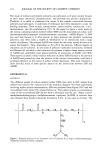
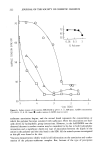
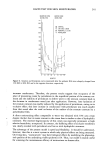
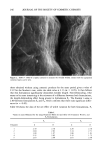
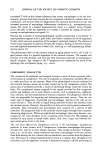
238 JOURNAL OF THE SOCIETY OF COSMETIC CHEMISTS GX I I I I 1 0 e 20 ao MINUTES OF OCCLUSION Figure 2. A totally occlusive effect of a polyethylene film placed on a sheet of stratum corneum. Measured at 2 IøC and 27% RH. WATER SORPTION AND DESORPTION TEST The curves before and 60 minutes after application were entirely comparable to those previously obtained on forearm skin in vivo (16). Figure 5 shows that 10% urea cream was the most effective for increasing both the hygroscopicity and the water-holding capacity of the stratum corneum. With petrolatum, the hygroscopicity decreased with a reciprocal increase of the water-holding capacity. BUFFER ACTION OF TEST AGENTS Figure 6 shows the hydration changes when the RH was suddenly changed. "Desorp- tion curves" represent the changes that took place when the models that had been already equilibrated with 90% RH for more than three hours were transferred to a 33% RH environment. "Sorption curves" show the changes when the model was moved in the opposite direction. The changes obtained in both directions corresponded well, and a buffering effect was demonstrated most prominently with petrolatum, then with hy- drophilic ointment. DISCUSSION The design of modern moisturizers has depended on selecting various hygroscopic com- ponents that have effects similar to natural moisturizing factors (NMFs) and effective

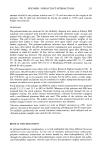
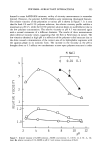
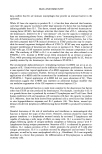
RAPID TEST FOR SKIN MOISTURIZERS 239 1000. 9OO 800 700 600 500 400 300 200 lOO RH 27 % 18 øC e: CONTROL O: 10% UREA CREAM •: HYDROPHILIC OINT pre 0 BO 60 l•O MINUTES Figure 3. In vivo hydration changes after application of topical agents on the flexor surface of the forearm. Ten volunteers were enrolled in this measurement. vehicles. Increased conductance values for 3.5-MHz high-frequency current can also be obtained in clinical tests after applications of test moisturizers (3, 11). However, in vivo measurements of the hydration level are greatly influenced by ambient conditions a change in weather rapidly alters conductance. Controlling the ambient conditions is difficult unless measurements are made in environmental chambers. We believe our model to be an equivalent for stratum corneum in vivo with regard to both hydration and electric properties (17). Thus, many of the variables that perturb clinical tests are eliminated. Measurements are feasible even under extreme conditions of low or high RH by simply placing the models in artificial environments. Immediately after application of petrolatum there occurred a decrease in conductance, particularly when the surface of the stratum corneum was well hydrated under condi- tions with a high ambient relative humidity. Because of its poor conductivity, petro- latum can strongly interfere with the probe's circuit if there is a thick layer between the probe and the surface of the stratum corneum. However, such a possibility is unlikely under our experimental conditions because the amount of all the emollients applied was adjusted to thinly cover the whole applied area. In addition, the probe was also pressed firmly to the surface of the stratum corneum to make close contact. In fact, in the present study, hydrophilic ointment, which, like petrolatum, is also poorly electrocon- ductive to the high-frequency current by itself, always induced an immediate increase in conductance when it was applied in the same way to the surface of the stratum corneum. We suggest this is because it delivers water to the stratum corneum, which
Purchased for the exclusive use of nofirst nolast (unknown)
From: SCC Media Library & Resource Center (library.scconline.org)