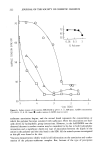
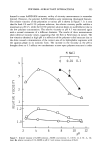
218 JOURNAL OF THE SOCIETY OF COSMETIC CHEMISTS This region of constant bulk pH activity widens with increasing amounts of the polymer. The rise in pH becomes apparent when the amount of SDS required to exhaust these sites has been exceeded, thereby promoting further protonation of other ionizable sites in the polymer. Since the degree of the cationic functionality of the polyamine varies with pH, as indi- cated by its acid-base titration results, different complexation behavior with SDS due to different degree of protonation is expected to result with increasing pH: the charge- charge interaction decreases in its contribution, while the hydrophobic and dipole-ion interactions increase. In this experiment, the various polymer/SDS mixtures were pre- pared without any adjustment in the pH. In these mixtures, turbidity and eventual precipitation are expected to occur when enough anionic surfactant adsorbs onto the positively charged polymer in a head-to-head configuration. The polymer charge is eventually neutralized, with a concomitant increase in its hydrophobicity. Maximum precipitation occurs at or near the stoichiometric ratio where the particles in suspension have zero or little charge (16,19). We observed in the solubility studies that maximum precipitation appears when the ratio of the polymer to SDS is in the neighborhood of 2:1 (w/w). (We note, however, that the manufacturer is uncertain about the exact copolymer ratio in this product. Moreover, we have not yet established a precise relationship between pH and the degree of ionization. Thus, the exact stoichiometric ratio could not be ascertained.) The re- sulting insoluble nondispersible gum precipitate is indicative of an effective neutraliza- tion of positive charges in the polymer by SDS. It is expected that particles above this ratio will have a positively charged surface because of incomplete charge neutralization. As the concentration of surfactants is increased beyond that required for maximum precipitation, resolubilization of the precipitate occurs due to the adsorption of a second layer of surfactant onto the neutralized polymer (8,20), forming a polyanion, with the solution eventually becoming clear. Dubin et al. (4), in their study of the complex formation between anionic polymer and cationic/nonionic surfactant systems, pointed out that there are three forms of associations that may be encountered: soluble aggre- gates, coacervate, or solid precipitate. And these phase boundaries are dependent on the mole fraction of the ionic surfactant. From Figure 2, it is clear that the same type of dependency also applies to polycation/anionic surfactant systems. A somewhat different solubilization behavior is reported for Cartaretin F-4, the higher charge density version of AADD (6). Here, the addition of excess surfactant did not resolubilize the precipitate aggregates. Many factors affecting the redissolution of pre- cipitated polyelectrolyte complexes have been studied by Goddard (8). Surfactant struc- ture, such as chain branching or introduction of polyethoxy chains, may render the dissolution incomplete. Most important is the charge density along the backbone of the polymer. If this happens to be very high, the redissolution of the precipitated complex is not going to occur. The difference in the resolubilization behavior of both Cartaretin polymers is an excellent example of this effect. The surface tension data at pH 2.5 are presented in Figure 4. The polymer, fully cationic at this pH, shows little surface activity, except at 1%, where the surface ten- sion drop becomes more pronounced. This observed sharp reduction is most likely due to surface film formation. SDS shows its usual behavior with a cmc at 6 x 10 -3 M. With the addition of a small amount of SDS, a strong interaction occurs that reduces

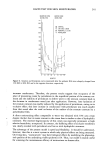
POLYMER- SURFACTANT INTERACTIONS 219 7O L• 68 64 0,01 0,1 1 % Polymer 4O 5 4 3 2 1 -Log [SDS] Figure 4. Surface tension of the systems SDS/AADD at pH 2.5, O, SDS alone. AADD concentration: O, 0.01%. •l, 0.1%. A, 1%. Inset: O, surface tension of AADD alone in water. the surface tension drastically. The greatest reduction occurs below the cmc of the surfactant. At 1% polymer, a constant surface tension is observed throughout the SDS concentration region, which indicates surface saturation. At 0.01 and 0.1% polymer, a minimum in surface tension is obtained in the zone of high precipitation. Further addition of SDS causes the surface tension to increase slightly, with concomitant clearing of the mixture. The low surface tension obtained demonstrates the formation of a highly surface-active complex. Surface-active complex and precipitated material result from the head-to-head interaction between the surfactant anion and the quaternium ion
Purchased for the exclusive use of nofirst nolast (unknown)
From: SCC Media Library & Resource Center (library.scconline.org)