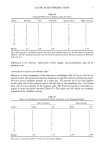
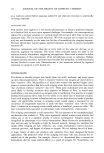
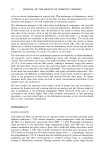
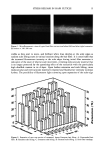
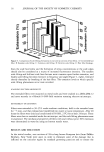
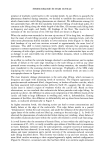
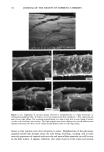
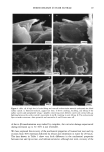
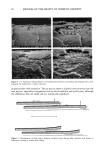
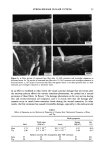
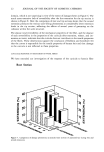
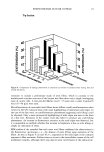
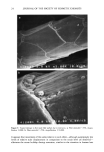
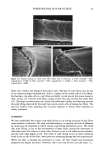
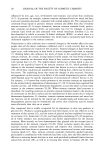
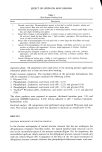
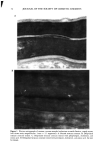
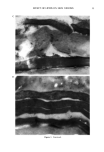
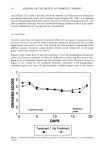
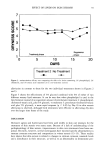
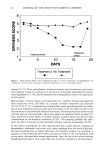
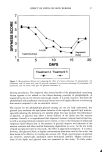
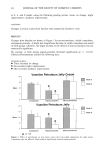
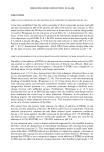
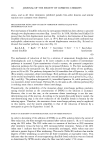
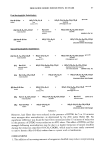
STRESS RELEASE IN HAIR CUTICLE 17 presence of multiple cuticle layers in the cuticular sheath. In our efforts to quantify the phenomena observed during extension, we decided to establish the extension level at which characteristic scale lifting phenomena are observed. We differentiate among (A) the unextended hair, (B) the first randomly distributed lifting of individual scales, (C) common scale lifting along the whole length of the fiber, (D) extreme scale lifting both in frequency and angle, and finally, (E) breakage of the fiber. The results for the extension of the root section of ten (10) hair fibers are shown in Figure 2. When the studies were extended to the near tip section of 18-in-long hair, we observed that the onset of scale lifting occurred at significantly lower extension levels, with the other stress phenomena shifted similarly to lower extension levels (Figure 3). Only the final breakage of tip and root sections occurred at approximately the same level of extension. This shift to lower extension levels clearly indicates that grooming and exposure to stresses experienced during the longer lifetime of the tip section have caused a loosening of scale edges, possibly involving damage to the endocuticular layer as well as damage to and conceivably loss of the intercellular domains, which is definitively irreversible in nature. In an effort to confirm the cuticular damage observed in auto fluorescence and to explore details of failure at the scale edge resulting in the scale lifting as well as any other potential events occurring on the surface cuticle during extension, the extended fibers were transferred to the scanning electron microscope. Highlights of the SEM study displaying the various damage phenomena at specific extension levels are seen in the micrographs shown in Figures 4a-1. The most dramatic damage phenomenon is the scale edge lifting, which increases in frequency and angle with increasing levels of extension. The frequent appearance of granular material underneath lifted, chipped away, or broken-off surface cuticles, which has been associated with endocuticular debris by Swift (9), suggests that the endocu- ticular layer is indeed a region of weakness within the cuticle cell. Based on these observations, we can conclude that endocuticular failure precedes scale edge lifting. As pointed out above, the difference in amino acid composition of the different layers of the cuticle cell leads to large differences in swelling and, with it, deformability. During extension of the fiber, this difference in deformability sets up shear forces between these layers, as indicated schematically in Figure 5. At higher extension levels, this shearing action can lead to stress concentrations and finally failure at the edge of the endocuticle. This edge failure results in a partial "delamination" within the scale structure, and under the influence of the shear forces the upper layers of the surface scale are lifted up, starting at the scale edge. J. A. Swift (9) observed the phenomenon of endocuticular failure during wet combing, where failure of the swollen endocuticular layer within the cuticle cell resulted in severe scale fracturing. It is well known that the extension of keratin fibers, at least within the yield region up to extensions of 25-30%, is totally reversible upon release of the fiber and its immersion in water. Similarly, extensive and, for some properties, complete recovery of mechanical properties has been observed. In our study, we have observed a total length recovery after release and water immersion and a partial recovery of the extension-induced cuticular scale lifting described above. This recovery was similar in tip and root sections, with most lifted cuticles returning to their original apparently tightly stacked configuration (Figure 6). However, occasional scales that had been lifted to an extreme angle remained

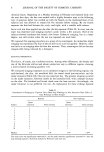
18 JOURNAL OF THE SOCIETY OF COSMETIC CHEMISTS 30•018 b 3000X c lOOOX . . 2000X 3500X Figure 4. a--c. Highlights of cuticular damage observed in autofluorescence in a light microscope. a: Untreated extended hair fiber. b: Typical view of an untreated hair fiber extended to --20%, displaying the start of scale edge lifting. The increasing magnifications of c show a high level of scale lifting of surface cuticles, scale buckling, and cracking. The high magnification clearly displays the torn-off endocuticular material underneath the lifted cuticle. Endocuticular failure results in scale edge lifting. frozen in that position even after relaxation in water. Manifestations of the previously imposed stresses that brought about the scale lifting, buckling, cracking, and in some cases the appearance of exposed endocuticular and intercellular materials can still be seen on the fiber surface. It appears, therefore, that while recovery of the cortex and reversal
Purchased for the exclusive use of nofirst nolast (unknown)
From: SCC Media Library & Resource Center (library.scconline.org)