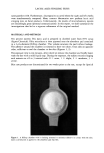
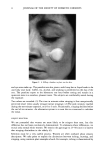
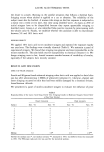
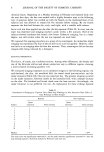
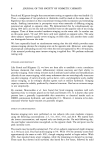
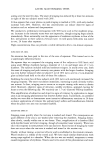
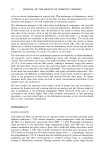
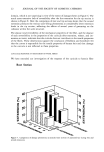
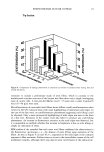
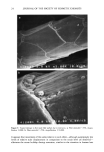
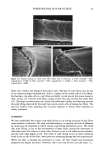
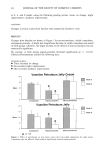
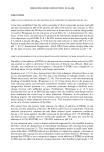
4 JOURNAL OF THE SOCIETY OF COSMETIC CHEMISTS Figure 2. A Hilltop chamber in place on the skin. and eye-area make-up. The panelists are also given a mild soap bar or liquid wash to be used only once daily. Coffee, tea, alcohol, and smoking is prohibited on the day of the test. The panelists report to the laboratory one hour before testing and remain in a quiescent state in a noiseless, pleasant room. The subjects are comfortably seated during the exposure. Two values are recorded: (1) The time in minutes when stinging is first unequivocally perceived (short times usually presage intense stinging). (2) The peak intensity reached during the ten-minute exposure, on a 0 to 3 scale. Occasionally, stinging declines before the end of ten minutes. An alternative system is to sum the ten scores and to calculate the mean. SUBJECT SELECTION We are persuaded that women are more likely to be stingers than men, but this difference has not been conclusively demonstrated. To eliminate ethnic differences, we recruit only normal white women. We restrict the age range to 25-50 since it is known that stinging diminishes in the elderly (6). Selection must be a very careful process. Women are often confused about sensory descriptors. We take pains to explain the distinction between itching, burning, and stinging, using common-place examples of each. For example, itching is characterized by

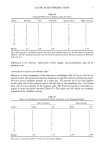
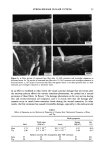
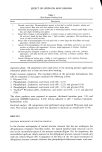
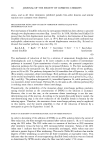
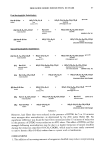
LACTIC ACID STINGING TESTS 5 the desire to scratch. Burning in the painful sensation that follows a thermal burn. Stinging occurs when alcohol is applied to a cut or abrasion. The reliability of the subject must also be checked. A woman who stings on the first exposure is subjected to a repeat test a week or two later, this time using distilled water. As many as 20% of initial stingers have to be disqualified because they report appreciable stinging to distilled water. Green et al. also identified false-positive reactors by prescreening with the vehicle only (4). Finally, we establish whether the candidate is able to discriminate between 5% and 10% lactic acid. REPRODUCIBILITY We applied 10% lactic acid to ten moderate stingers and repeated the exposure exactly one year later. The findings were virtually identical (Table I). We maintain a panel of experienced stingers. We found that stinging was greatest and most reproducible in the winter months (6). This also holds true for susceptibility to chemical irritants (11). We forego stinging tests in hot, humid summer months because of variability of results, especially if the subjects have recently sweated. RESULTS AND DISCUSSION EFFECT OF PRIOR DAMAGE Frosch and Kligman found enhanced stinging when lactic acid was applied to facial skin one day after administering 2 MEDs of ultraviolet radiation (1). Likewise, sharper and faster stinging occurred on skin that had been mildly damaged by a chemical irritant, benzalkonium chloride. We preselected a panel of mild-to-moderate stingers to evaluate the influence of prior Table I Reproducibility of the Lactic Acid Sting Cheek Test: Stinging Grades in Moderate Stingers Tested After a One-Year Interval Onset (minutes) Peak intensity Subject Nov. '92 Nov. '93 Nov. '92 Nov. '93 1 2 4 2 2 2 3 3 1 2 3 4 2 2 3 4 5 3 1 2 5 3 4 1 1 6 2 3 3 2 7 4 3 2 1 8 4 4 2 2 9 2 2 3 2 10 1 2 3 3 Median 3.0 3.0* 2.0 2.0'* Neither the median onset *, nor median intensity **, measured in 1993, was different from that measured in 1992. The Wilcoxon rank sum test was used for the statistical analysis.
Purchased for the exclusive use of nofirst nolast (unknown)
From: SCC Media Library & Resource Center (library.scconline.org)