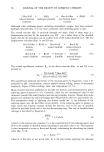
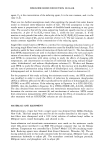
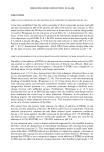
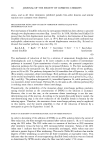
50 JOURNAL OF THE SOCIETY OF COSMETIC CHEMISTS 2 Ker-S-H q- H202 --• Ker-S-S-Ker q- 2820 (2) reduced keratin hydrogen peroxide new keratin bond (cysteine) (cystine) Although other oxidizing agents, including atmospheric oxygen, have been utilized, hydrogen peroxide (Eq. 2) is the most commonly used oxidizing agent to date. The overall reaction (Eq. 1) proceeds through two steps. Each of these steps is a displacement reaction by the mercaptan ion, RS-, on a sulfur atom of the disulfide bond, then by the mercaptan ion on a sulfur atom of the mixed disulfide (12). The two displacement reactions (Eqs. la and lb) are: Ker-S-S-Ker q- RS-H •-• Ker-S-S-R q- keratin mixed disulfide (cystine) Ker-S-S-R + RS-H •-• R-S-S-R + mixed disulfide mercaptan disulfide Ker-S-H (la) reduced keratin (cysteine) Ker-S-H ( 1 b) reduced keratin (cysteine) The overall equilibrium constant, Ka, of the above reactions (Eqs. la and lb) is ex- pressed as: [R-S-S-R] * [Ker-SH] 2 Kam [Ker-S-S-Ker] * [R-SH] 2 (3) The equilibrium positions and extent of the reactions given by Equations 1 and 2 are governed by pH, concentration, tension applied during rolling, nature of mercaptan employed, degree of fiber swelling, time, and temperature (12, 13). Much research has been performed to describe the kinetics and mechanisms by which reducing agents function (1-11). Currently, there are two mechanisms cited in the literature: pseudo first-order kinetics and moving boundary kinetics. Pseudo first-order kinetics are exhibited by sodium thioglycolate (TGA) below pH 9 (1) and bisulfite (4). The assumptions made in applying this kinetic model are: 1) the diffusion of the reducing agent into the hair fiber occurs rapidly, 2) the reducing agent is present in large excess and remains constant during the reaction, and 3) the rate of disulfide reduction proceeds slowly and is the rate-determining step. The rate of disulfide bond cleavage is described by Equation 4: d(S-S) - - k Co(S-S) (4) dt where k is the reaction rate constant, C O is the concentration of the reducing agent, and (S-S) is the number of disulfide bonds remaining at any given time (1,4). This equation is then integrated to arrive at Reese and Eyring's relationship for describing the tensile stress (Eq. 5) (4): F• = Foex p- kCo• (5) where F• is the force at any given time, F o is the force before applying the reducing

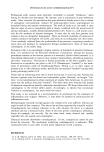
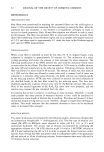
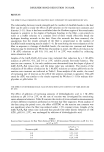
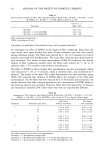
DISULFIDE BOND REDUCTION IN HAIR 51 agent, C O is the concentration of the reducing agent, k is the rate constant, and t is the time (1,4). There are two further assumptions made when applying the pseudo first-order kinetic model to chemical stress-relaxation studies of hair. The first assumption is that the tensile stress is proportional to the number of disulfide bonds remaining at any given time. The second is that all the stress-supporting bonds are equally reactive or totally nonreactive. A plot of-ln (Ft/Fo) versus time, t, yields the rate constant, k. If the reaction is truly pseudo first-order, then a plot of the In [(Ft-Ff)/(Fo-Ff)] versus time will be linear with a slope of kCo and an intercept of zero (1,2). The rate constant, k, should remain constant regardless of the concentration of the reducing agent. Single fiber tensile kinetics (SFTK) is a method for investigating reduction kinetics of hair using single fibers based on stress relaxation caused by disulfide bond cleavage. This method is useful for basic studies of interaction of thioIs with hair (1). The data obtained from SFTK measurements are used to elucidate information about the rates and mech- anisms of reactions of reducing agents and to derive mathematical models (1). Wickett used SFTK in conjunction with strain cycling to study the effects of changing pH, temperature, and concentration on reduction of individual hairs using sodium thiogly- colate, dithiothreitol, and sodium dihydrolipoate solutions (1). Wickerr and Barman used SFTK to study the efficacy of perms affected by the reaction with disulfide bonds and the ease of penetration using solutions of dihydrolipoic acid, dithiothreitol, 1,3- dithiopropanol and its derivatives, and 1,4-dithio-2-butanol and its derivatives (2). For the purposes of this study utilizing the miniature tensile tester, the SFTK method was modified in order to study the effects of reduction by ammonium thioglycolate (ATG) at different pHs and the effects produced by the addition of dithiodiglycolic acid (DTDG) to an ATG solution. If the reducing agent in Equation la is ATG (HS-CH2- COOH), then the disulfide in Equation lb is DTDG (HOOC-CH2-S-S-CH2-COOH). The data obtained from stress-relaxation and stress/strain measurements were used to determine the reaction rate constants (k) and mechanisms of reduction. SFTK results from stress/strain measurements (20% index) showing the effects of reoxidation of hair after treatment with an ATG/DTDG solution are also discussed. MATERIALS AND EQUIPMENT Medium-brown, virgin hair from a single source was obtained from DeMeo Brothers, New York. This hair sample was used for all the studies described in this report. The hair fibers were shampooed with a 10% (w/w) solution of sodium lauryl sulfate in Millipore water, rinsed thoroughly, and allowed to dry. Stress-relaxation and stress/strain measurements were made on the miniature tensile tester (Dia-stron) interfaced to an IBM 386 personal computer that ran the Rheopc software. Temperature was controlled by a Techne © Model 1252-00 circulating water- bath. Reducing agents were obtained from Evans Chemetics, Waterloo, NJ. The re- ducing solutions used in this study contained only the mercaptan, Millipore water, and ammonium hydroxide to adjust pH. The neutralizer contained hydrogen peroxide, Millipore water, and phosphoric acid to adjust pH.
Purchased for the exclusive use of nofirst nolast (unknown)
From: SCC Media Library & Resource Center (library.scconline.org)