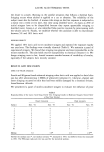
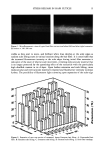
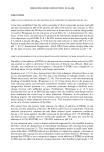
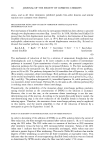
52 JOURNAL OF THE SOCIETY OF COSMETIC CHEMISTS METHODOLOGY FIBER SELECTION TEST Hair fibers were preselected by straining the untreated fibers into the yield region in water (25% extension) and measuring the force necessary to extend the fiber. After the untreated hair was measured, it was allowed to re-equilibrate overnight in water to recover its tensile properties. Each 30-mm fiber segment was allowed to soak in water for 60 minutes. The fiber was extended 20% in water and held for five seconds. Only those fibers exhibiting a linear Hookean region and an acceptable yield region (turnover of 2-5 % and slope equal to approximately 0.1 times the slope in the Hookean region) were used for SFTK measurements. STRESS RELAXATION When a hair fiber is extended in water by less than 2% of its original length, stress relaxation is complete in approximately 30 minutes (1). The utilization of a strain cycling procedure will reduce the amount of time necessary for stress relaxation. The following modification of the SFTK method was used with the miniature tensile tester to stress relax the hair fibers. The fiber was extended to 2.0% strain in a buffer solution the same pH and temperature as the reducing solution. Following extension, the hair fiber was allowed to stress relax for 60 seconds. The amount of strain was then reduced to 1.50% and the fiber was allowed to stress relax until a constant level of stress was achieved (2-3 minutes). After stress relaxation, the buffer solution was replaced rapidly by the reducing solution. SFTK data were collected to monitor the stress relaxation of the disulfide bonds in the hair fiber caused by the reducing agent. The data were displayed graphically as grams of force versus time by the Rheopc software (Dia-stron). Plots of the natural logarithm of [(Ft-Ff)/Fo-Ff)] versus time were prepared, and the reaction rate constant (k) was calculated from the slope. It is known that as hair is reduced, its swelling in water increases. Therefore, it would seem possible that some portion of measured decrease in force could be attributed to increased zero strain length of the hair due to swelling. Wortman and Souren (14) have shown that length setting does not occur therefore, changes in length from swelling are unlikely. This result indicates that the measured decreases in force can be attributed solely to decreased fiber strength. REDUCTION METHOD Two types of solutions were prepared for the following studies: ammonium thioglycolate and ammonium thioglycolate + dithiodiglycolic acid. The first type of solution con- tained 1M ATG in Millipore water adjusted to either pH 8.0, 9.0, or 9.5 with ammonium hydroxide. The second type of solution was prepared by combining the appropriate volumes of a 2 M ATG solution at pH 9.0 with a 1 M DTDG solution at pH 9.0 and readjusting the pH to 9.0 in order to acquire the desired solution combi- nations. Each 30-mm hair fiber was prestretched in a phosphate buffer of the appropriate pH and reduced in 50 ml of reducing solution. Stress-relaxation data were collected for 30 minutes during reduction.

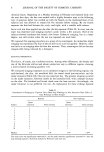
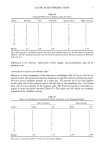
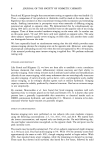
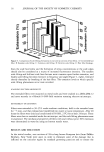
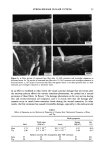
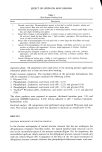
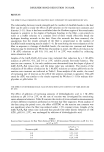
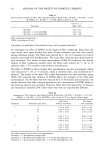
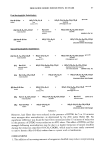
DISULFIDE BOND REDUCTION IN HAIR RESULTS THE EFFECT OF pH VARIATION ON REACTION RATE CONSTANT OF HAIR REDUCED BY ATG The relationship between tensile strength and the number of disulfide bonds in the hair fiber can be used to study the effects of pH variation on the reaction rate constants and kinetics (1-11). Since it has been established that the Hookean region of the stress/strain diagram is sensitive to the degree of hydrogen bonding in the fiber, a pre-stretch in water or a buffer solution to a constant level of force would effectively break the hydrogen bonding network in the hair. Once this network has been removed, the assumption that the tensile strength of the fiber is proportional to the number of disulfide bonds remaining may be made (1-4). By monitoring the stress relaxation of the fiber in response to cleavage of disulfide bonds, the reaction rate constant and kinetic behavior may be determined. With this relationship in mind, the effects of reduction by 1 M ATG solutions at pH 8.0, 9.0, and 9.5 at 23øC were studied by collecting stress-relaxation data. Graphs of the ln[(Ft-Ff)/(Fo-Ff)] versus time indicated that reduction by a I M ATG solution at pH 8.0, 9.0, and 9.5 at 23øC exhibits pseudo first-order kinetics. The reaction rate constant, k, for each condition was determined from the slopes of plots of ln[(Ft-Ff)/(Fo-Ff)] versus time, and the mean value was calculated. The results of the evaluation of the effects of reduction by 1 M ATG solutions at various pH levels on the reaction rate constants are indicated in Table I. From analysis of the results, the trend of increasing rate of reaction as the pH of the solution increases is apparent. This pH trend for ATG was similar to the results reported by Wickerr (1-3) for sodium thio- glycolate at pHs below 10. THE EFFECT OF DITHIODIGLYCOLIC ACID ON REACTION RATE CONSTANT OF HAIR REDUCED BY ATG The effect of addition of increasing amounts of dithiodiglycolic acid to 1 M ATG solutions at pH 9.0 at 23øC on the rate of reaction was investigated by monitoring stress-relaxation behavior. Table II contains the results of stress-relaxation measurements of three different treatments performed on 30-mm hair fiber segments. From analysis of the data using the paired t-test, the effect of DTDG on the reaction rate constant was not significant when the fiber was reduced under 1.5% constant strain. Graphs of the ln[(F•-Ff)/(Fo-Ff)] versus time indicated that pseudo first-order kinetic behavior of 1 M ATG, pH 9.0, 23øC, was unchanged by addition of dithiodiglycolic acid. Table I Reaction Rate Constants for Hair Fibers Reduced With 1 M Ammonium Thioglycolate at pH 8.0, 9.0, or 9.5 at 23øC k* 103 (s- •) Treatment (pH) (Mean, SD) 8.0 1.52, 0.35 9.0 4.57, 1.59 9.5 6.29, 0.46
Purchased for the exclusive use of nofirst nolast (unknown)
From: SCC Media Library & Resource Center (library.scconline.org)