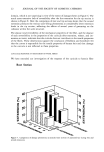
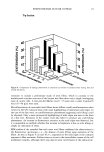
8 JOURNAL OF THE SOCIETY OF COSMETIC CHEMISTS Frosch and Kligman thought that concomitant testing on opposite sides was feasible (1). Thus, a comparison of two products or chemicals could be made at the same time (1). Experience has convinced us that concomitant testing yields inconsistent and misleading results. Striking interactions in perception occur when materials of differing stinging potential are applied to opposite sides. We demonstrated this by simultaneously ap- plying 10% lactic acid on one side and distilled water on the opposite side of ten strong stingers. Three of these recorded moderate stinging on the water side. In another test on this same panel, 5% and 10% lactic acid were applied on opposite sides. The same three subjects reported equally severe stinging on both sides, and another three could not distinguish between the sides. We have repeatedly found on simultaneous testing that the side which provokes more intense stinging elevates the stinging score on the opposite side. Moreover, some degree of perceptual confounding occurs even when the tests are separated by 30 to 60 minutes, if the material producing more intense stinging is applied first. We perform unilateral testing only. STINGING AND IRRITANCY Like Frosch and Kligman (1), we have not been able to establish a strict correlation between chemicals that induce inflammatory irritant reactions and their ability to provoke stinging. Some strong irritants such as sodium lauryl sulfate and benzalkonium chloride do not cause stinging, while many substances that are toxicologically innocuous can elicit stinging. A variety of acids, such as lactic, citric, and phosphoric acids, readily induce stinging, as do strongly alkaline agents such as sodium hydroxide. Stinging capacity cannot be reliably predicted by chemical structure. One has no recourse except to test empirically. By contrast, Muizzudden et al. have found that facial stinging correlates well with hyperreactivity to irritants placed on the back and forearm (13). It is known that some persons have a generally hyperirritable skin sensitivity to chemical insults such as DMSO, ammonium hydroxide, and cantharidin (11). However, it remains to be dem- onstrated whether hyper-reactors are generally stingers. EFFECT OF CONCENTRATION Routine stinging tests were performed on ten subjects who were moderate stingers, using the following concentrations: 2.5, 5.0, 10.0, 15.0, and 20.0. We started with the lowest concentration, and exposed only one cheek per day. On each following day, the next higher concentration was applied, on the opposite cheek. The end point was the peak intensity score. The results may be readily summarized. Two of ten subjects experienced slight stinging to 2.5% lactic acid. Four had mild stinging to 5%. With 15% the intensity scores were approximately the same as with 10%, though stinging tended to begin earlier. With 20%, four reported more severe stinging, while the remaining six showed no increase. These same four showed mild erythema that lasted for a few hours, followed by mild

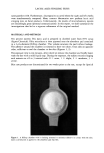
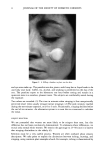
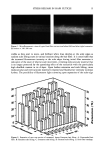
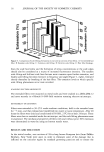
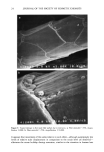
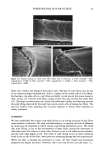
LACTIC ACID STINGING TESTS 9 scaling over the next few days. The onset of stinging was reduced by at least two minutes in eight of the ten subjects tested with 20%. It thus appears that a near plateau in peak stinging is reached at 10%, with only modest increases with 20%. However, this last concentration can induce objective signs of irritation such as redness and desquamation. •(•e conducted a preliminary investigation with 50% lactic acid in five moderate sting- ers. Increases in the intensity scores were not impressive, though stinging began almost immediately. More noteworthy was the appearance of moderate erythema in four of the five, still present in three subjects 24 hours later. A mild spotty folliculitis was noted in two, 24 hours after exposure. High concentrations thus can provoke a visible dermatitis after a ten-minute exposure. INFLUENCE OF AREA No attention has been paid to the size of the area of exposure. This turned out to be a surprisingly influential factor. On separate days we compared the stinging scores of five subjects to 10% lactic acid using small Hilltop chambers having a diameter of 1.2 cm and larger ones of 1.7-cm diameter. The subjects included mild and moderate stingers. In nearly every case, both the onset of stinging and peak intensity was greater with the larger chamber. Stinging was even further enhanced when we placed 3 ml of 10% lactic acid in a 3-cm-diameter glass cylinder hand held to the skin of these five subjects. Swabbing the entire face of these subjects with 10% lactic acid enormously increased the stinging response. The onset was almost immediate, increasing to peak intensity within one minute. In four, stinging was so severe as to require rinsing with water to obtain relief. Moreover, objective signs of irritation, notably erythema, appeared, lasting for hours or even the following day. •(•e routinely use 1.7-cm -diameter Hilltop chambers. This amplification of subjective and objective signs of irritancy by application to larger areas is an intriguing phenomenon that deserves further study. Incidentally, in unrelated studies we were able to demonstrate more intensive inflammatory reactions to 24-hour occlusive applications of irritants like sodium lauryl sulfate and benzalkonium chloride when the patch test area was increased fourfold. RESERVOIR EFFECTS Stinging ceases quickly when the test area is washed and rinsed. The consequences are quite different if the area is not washed after removing the chambers. Stinging dimin- ishes slowly, usually within one to two hours. Then, reapplication of a chamber filled with distilled water will elicit stinging, though of somewhat lesser intensity. •(•ater can elicit this response in some persons even one day later. Reactivation of stinging by water does not occur when the test area is washed and rinsed in the routine way. Clearly, without rinsing, a reservoir of lactic acid is established in the stratum corneum. •(•ater results in a release of the stored acid. •(•e have made similar observations with strong soaps applied in a chamber. When the site was not washed, reexposure to water caused reappearance of erythema. Testers need to be aware of this phenomenon and insist
Purchased for the exclusive use of nofirst nolast (unknown)
From: SCC Media Library & Resource Center (library.scconline.org)