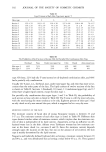
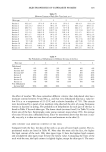
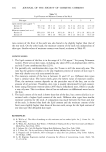
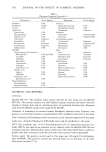
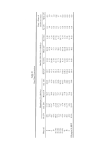
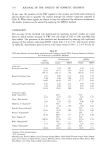
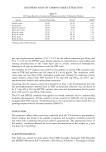
304 JOURNAL OF THE SOCIETY OF COSMETIC CHEMISTS Table VI Lipid Content and Moisture Content of the Neck Skin type 1 2 3 4 5 6 Lipid content (unit: •tgcm -2) Section 13 Section 14 Moisture content (unit: a.u.) Section 13 Section 14 96 --- 30 58 + 15 61 ___ 16 54 + 14 29 +- 22 17 + 10 77 + 36 45 + 20 46 + 15 43 +_ 24 24 _+ 14 33 --- 17 169 --- 10 102 ñ 8 105 -+- 8 96 --- 5 97 + 19 102 ___ 10 82 _+ 10 98 + 10 99 --- 16 94 + 13 85 + 23 91 -+ 10 ture content of the front of the neck was also found to be slightly higher than that of the rear neck. On the other hand, the moisture content of the neck was independent of skin type. Similar values of moisture content were found, as shown in Table VI. CONCLUSIONS 1. The lipid content of the face is in the range of 4-254 ptgcm -2 for young Taiwanese women. There are six skin types, including oily skin (20%), oil-depleted skin (10%), and oily T-zone combination skin (22%). 2. For partially oily combination-skin type, the T-zone is still the most oily area. The nose has the greatest tendency to be oily. Eighteen percent of women of skin type 3 have oily cheeks or an oily area around the eyes. 3. The moisture content of the face is between 23 and 147 a.u. Different skin types have a similar value. The lower cheek gives the lowest value of moisture content. Thus, the moisture content depends on the particular area of the face, not on the amount of oil secretion. Therefore, skin type is mainly determined by lipid content. 4. Some young Taiwanese women (about 20%) had a dehydrated nose, which is usually a very oily area. This is evidence that oil has no influence on diffusional water loss in the skin. 5. The lipid content of the neck is lower than that of the face, but a more oily face is as- sociated with a higher lipid content of the neck. Different skin types have similar moisture contents for the neck. A comparison was made between the front and rear of the neck. It showed that both the lipid content and the moisture content of the front were slightly higher than those of the rear neck, except for the lipid content of one skin type (the delipided skin type). REFERENCES (1) R. Wolf eta/., The effect of smoking on skin moisture and on surface lipids. Int. J. Cosmet. Sci., 14, 83-88 (1992). (2) K. Walas, Ed., ReM Bea•ty ReM Women: A Workbook for &lahing the Best of Your Own Good Looks (Master- Media Press, New York, 1992). (3) C. Jackson, Ed., Co/or Rle Beautify/Rlake•p Book (Ballantine Press, New York, 1988). (4) S.C. Place, Ed., The Art and Science ofProj•ssiona//Vlake•p. (Milady Press, New York, 1990). (5) L. Nogueira and D. Gabrielle, New techniques to assay skin care products, Dr•g Cosmet. Industry, 46-48 (Sept. 1988). (6) A.M. Kligman, Regression method of assessing the efficacy of moisturizing, Cosmet. Toilerr., 93, 27-35 (1978).

SKIN PROPERTIES OF TAIWANESE WOMEN 305 (7) E. K. Biosits et al., The refined regression method, J. Cutan. Aging Cosmet. DermatoL, 1, 155-163 (1989). (8) M. M. Rieger and D. E. Deem, Skin moisturizers: Methods for measuring water regain, mechanical properties, and transepidermal moisture loss of stratum corneum,J. Soc. Cosmet. Chem., 25, 239-252 (1974). (9) D.C. Salter, Instrumental methods of assessing skin moisturization, Cosmet. Toiletr., 102, 103-109 (1987). (10) P. L. Dorogi and M. Zielinski, Assessment of skin conditions using profilometry, Cosmet. Toiletr., 104, 39-44 (1989). (11) E. W. Packman and E. H. Gans, Topical moisturizers: Quantification of their effect on superficial fa- cial lines,J. Soc. Cosmet. Chem., 29, 79-90 (1978). (12) G. Nole et al., Global face assessment•A clinical evaluation method, Cosmet. Toiletr., 109, 69-72 (1994).
Purchased for the exclusive use of nofirst nolast (unknown)
From: SCC Media Library & Resource Center (library.scconline.org)