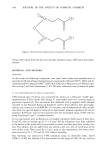
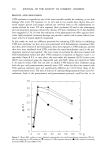
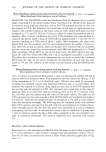
j. soc Cosmet. Chem., 47, 307-313 (September/October 1996) In vivo photoprotective effect of I-bis(carboxyethyl)germanium sesquioxide L. MONTENEGRO and E P. BONINA, Department of Pharmaceutical Sciences, University of Catania, Vle A. Doria 6, 95125 Catania, Italy, and J. C. DEDEREN, ICI Surfactants, Everslaan 45, Everberg, Belgium. Accepted for publication September 3 O, 1996. Synopsis In this paper in vivo radical scavenger activity of [3-bis(carboxyethyl)germanium sesquioxide (CEG) was in- vestigated. CEG aqueous solutions were topically applied to healthy human volunteers before and after skin exposure to UVB radiation. Skin erythema was monitored by calculating erythema index values from the skin spectral data obtained using a reflectance spectrophotometer. The results of these experiments indi- cated that CEG was not able to inhibit UVB-induced skin erythema both in the pretreatment and in the posttreatment protocol. In order to assess if the lack of CEG photoprotective activity was due to poor CEG in vivo skin permeation, we tested CEG aqueous formulations containing a skin penetration enhancer such as dimethylisosorbide (DMI). CEG aqueous solutions containing DMI were able to reduce UVB-induced skin erythema when applied before skin exposure to UV radiation, but they were ineffective when topically applied after UVB irradiation. INTRODUCTION The use of radical scavengers to prevent UV-induced skin damage has recently been met with considerable interest. Bissett et al. (1) and Trevithick (2) reported that superoxide- scavenging antioxidants, such as tocopherol and tocopheryl acetate, decreased UVB skin damage after topical application in mice. Other authors (3) suggested that topical free radical scavengers, like SOD, could exert photoprotective effects against ultraviolet ra- diation-induced cutaneous damage. [3-Bis(carboxyethyl)germanium sesquioxide (Arlamol GEO ©, CEG) (Figure 1), a com- pound of very low toxicity, has been shown to have antioxidant/radical scavenger prop- erties in in vitro studies (4,5). Presently CEG is used in anti-aging and skin-protective products in Europe and Asia and as a dietary supplement in several Asian and European countries. However, to date in the literature no data have been reported on a CEG pro- tective effect against UV radiation. Therefore, in this study the in vivo radical scavenger activity was assessed by determin- ing the ability of CEG to reduce UVB-induced skin erythema on healthy human volun- teers. CEG aqueous solutions were topically applied before and after skin exposure to UVB radiation, and the subsequent skin erythema was monitored by calculating ery- 307

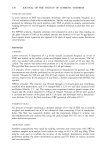
308 JOURNAL OF THE SOCIETY OF COSMETIC CHEMISTS 6e',..vA,OH O' 0 oX X OH o Figure 1. [•-Bis(carboxyethyl)germanium sesquioxide (CEG) chemical structure. thema index values from the skin spectral data obtained using a reflectance spectropho- tometer. MATERIALS AND METHODS MATERIALS In this study the following compounds were used (trade names and manufacturers in parentheses): [3-bis(carboxyethyl)germanium sesquioxide (Arlamol GEO ©, CEG) and di- methylisosorbide (Ariasolve DMI ©, DMI) (ICI Surfactants, Belgium) and [3H]water (spe- cific activity 5 mCi/ml) (Amersham, U.K.). All other substances were of analytical grade. IN VIVO PHOTOPROTECTIVE EFFECT EVALUATION UVB-induced skin erythema was monitored by means of a reflectance visible spec- trophotometer, X-Rite model 968, having 0 ø illumination and a 45 ø viewing angle, as previously reported (6). The instrument was calibrated with a supplied white standard traceable to the National Bureau of Standards' perfect white diffuser. The spectropho- tometer was connected to an IBM PS2 50 computer, which performed all color calcula- tions from the spectral data by means of the Spectrostart program supplied with the in- strument. Reflectance spectra were obtained over the wavelength range of 400-700 nm using illuminant C and 2 ø standard observer. In vivo experiments were performed on six healthy volunteers (both sexes) of skin types II and III, with an average age of 31 _ 9 years. All the volunteers were fully informed of the nature of the study and the procedures involved, and they gave their written con- sent. The subiects did not suffer from any ailments and were not on medication at the time of the study. They rested for 15 min. prior to the experiments, and room condi- tions were set at 22 4- 2oc and 40-50% relative humidity. Skin erythema was induced by UVB irradiation using an ultraviolet lamp, model UVM-57 (UVP, San Gabriel, CA), that emitted in the range of 290-320 nm, with an
Purchased for the exclusive use of nofirst nolast (unknown)
From: SCC Media Library & Resource Center (library.scconline.org)