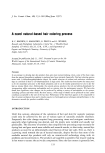
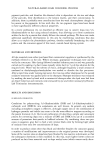
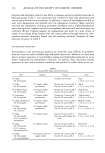
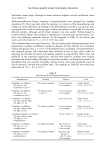
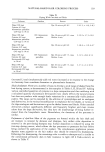
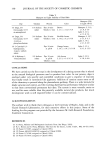
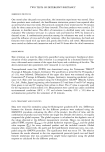
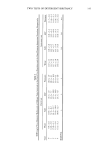
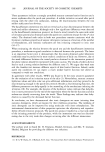
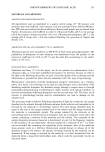
NATURAL-BASED HAIR COLORING PROCESS 139 Table IV Dyeing With Catechols and ThioIs Colorant Oxidant Process Color Dopa (100 mg) Dye 20 min at pH 8.2 L 41.5, a -0.9, b 8.3 Cysteine (61 mg) Ammonium persulfate (228 mg) in 10 ml Dopa (100 mg) 10% Ammonium Cysteine (61 mg) persulfate Ammonium persulfate (228 mg) in 10 ml Dopa (100 mg) Cysteine (121 mg) Ammonium persulfate (342 mg) in 10 ml Dopa (100 mg) 10% Ammonium Cysteine (61 mg) persulfate Ferricyanide (659 mg) in 10 ml Dopa (100 mg) 10% Ammonium Cysteine (121 mg) persulfate Ferricyanide (659 mg) in 10 ml Dye 20 min at pH 8.2, rinse Oxidize 4 min Dye 20 min at pH 8.0 Dye 20 min at pH 7.5, rinse Oxidize 4 min Dye 20 min at pH 7.5, rinse Oxidize 4 min L 29.2 a 3.7, b 10.9 L 38.4, a -0.9, b 6.7 L 14.5, a 0.6, b 1.3 L 27.3, a 2.4, b 9.4 (increased L) and simultaneously adds red tones (increased a) in response to the change in chemistry from eumelanin formation to pheomelanin formation. Shade development. There are a number of ways to develop a wide range of shades from this hair dyeing system, as demonstrated in the examples in Tables I, II, III and IV. Adding various controlled quantities of cysteine to a dopa composition and then oxidizing with a calculated quantity of potassium ferricyanide most closely reflects the natural process but does not produce wide enough shade variations for a commercially viable product palette. The range can be extended by the addition of cysteinyldopa and its analogues and derivatives, or the various benzothiazines to emphasize the red shades, or various of the dopa analogues and derivatives to give the darker browns and blacks. Other catechol derivatives produce significantly different and frequently brighter and more intense colors than the dopa derivatives, but they have the disadvantage of being further re- moved from the biosynthetic route. Nevertheless, the chemistry of the processes is similar. Performance of dyed hair. Most of the pigments are formed within the hair shaft and are resistant to removal by abrasion and shampoo. Any surface color deposition is removed in the post-dyeing shampoo step. Surface deposition is reduced by using the two-step dyeing process, which allows the dye precursors to penetrate the hair before being oxidized by application of the oxidant. The simultaneous application process deposits some pigment on the hair surface that should be removed by shampooing. Following this shampooing, the remaining color is stable to shampoo and is similar to the conventional permanent dyes in fade resistance to light (48 h Fade-o-meter), as shown in Table V.

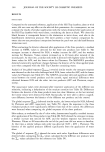
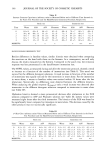
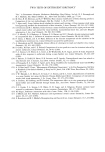
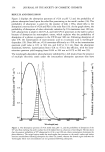
140 JOURNAL OF THE SOCIETY OF COSMETIC CHEMISTS Table V Shampoo and Light Stability of Dyed Hair Dye Shampoo (5X) Oxidant Process Color or Light (48 h) 1% Dopa, 6% ferricyanide, 0.3 % m-aminophenol 1% Dopa, 6% ferricyanide, 0.3 % 2-nitro-p- phenylenediamine 1% 2-Cysteinyl- 1,4- hydroquinone, 4-equiv. sodium iodate 1% 6-Hydroxy-1, 4-benzothiazine 1% Sodium Dye 20 rain Brown Shampoo: L 21.9, iodate Oxidize 2 rain L 21.7, a 1.8, b 4.8 a 1.8, b 4.9 Light: L 22.5, a 2.2, b 5.4 5% Sodium Dye 20 rain Reddish brown Shampoo: L 19.7, iodate Oxidize 2 min L 19.6, a 4.3, b 4.0 a 4.5, b 4..3 Light: L 19.5, a4.1, b4.0 Dye 10 rain Orange brown Light: L 35.3, at pH 8 L 34.7, a 10.7, b 14.8 a 9.3, b 13.9 1% Sodium Dye 10 rain Ash brown Light: L 22.9, iodate at pH 8 L 21.1, a 1.4, b 5.9 a 2.8, b 6.6. Oxidize 2 rain CONCLUSIONS We have carried out the first steps in the development of a dyeing system that is related to the natural biological processes used to produce hair color. In our process, dopa is oxidized under very specific and controlled conditions to give a sequence of reactions that finally result in eumelanin-like pigments. Addition of cysteine causes some or all of the chemistry to proceed along the pheomelanin pathway. There is a wide latitude for shade variation and control, and the resulting dyed hair has performance behavior similar to that from conventional permanent hair dyes. The system is more versatile, easier to use, and far more reliable than the presently available natural dye products, but much development work is still required before it can be commercialized. ACKNOWLEDGMENTS The authors wish to thank their colleagues at the University of Naples, Italy, and in the Clairol Research Laboratories, for their extensive efforts in this project. Some of the funding for this program was provided by the Lawrence M. Gelb Research Foundation, Stamford, Connecticut. REFERENCES (1) G. Prota, Melanins and Melanogenesis (Academic Press, San Diego, 1992). (2) K. C. Brown and G. Prota, Melanins: Hair dyes for the future., Cosmet. Toiletr., 109, 59-64 (1994). (3) US Patent 5173085, assigned to Clairol (1992). (4) US Patents 4804385,4808190, assigned to L'Oreal (1989). (5) US Patent 5374288, assigned to Clairol (1994). (6) US Patent 5435810, assigned to Clairol (1995).
Purchased for the exclusive use of nofirst nolast (unknown)
From: SCC Media Library & Resource Center (library.scconline.org)