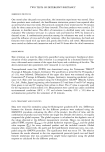
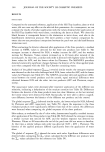
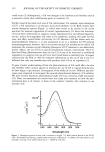
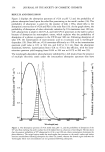
154 JOURNAL OF THE SOCIETY OF COSMETIC CHEMISTS RESULTS AND DISCUSSION Figure 2 displays the absorption spectrum of t-UA at pH 7.2 and the probability of photon absorption based upon the solar flux penetrating to the earth's surface (16). The probability of absorption is given by the product of E(}t) * F(}0, where E(}t) is the absorption cross-section of t-UA and F(}t) is the solar flux (16). As the graph shows, the probability of absorption of solar ultraviolet radiation by UA maximizes near 300 nm. UA's absorptivity is small in the UV-A, and little UV-C penetrates to the earth's surface because of absorption by stratospheric ozone, which explains why the probability of absorption of a photon is greatest in the UV-B near 300 nm. Following absorption of solar UV, the isomerization of trans-urocanic acid to cis-urocanic acid is wavelength- dependent (19). Near 300 nm, t-UA isomerizes efficiently to c-UA, as the isomerization quantum yield value is 0.31 at 302 nm, and 0.49 at 313 nm. Near the absorption maximum, however, isomerization from t-UA to c-UA is less efficient, with the isom- erization quantum yield ranging from 0.044 at 264 nm to 0.079 at 289 nm (19). The wavelength-dependent photochemistry exhibited by t-UA results from the presence of multiple electronic states under the structureless absorption spectrum that have • 1.5 ß ,• 1.0 ß .• 0.5 . ?l , 2.' i -., , m m m I 260 280 300 320 340 360 380 Wavelength (nm) Figure 2. The absorption spectrum of t-UA (solid line), pH 7.2, and the probability of absorption of the UV solar flux reaching the earth's surface by t-UA (dashed line) as a function of wavelength. The data show that the greatest probability of UV absorption by t-UA is near 300 nm, where isomerization dominates the photochemistry. The striped region marks the wavelengths that penetrate to the earth's surface and induce reaction intermediates following absorption by either UA isomer, whereas the dotted region indicates the wavelengths where such intermediates are not generated following absorption.

PHOTOCHEMISTRY OF UROCANIC ACID 155 distinct photochemistries (13). Specifically, photoacoustic (ultrasonic) results showed that following absorption near 308 nm, isomerization by t-UA occurs efficiently and reactive long-lived intermediate(s) are not produced. Supporting time-resolved laser studies showed that upon absorption in the vicinity of 300 nm, t-UA isomerizes in less than 100 x 10 -12 seconds (20). In contrast and in the same study, it was determined that isomerization following excitation at 264 nm near the absorption maximum is so inef- ficient because t-UA undergoes rapid intersystem crossing to a long-lived electronically excited triplet state that is approximately 230 kJ/mol above the ground state. This value is in agreement with triplet sensitization studies (21). Cis-urocanic acid was also found to generate a long-lived triplet state following absorption of 264 nm irradiation, but, like t-UA, c-UA also released essentially all of the absorbed energy after excitation near 308 nm without the generation of a long-lived intermediate state. This study deter- mined that the photochemistry seen at 264 nm is the result of an electronic transition peaking near the absorption maximum (270-280 nm), extending past 290 nm and weakening in its absorptivity past 300 nm, where a second transition begins to dominate the absorption in this region and therefore alters the photochemistry exhibited by the molecule. This conclusion is supported by similar isomerization quantum yield values seen between 254-289 nm and 300-313 nm, respectively (19). Cis-urocanic acid's role as an immunomodulator is proposed to be greater than that of trans-urocanic acid (6) however, the Cosmetic Ingredient Review Expert Panel could "not conclude whether UA is safe for use" based upon the data used in their assessment study, and they question whether cis-urocanic acid is the sole culprit or if reactive intermediate(s) should be of concern as well (3). Ultrasonic techniques have shown that both t-UA and c-UA not only generate long-lived triplet state intermediates but also generate singlet oxygen under an 02 or air-saturated solution (13) following absorption at 264 nm. These results caution against urocanic acid's use as a cosmetic ingredient. For example, as Figure 2 shows, the probability of absorption at 264 nm in the UV-C is negligible. Little if any UV-C penetrates through the earth's stratospheric ozone layer, and therefore should have little effect upon the UA photochemistry. However, when we consider that the transition excited at 264 nm also dominates the absorption spectrum and thereby the photochemistry between 264 nm and 289 nm, we conclude that triplet-state and singlet-oxygen chemistry results in this lower UV-B region and there- fore is important when considering the effects UA may have in the skin. In Figure 2, this region where solar UV reaches the earth's surface and t-UA isomerization is inefficient, but where triplet-state and singlet-oxygen production dominates the photochemistry, is marked by the striped region. The dotted region marks the wavelengths where isom- erization to c-UA from t-UA is the dominant photochemical pathway. Evidence that both UA isomers produce a long-lived electronically excited triplet state upon absorption of UV between 264 nm and 289 nm raises concerns about the subse- quent effects of the excitation of UA in the epidermis. Such electronically excited triplet molecules are of concern because of their ability to sensitize triplet reactions with natural chromophores in the skin, which in turn indicate the possibility of antigen production within the cell. Of concern as well is the application of other topical ingredients that will generate a triplet state of either greater or lesser energy than UA's (approximately 230 kJ/mol) and in turn undergo energy transfer to or from UA, respectively. In addition, our data show that both UA isomers undergo energy transfer to produce singlet oxygen following absorption of UV near the absorption maximum. Singlet oxygen is believed to
Purchased for the exclusive use of nofirst nolast (unknown)
From: SCC Media Library & Resource Center (library.scconline.org)