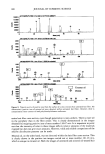
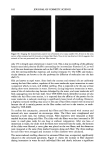
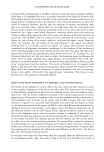
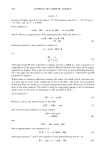
174 JOURNAL OF COSMETIC SCIENCE 1.2E+6 1.0E-6• ß . 4.0E+52 2.0E+5 0: H:•TANDAR•UT_OII._NEG.TDC - Io• 811•n 3752923 16 13 ' s I i I•ass [m/z] H:L•TANDAR!•ONUT OIL_NEQ.TDC. lens 811Jm 3752923 cts 7000i 4b 6'0 8•0 Mass [m/z] H:•I'ANDAR•ONUT_OIL NEG.TDC - Ions 81Wn 3752923 97 lOO 25000 I 20000 • Coconut Oil I ' "' ' '3l•0 .... 4(•)0 .... 5• .... 6l•0 .... 7l•)0' ' Mass [.Vz] Figure 3. Spectra of negative ions of coconut oil deposited on a silicon wafer, including the highlighted characteristic negative ions of coconut oil. the hair fiber interior. Mapping/imaging coconut oil in the fiber cross section via one of its unique ions (the positive ion at 127 (126.67) m/z) will confirm this conclusion. TOF-SIMS IMAGING OF COCONUT OIL IN HAIR The positive ion images at mass number 126.67 map the distribution of coconut oil in cross sections of an untreated control (Figure 6a) and coconut-oil-treated hair fibers (Figure 6b-d). The image of the untreated control hair fiber at mass number 126.67 in Figure 6a does not show much activity, suggesting essentially the absence of coconut oil. However, ion images at the same mass number of the coconut-oil-treated hair fibers clearly show partial (Figure 6d) to complete (Figure 6b,c) penetration of the coconut oil into the bulk of the hair fiber. Figure 6d shows only partial and unsymmetrical pen-

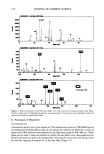
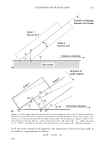
PENETRABILITY OF OILS IN HAIR 175 10000- 2UNSVROiI + lofts 1251J'n 496920 cts 15 0 , 2UNSVROI1 + Ions 1251Jm 496920 cts lOOO c lOO 12o Mass !mtz] ß 109 1 •7 137 ' 140 Mass Ira/z] 2UNSVROI1 + Ions 12r"4m 4Eft& cts Siloxane I 326 413 465 529 •[•1 Figure 4. Spectra of positive ions found on the surface of cross sections of an untreated hair fiber (se•ing as control). No characteristic positive ions of coconut oil were detected within the interior of untreated hair. etration of the oil. The oil has penetrated into the fiber center from one side, but is restricted to the periphery on the other side. Ion images of cross sections in Figures 6b,c show complete penetration of the coconut oil, even though penetration is non-uniform. There is more oil in the periphery than in the fiber center. The intensity of color reflects relative amounts, but does not give exact amounts. The exact quantification requires calibration with known quantities of oil in the hair. Even then it may not be exact, because penetration of the beam over the sample surface may be non-uniform. Therefore, this method can give information only on penetration and relative distribution patterns of materials, but not on the exact amounts present in a given fiber. The same format was used to investigate penetration of mineral oil into the hair shaft.
Purchased for the exclusive use of nofirst nolast (unknown)
From: SCC Media Library & Resource Center (library.scconline.org)