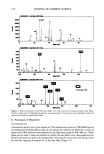
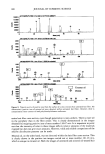
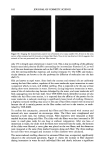
172 JOURNAL OF COSMETIC SCIENCE SAMPLE PREPARATION FOR TOF-SIMS Oils. Small amounts of the pure coconut and mineral oils were deposited on clean silicon wafers at ambient temperature to establish the characteristic positive and negative ions from the mass spectra of the oils for their mapping in the hair cross sections. Untreated and oil-treated hair fibers, The untreated (control) and oil-treated hair fibers were cross-sectioned with a clean stainless steel blade and mounted in small holders with the cross sections facing the spectrometer. OBTAINING ION MASS SPECTRA: ESTABLISHING CHARACTERISTIC POSITIVE/NEGATIVE IONS Positive and negative static TOF SIMS mass spectra were acquired from several locations on each of the oils and from the "interior" cross-sectioned surface of the untreated and oil-treated fibers. In this study, the raw spectra from the pure oils and the fiber "interior," that is, from the surface of the cross-sectioned untreated and oil-treated fibers, were collected and compared. This was done to establish the characteristic positive and negative ions of the pure oils, and to "spectrally" establish their absence or presence in the untreated (control) and oil-treated hair fibers. Since the goal of this study was to establish penetration of the oils into the fiber interior, special attention was directed to mapping the presence of these compounds within the fiber cross section. RESULTS AND DISCUSSION I. Penetration of Coconut Oil ION MASS SPECTRA Coconut oil on a silicon wafir. As the first step, the positive and negative characteristic ions of pure coconut oil, resulting from ion bombardment, have to be established. It is shown that the positive and negative TOF-SIMS spectra of coconut oil contain several charac- teristic ions that can serve as markers for the coconut oil within the hair fibers. Characteristic positive ions of pure coconut oil. Characteristic positive ions are at 127, 155, 171,183,211,257,411,439, and 467 m/z. The positive ion at 127 (126.67) m/z may be the best ion for the imaging of coconut oil, since it is intense and is likely to be free of mass interference. Figure 2 shows the mass spectra of the characteristic positive ions for coconut oil. Characteristic negative ions of pure coconut oil. Characteristic negative ions of pure coconut oil are at 41, 58, 71, 143, 171, 199, and 227 m/z. The individual peaks have not been identified, but many are due to fatty acids such as lauric and oleic acids. Obviously, some of these may be resulting from mixed triglycerides present in minor quantities in coconut oil. Because the coconut oil forms strong positive ions, it tends to form weak negative ions. Therefore, the positive ion at 127 (126.67) m/z will be used for imaging coconut oil in the cross section of the hair fiber (see Figure 3 for the mass spectra of the negative ions for coconut oil).

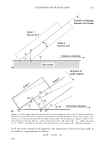
PENETRABILITY OF OILS IN HAIR 173 OOGONUT OIL_IaO•.TDG + Ioee 81pro 1045g•1 c• coconut oil mf , . 20O001 15 6 OOOONUT_OILi•.'!'D• + lans 811•m 1045961 c • coconut oii ref Coconut Oil 311 • [mtz] Figure 2. Spectra of positive ions of coconut oil deposited on a silicon wafer, including the highlighted characteristic positive ions of coconut oil. Characteristic positive ions of untreated hair: controls •br coconut-oil-treated hair. The TOF- SIMS spectra were obtained from the surface of the cross sections of untreated hair fibers. These spectra are very different from those obtained for the pure coconut oil. The spectra contain hydrocarbon and Na* peaks (Figure 4). The spectra do not contain any of the high-mass peaks observed in the coconut oil mass spectra. Characteristic positive ions of coconut-oil-treated hair. The positive TOF-SIMS spectra were obtained from the surface of the cross sections of hair fibers treated with coconut oil. As can be clearly seen, these spectra of the coconut-oil-treated fibers have intense peaks at 127, 183, 257, 383, 411,493, 467, and 495 m/z (Figure 5). These peaks match those of the coconut oil mass spectra, that is, these peaks are unique to the coconut oil. This comparison of the ion mass spectra suggests that coconut oil has indeed penetrated into
Purchased for the exclusive use of nofirst nolast (unknown)
From: SCC Media Library & Resource Center (library.scconline.org)