184 JOURNAL OF COSMETIC SCIENCE of small diffusible molecules into the cortex of hair. Due to its polarity and affinity for the protein, coconut oil was found to penetrate into the hair cortex. Mineral oil, on the other hand, did not penetrate the fiber. The reason is likely to be its lack of affinity for the protein. Penetration of oils seems to reduce the hydrophilicity of the protein, as indicated by the lower amount of swelling observed in hair fibers treated with coconut oil. Mineral oil also shows lower levels of swelling compared to the untreated fiber, suggesting that it may have penetrated into the cuticular regions, thereby preventing further penetration of water into the hair shaft during the swelling experiment. Significant reduction in swelling suggests that this will prevent swelling and de- swelling (hygral fatigue) of the fiber. Hygral fatigue can lead to cuticular damage as well as damage to the cortex, which can, in turn, affect the mechanical properties. These re- suits support the beneficial effects of coconut oil to the hair observed in earlier work (1). REFERENCES 1. A. S. Rele and R. B. Mohile, J. Cosmet. Sci. 50, 327-339 (1999). 2. E. D. Goddard and J. V. Gruber, Eds., Principals of Polymer Science and Technology in Cosmetics and Personal Care (Marcel Dekker, New York, 1999), p. 469. 3. C. R. Robbins and K. M. Fernee, J. Soc Cosmet. Chem., 34, 21 (1983). 4. P. Stam, R. F. Katy, and J. R. White, Text. Res. J., 22, 48 (1952). 5. J. A. Swift, Proceedings of the 8th International Hair Science Symposium of the DWI, Kiel, Germany, September 9-11, 1992.

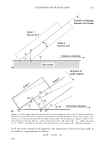
J. Cosmet, Sci., 52, 185-193 (May/June 2001) Mechanical extension of human hair and the movement of the cuticle M. FEUGHELMAN and B. K. WILLIS, Department of Fibre Science, University of New South Wales, Sydney, NSW 2052 (M.F.), and Reckitt and Colman, P.O. Box 138, West Ryde, Sydney, NSW 2114 (B.K.), Australia. Accepted for publication March 15, 2001. Synopsis Goniophotometry has enabled measurement of the angle that the surface of the cuticle (the scales) of a human hair fiber makes with the axis of the hair shaft. This measuring technique has been used to obtain the change of this scale angle with extension of a hair fiber under fixed conditions of temperature and relative htunidity. Based on a simple model of overlapping scales of the hair cuticle, analysis shows that, for hair fibers extended to strains above 10% at 35% relative humidity and at 35øC, overlapping scales become progressively detached from each other. This scale detachment has been suggested to result from the mechanical failure of the endocuticle layer in the scale structure. This endocuticle layer is low in disulfide cross-linking, which would result in a lowered stiffness and greater extensibility, as indicated by the higher swelling of the layer in water as against the highly cross-linked exocuticle layers. The greater extensibility of the endocuticle would also explain the greater distortion of this layer under stress, but it would not follow that endocuticular failure under stress should result. An alternative mechanism of failure of adhesion between overlapping scales in the cuticle is suggested, based on the involvement of the hydrophobic upper-[3-1ayer with its surface of 18-methyleicosanoic acid (18- MEA), which may provide mobility and a reduction in adhesion between scales. This potential failure of the cementing of the overlapping scale structure due to the 18-MEA is discussed, with particular reference to the standard permanent setting procedure of human hair. INTRODUCTION Stammet aL (1) have studied by means of goniophotometry the specular reflection and the diffuse scattering of light by human hair. The data obtained provided a means of measuring the luster of hair fibers under differing conditions, such as cleanliness of the hair surface, the straightness of the hair and its alignment, and cuticle damage. Fur- thermore, the technique enabled the measurement of the scale angle that the surface of the cuticle (the scales) makes with the axis of the hair shaft. Guiolet et aL (2) have studied the effect of stretching hair on the scale angle. Two series of black and medium bleached hair were examined by them, and both types of hair were found to behave identically, from the point of view of scale angle versus the strain applied. 185
Purchased for the exclusive use of nofirst nolast (unknown)
From: SCC Media Library & Resource Center (library.scconline.org)