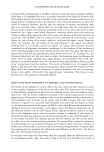
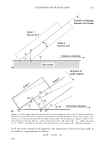
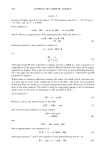
186 JOURNAL OF COSMETIC SCIENCE All these latter measurements were carried out at 35øC and 35% relative humidity. Table 2 in the paper by Guiolet eta/. (2) shows the strain and the corresponding scale angle up to a strain of 33.9%. These results are shown here graphically in Figure 1. Each result is the mean scale angle for 20 fibers at the indicated strain. Although the individual measurements at each strain level fall within a wide range, the general trend of the change of scale angle with strain is clear. In this note the authors examine on the basis of a simple model the scale angle change expected with extension of the hair fiber and its significance in terms of the cuticular scale attachment to the hair fiber main shaft. THE OVERLAPPING SCALE STRUCTURE If no "decementation," mechanical failure, or slippage between overlapping scale struc- tures occurs, the whole cuticle overlay of the fiber will act as a solid as if it were part of the hair cortex. The scale angle versus the longitudinal strain of the fiber is shown in the Appendix to follow Curve B in Figure 1. If slippage between overlapping scales occurs, then the scales will move relative to each other as the hair fiber is extended. Each scale unit is attached directly by its back edge to the hair cortex, and this attachment edge will act as a fulcrum (see Figure 3). The scale angle versus longitudinal strain of the fiber in this latter case is shown in the Appendix to follow Curve A. It should be noted that the thickness of the scales remains unchanged in the calculation of Curve A. If the overlapping scales completely detach from each other, then the scale angle of the extended fiber would be even less affected 3.2 3 2.8 2.6 2.4 0 5 10 15 20 25 30 35 40 •train E• % Figure 1. The plot (x axis) of the relationship between the longitudinal strain, e, applied to a hair fiber (see text) versus the scale angle, 0 (see Figure 3), shown in conjunction with the theoretical curves based on the model shown in Figure 3. Curve A corresponds to the case of free slippage between scales and Curve B to no slippage.

EXTENSION OF HUMAN HAIR 187 by extension of the main shaft. The points on Figure 1 of the measurements of scale angle versus strain obtained by Guiolet eta/. (2) suggest that up to a strain of about 8%, with the fibers at an environmental relative humidity of 35%, there is no slippage between scales, and that above 10% slippage plus some detachment has occurred. This also concurs with the observation in Table 2 of Guiolet's paper (2) that the transparency of the hair is constant up to 7.5% strain and then drops rapidly with further extension. This change would be brought about by an air film forming between overlapping scales along the surface of detachment. These suggestions generally concur with the observations of Gamez-Garcia (3) that the lower the moisture content of the hair fiber under test the lower the strain level at which detachment of the scale structure is initiated. The latter also noted that the lifting of the scales showed no presence of endocuticular debris at their internal surfaces. As suggested elsewhere (4), although the endocuticle has the least concentration of cystine cross-links of the layers in the cuticle cell and the highest swelling in water, it is the upper-p-layer in the cell membrane complex (CMC) that provides the possibility of specific mechanical weakness (see Figure 2). Further discussion on the nature of this p-layer will follow. Ruetsch and Weigmann (5) also have examined the damage to both human hair and wool cuticles by fiber extension to 30-35% strain. In the case of wool fibers, although Hair surface Upper 13-1ayer• i i i i I I I I !1•1 II Exocuticle '''''' (high S) J• Endocuticle (low S) Inner layer 8 layer ••w^•• Lower I• layer "*'--- Upper I•-Iayer i i ill i i i i i i i i i i i i i i ,, ,,,,,, , .............. ,,,,',,,• Exocuticle Iiiii I Iii I I I I I I I Iii I I I I I (a) ' ' "'' ' ' ' ' "'' '"" '''• ' ' ' '"i"'"'"'"' ' ' (highS) Hair surface -. a Upper I• layer "A" I •Ya•re• (nhl gehX•s• uticle- •. / Distortion of endocuticle Endocuticle •/ '••' X upper I• layer "A" layer anhd exocuticle layer ( igh S) Endocuticle • //J Figure 2. A sectional diagram of two overlapping scales showing in 2a details (see text) of the different layers of the scale structure. In 2b are shown the proposed distortion of the low cross-linked endocuticle when the hair fiber is extended, resulting in opposing relative stresses (a and b) in the two scales. At the endocuticle edge (X) these stresses result in shear forces, which may lead to scale lifting.
Purchased for the exclusive use of nofirst nolast (unknown)
From: SCC Media Library & Resource Center (library.scconline.org)