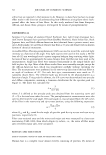
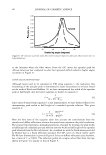
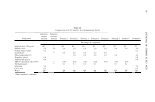
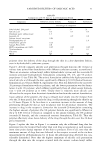
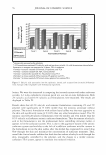
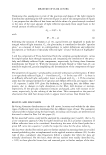
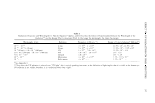
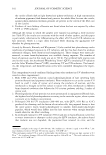
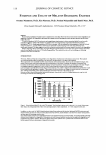
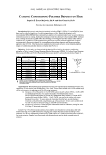
2003 ANNUAL SCIENTIFIC MEETING CATIONIC CONDITIONING-POLYMER DEPOSITS ON HAIR Paquita E. Erazo-Majewicz, Ph.D. and Shu-Chun Su, Ph.D. Hercules Incorporated, Wilmington, DE Introduction -Microscopic and chemical methods, including SEM [l], ESCA [2], and AFM [3,4] have been used to study the deposition of conditioning polymers on hair. Recent developments with environmental SEM (ESEM)[5] have allowed hair samples to be examined under lower vacuum conditions, without desiccation or coating, making this technique overall less destructive than standard SEM. Confocal laser scanning microscopy (CLSM) offers the advantage of viewing the hair fiber surface under ambient conditions [ 6]. In addition, CLSM surpasses these techniques with the enhanced capabilities of optical sectioning and a fluorescent channel for viewing fluorescent polymer deposits and fluorescent probes applied to hair [6,7,8,9]. This fluorescence capability has been used on hair to create detailed graphical images of conditioning polymer deposits on human hair [9,10,11]. Objective - In this study, we characterized the deposits left on hair by the cationic conditioning polymers in Table l using 1) Natural Scanning Electron Microscopy (NSEM), 2) Confocal Laser Scanning Microscopy (CLSM), and 3) CLS Fluorescent Microscopy (probe: 5-carboxyfluorescein dye, Figure 1). Table 1. Conditioning Polymers Polymer guarhydtOX)IPtOpyltrimoniumchloride guarhydroxypropyltrirnoniumchlolide guar hydroxypropyltrimoniumchlorida guathydro:.:ypropyttrimoniumchiofide Potyqualernium-10 Po1yqualernium-1O Polyqualernium-7 Potrqualarnium-44 No Polym• Control galaclomannan gale.etomannan gale.clomannan gale.ctomannan hydtoxyalhylc:elluloae hydro:.:yelhylcatlulosa Viscoaity 1 3200-4200cpa 01%1olids 4000-- 01%solids 3000-4000Cp8 01% solids 100cps 0 1 Owt% solid a 300-SOOcpa 02%aolida 300-SOOcpa 02%aolida diallyldimethylammoniumchloride- 7500-1,000cps acrylamidecopolymer oe.,-9.1%solida quatarnizedvinylimldazole- 30000cpa \Jinylpyrroidonecopolymer 07.0%aolida High High High High High Charge Density' meal• HOU1�0, ,,. o "' /, /, C-0-t I : 0 C-OH 0 Figure I. 5-carboxyfluorescein (5-FAM) Viscosity 1nlormat1on from supplier brochures correlates with molecular weight. Low Mw is less than 100,000 Medium Mw is 400,000-700,000 High Mw is greater than 1,000,000. c Charge density measured by turbidimetric titration, except Polyquatemium-44 was taken from supplier literature. Experimental - Bleached European medium brown hair and virgin European medium brown hair were supplied as 12 inch tresses from De Meo Bros., New York. Tresses were washed with a 4.5% sodium lauryl sulfate solution prior to applying one of the following treatments: A) Shampoo A: 0.2wt% polymer in 12wt% SLES (sodium laureth sulfate (3EO)) + 3wt% CAPB (cocamidopropyl betaine), was used in the studies with bleached hair tresses. Shampoo fl_: 0.4wt% polymer in 12wt% ALS (ammonium lauryl sulfate)+ 3.9wt% ALES (ammonium laureth sulfate (3EO)) + l.2wt% CAPB, was used in the studies with virgin European brown hair. To assess removal of polymer from the hair, second shampoo treatments were performed using Shampoo A, without polymer. Tresses were combed while wet and were then air dried at 72 deg. C and 50% relative humidity. B) Conditioning treatment: 0.2wt% polymer in deionized water for 4 minutes, rinsing for lmin @ 40 deg. C deionized water rinse. Sample Prep - For all microscopic analyses, hair samples were mounted on a clean glass slide with double-sided tape. For CLSM fluorescence imaging, hair samples that were treated according to hair treatment A or B were subsequently treated with a 15µM solution of 5-FAM in deionized water, at pH 6.5, for twenty minutes. Samples were then rinsed with deionized water and air-dried overnight, prior to analysis. 125

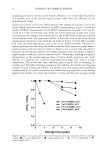
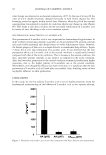
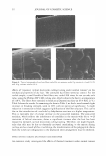
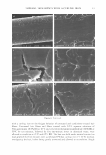
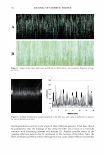
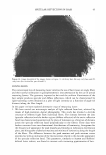
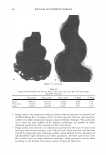
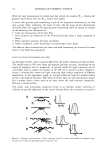
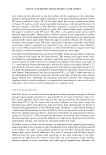
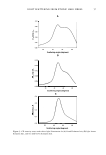
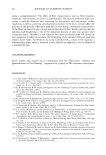
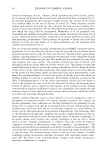
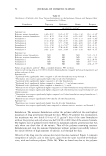
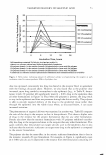
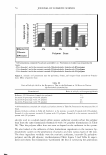
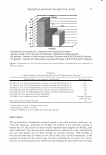
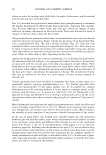
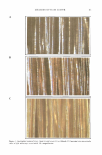
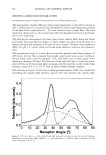
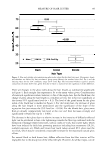
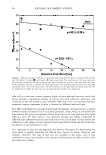
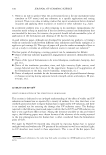
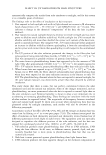
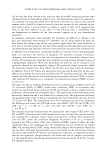
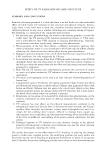
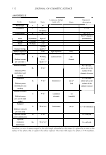
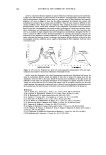
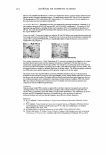
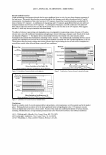
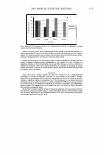
126 JOURNAL OF COSMETIC SCIENCE Microscopy - Natural scanning electron microscopy was carried out on a Hitachi S2460N Variable pressure Scanning Electron Microscope (NSEM). All confocal microscopy data was acquired on a Zeiss inverted 200M Axioskop equipped with a Zeiss 510 LSM NLO confocal microscope (Jena, Germany) using AIM software release v3.2. Results and Conclusions NSEM - The NSEM micro graphs of bleached hair tresses in Figure 2 show the surface texture of the hair fibers treated with shampoos containing polymers A, !2, , and!: to be visibly smoother than the control hair fibers in I- Samples treated with formulation l have a jagged, roughened cuticle structure. The surface of the hair samples treated with formulations containing polymers A, !2, , or!: have a smooth, coated appearance, the edges of the cuticle visibly less jagged. At higher magnification, the coating appears to be a textured deposit, with larger concentrations near the cuticle edges. The deposit visible on the control sample I is spread over the cuticle surface with less concentration at the cuticle edge, suggesting that these textured deposits represent the surfactant or polymer+surfactant deposits left on the hair. The s_urface of the hair sample treated with polymer g appears to be more heavily coated, with thread-like trails of deposit remaining on the hair. Note that this polymer has the highest cationic charge density of all the polymers in Table 1. Estimated coating thickness increases in the order polymer !2A !: and apparent ease of removal by a second shampoo treatment shows the opposite trend, ~AEQ. These results are consistent with charge density and polymer backbone type being the dominant factor in polymer deposition with molecular weight and charge density playing a role in buildup of this deposit from anionic shampoo. CLSM - CLSM was used to study bleached hair fibers from the same tresses examined with NSEM. As with NSEM, the reflection image in Figure 3 of hair fibers from the control sample, I, shows a roughened cuticle surface. The reflection images for all hair fibers in Figure 3 treated with a shampoo containing a cationic polymer show an improvement in the smoothness of the cuticle surface, reflecting the conditioning performance of these cationic polymers. The level of coating between samples can only be estimated from this technique as following the order: polymer QH QA~ . Ease of removal of the surface coating by a second shampoo treatment is shown by the reflectance images in Figure 4. CLSM Fluorescence Images - Bleached and virgin European medium brown hair tresses were treated with 0.2wt% aqueous solutions of the polymers in Table l. Tresses were then treated with 5-FAM, an anionic dye, intended to bind to cationic polymer deposits on the hair fibers. All tresses in Figure 5 show varying levels of fluorescence located mainly at the cuticle edges of the tresses, with the exception of thl! tress treated with polymer E. The fluorescence image for polymer g is a nonuniform deposit trailing down the hair fibers. A similar image was reported for polyquaternium-10 containing a covalently bound fluorescent chromophore [12]. The location of the fluorescence at the edges of the cuticle for polymers A-Q correlate with the NSEM results, showing a concentration of a deposit at the cuticle edges. The results for polymer g correlate with both the NSEM and CLSM images, showing a deposit along the hair fiber for polymer . In a second study with virgin European brown hair and shampoo formulation B, concentration of the fluorescence at the cuticle edges was again observed for polymers A,!!, Q, !:, and Q. These results support the interpretation that the deposits at the cuticle edges observed in NSEM and in CLS fluorescent microscopy are derived from cationic polymer and surfactant. References l. S. B. Ruetsch, Y. K. Karnath, H.-D. Weigmann, J. Cosmet. Sci., 54, 63-83, 2003 2. E. D. Goddard and W. C. Harris, J. Soc. Cosmet. Chem., 38, 233-246, 1987. 3. P. Hosse!, R. Dieing, R. Norenberg, A. Fau, R. Sander, International Journal of Cosmetic Science, 22, 1-10,2000 4. V. F. Monteiro, A.S. Pinheiro, E. R. Leite, J. A. M. Agnelli, M.A. Pereira-Da-Silva, E. Longo, J. Cosmet. Sci., 54, 271-281, 2003 5. J. S. Dalton, G. C. Allen, P. J. Heard, K. R. Hallam, N. J. Elton, M. J. Walker, G. Matz, J. Cosmet. Sci., 51, 275-287, 2000 6. C. Hadjur, G. Daty, G. Madry, P. Corcuff, Scanning, 24(2), 59-64, 2002 7. S. T. A. Regismond, Y.-M. Heng, E. D. Goddard, F. M. Winnick, Langmuir, 15, 3007-3010, 1999
Purchased for the exclusive use of nofirst nolast (unknown)
From: SCC Media Library & Resource Center (library.scconline.org)