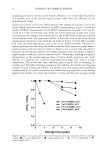
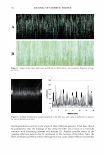
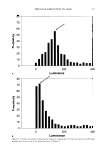
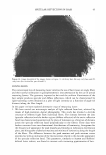
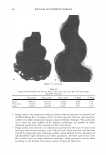
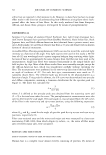
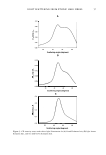
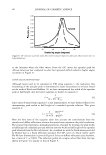
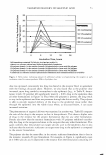
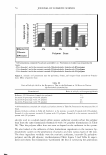
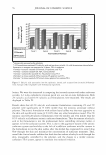
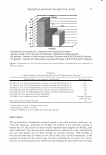
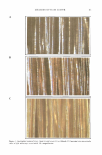
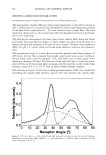
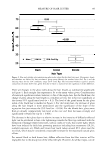
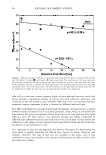
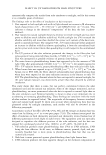
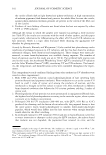
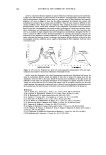
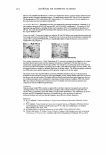
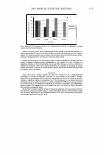
2003 ANNUAL SCIENTIFIC MEETING Luster can be also affected by hair style geometry. Thus, we have also investigated the luster of hair in its natural configuration i.e. in the form of free hanging tresses before and after treatments with styling products. The hair types examined consisted of Caucasian frizzy, Caucasian very curly, and Caucasian curly hair. Using the products mentioned above, the luster of curly hair, for example, can be increased by reducing the nwnber of frizzies and increasing the concave and convex specular reflection which is intrinsic to the tress due to the curliness of the hair. Figure l provides an example of luster analysis performed on very curly hair. Figure 1. Plot of luminance as function of distance for very curly hair, where the outlined area in each image was used as the sampling area. Figure 2, on the other hand, illustrates the color analysis of a light brown hair image obtained under controlled illumination and geometry for straight hair spread on a cylinder. Histograms (plots of pixel quantity as a function of color value, which scale from 0 to 255) for red, green, and blue tones as well as luminosity were generated and the positions of peak maxima were recorded. It is demonstrated that different types of styling products can produce small optical effects on the surface hair leading to differences in hair coloration. Figure 2. Image histograms for untreated light brown hair. References [ l] R. McMullen and J. Jachowicz, "Optical properties of hair: Effect of treatments on luster as quantified by image analysis," J. Cosme!. &i., 54, 335-351 (2003). [2] R. McMullen and J. Jachowicz, "Optical Properties of Hair - Detailed Examination of Specular Reflection Patterns in Various Hair Types", J. Cosmet. Sci., accepted. 129

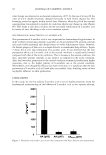
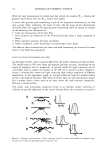
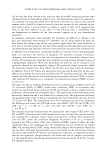
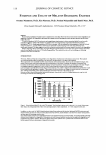
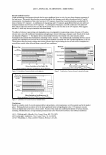
130 JOURNAL OF COSMETIC SCIENCE THE USE OF SILICONES AS A COLOR-LOCK Arn IN RINSE-OFF HAIR CONDITIONERS Sabrina Marchioretto* Dow Corning S.A., Senejfe, Belgium * This presentation is being made by Todd Ostergaard on behalf of Sabrina Marchioretto. Synopsis Based on a market study of existing hair care products and claims, a study was conducted to determine the efficacy of several relatively new silicone technologies in hair color preservation when delivered from rinse-off conditioner formulations. Testing methodology was developed which evaluated the effect of intense UV radiation exposure, shampoo washing and rinse-off product treatments along with their contributions to the removal of permanent hair colorants. Color evaluation was completed using a spectrophotometer-colorimeter which measures L *, a* and b* values. The washing process was found to be the most significant factor in the removal of hair color. While UV exposure had a significant impact only after 90 hours of intense irradiation. Results of the study concluded that the use of amino functional silicones along with other functional silicone materials provide enhanced color retention when delivered from a rinse-off conditioner formulation. It was also confirmed that silicone materials provide additional benefits beyond color retention including, shine, wet combing, reduced drying time, etc. Introduction There has been significant amount of work in the area of prevention of fading of natural and artificial hair dyes, as this is a stated market need from consumers. There are several published studies that address this subject (1-3 ). There have been several products introduced on the market that claim efficacy in color preservation. This study focused on the contribution of silicones, when incorporated into rinse-off conditioner formulations, and the effect they have in preventing color Joss of permanent colorants from hair fibers. In this study, a three-step approach was taken to determine the most appropriate methodology for evaluating the efficacy of silicones to prevent color loss from hair. The three phases consisted of I) a market study of formulated hair care products that claimed color protection, 2) color loss methodology development and, 3) finally an investigation of silicone efficacy in hair color protection. Market Study A market study was completed which looked at current market products, product form penetration, product claims, and formulation ingredients that could possibly promote hair color longevity. The results of this investigation showed that the use of silicones is very high in both rinse-off and leave on hair care products with many including two or more silicones in the formulation. Products claiming color protection, however, focused on other dominating benefits such as shine and softness more than the color protection claim, which Jed the researchers to conclude that, the benefit of color protection has not been completely satisfied. Method Development Sample Preparation Samples of partially bleached Caucasian hair, obtained from International Hair Importers were used for this work. Flat hair tresses of 15 cm in length and 4 ± 0. 5 g were prepared for this investigation. Each tress was dyed using a leading commercial permanent hair colorant to help ensure color reproducibility. The particular shade used was a red hair color. A commercial non-silicone containing shampoo (0.4 g/gram of hair) was used for washing the tresses each washing procedure. The rinse-off conditioner was a base formulation that included a UV filter. This formulation was also applied at a level of 0.4g / g of hair. Methods An initial study was completed to determine the most significant effect for color Joss from treated hair. Four different trials were conducted to determine the effect of I) shampoo washing alone, 2) Intense UV exposure, 3) Shampoo Washing+ UV exposure and, 4) Shampoo + Rinse-off Conditioner with UV filter included+ UV exposure. UV exposure was completed using a QUV Accelerated Weathering Tester at an exposure intensity of0.89 W/m2/nm. The color measurement was conducted using a Spectrophotometer Colorimeter BYK Gardner. When testing silicone efficacy, each hair tress received a similar procedure using the commercial shampoo and rinsing, application and rinsing of the rinse-off conditioner formulation, a drying procedure and seven hours of intense UV light exposure. Each tress had a control zone that was protected from UV light exposure.
Purchased for the exclusive use of nofirst nolast (unknown)
From: SCC Media Library & Resource Center (library.scconline.org)