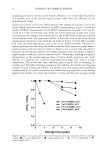
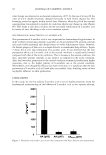
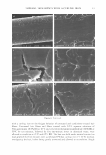
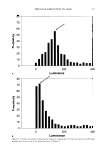
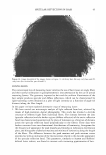
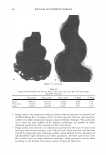
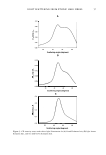
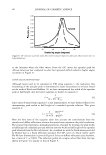
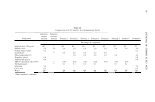
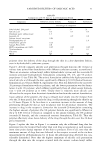
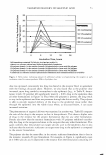
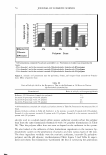
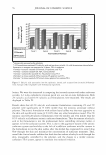
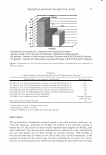
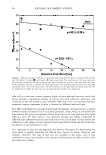
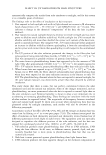
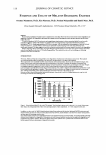
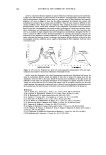
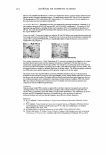
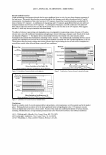
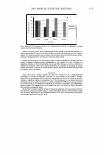
2003 ANNUAL SCIENTIFIC MEETING Results and Discussion Initial methodology development showed that the most significant factor in color loss was from shampoo treatments of the hair tresses. The greatest discoloration occurred during the first shampoo wash after coloration in both L * and b* measurements. Investigation of hair color loss due to UV exposure showed that visual discoloration occurred after 90 hours of intense UV exposure. A combination of shampooing and UV exposure again affected the hair color after one shampoo treatment and 56 hours of UV exposure. A combination of shampoo, rinse-off conditioner with added UV filter and UV exposure showed color loss after the first wash but no color loss due to the UV exposure. This suggests that the UV filter may have prevented the color from fading. The effect of silicone in preventing color degradation was investigated by incorporating various silicones at 2% active silicone into a rinse-off conditioner formulation and applying to tresses following a shampoo wash. Results of the study are depicted in Figures l-3. The figures show a relationship between a tress treated with a non-silicone control formulation and a similar base formulation containing various silicones. The mathematical relationship shown is used to quantify the contribution the silicone has in each measured attribute associated with hair colorant degradation (L * ,b* ,a*). These figures show the positive impact that various silicones have on preventing the Joss of hair color as compared to a non-silicone control when delivered from a rinse-off hair conditioner. Amino M lcroem ulaion Amino Functional Polymer Potyamide 10 2D 30 40 SIDoono Catrlb.Clonlcr Antl-;tU-lng -II'(%) 131 SIiicone Contribution on Color Depth-l * (0/ s,I,cone contribution L*(%) = {(L*,-L*0)*100/L*0},on1,o1· ((L.·L.)*100/L.}, """" Silicae cortnb.tio. tr(%)= ((trrtr .)"1cntr J,ar,.,.. {(q-t\,)"1mt.}-., Figure 1 - Contribution of various silicone on coloc darkness Poli,ether .amino Deriseti-.e Pol)!Tler .Amino Mcroernulsion 00 5.0 10.0 Silicone 0:Jnlrlbullon 011 Coler Malnlalnen:e-e• r.,,. 15.0 Silicone contribution a*(%)= {(a"re*.)*100/a*J,.......- {(a,-a,,)*100/aJ,mcono Fi gu re 3 - Contribution of various silicones to maintain redness Conclusions Figure 2 - Contribution of various silicones to prevent yellowing Based on a market study of several commercial hair care products, color maintenance is still an wimet need in the market place. Washing the hair was shown to be the most significant factor in degrading hair color. UV exposure was also shown to degrade hair color but to a lesser extent. Results of this study also confirmed the ability of various silicones, including Amodimethicone, to help maintain permanent hair color when delivered from a rinse-off hair conditioner. (1) J.L. Wolfram and L.Albrecth, J.Soc.Cosmet.Chem., 82, 179 (1987). (2) B. Locke and J. Jachowicz, J.Soc.Cosmet.Chem., 54, 212 (2003). (3) M.V. Bhambhan, A. Chan, and G.R. Hawkins, Revlon, 6,143,286.

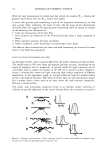
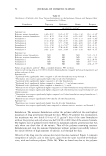
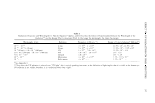
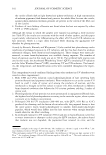
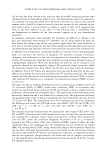
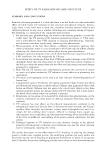
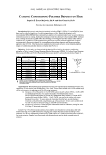
132 JOURNAL OF COSMETIC SCIENCE BASICS OF SKIN STRUCTURE R. Randall Wickett, Ph.D. University of Cincinnati College of Pharmacy, Cincinnati, Ohio Introduction to the skin The skin is the largest organ of the human body accounting for about 16% of total body weight. Its vital role Is to keep us in and the world out. The skin also has immune functions and helps to regulate body temperature. Understanding the skin especially the Sratum Corneum is important to the cosmetic scientists as cosmetic products are bound to come in contact with the skin. Layers of the skin The main structural components of the skin are the dennis, the epidennis. The dermis is divided into two layers, the papill.ary dermis and the reticular dermis. The dermis provides the bulk of the mechanical strength to the skin. The hypodermis which contains the subcutaneous fat is beneath the dermis. Growing hair follicles are rooted in the hypodermis. The epidermis is subdivided into five strata, basal, spinous, granular, lucid and corneum. The top layer, the Stratum Corneum (SC) is the primary barrier to transport of water and other molecules across the skin. This lecture will focus on the formation and structure of the Stratum Corneum. Nomenclature for I avers of the Eoidermis Eni:ilish Latin Alternative Basal cell laver Stratum Basa/e S. Germinativium MalphQhian layer Prickle Laver S. Spinosum Maloiahian laver Granular Laver S. Granulosum Maloiohian laver Clear Laver S. Lucidum Horny Layer S. Corneum The major cell type of the epidermis is the keratinocyte which makes keratin proteins. Keratins are fibrous proteins of the epidermis that are the major structural proteins of SC hair and nail. Keratins are in class of proteins called intermediate filaments which from part of the cytoskeleton of all nucleated cells. Formation of the SC barrier The epidermis continually renews. Slow cycling stem cells at the basal layer divide and one daughter cell remains as a slow cycling stem cell and the other becomes a transient amplifying cell. T.A. cells continue to divide until they become post mitotic and terminally differentiate. Specific keratins (k1 and k10) are expressed as markers of the transition from proliferative TA cells to terminally differentiated keratinocytes that will be committed to forming SC. At the Stratum Granu/osum(SG) keratohyalin granules full of protein and lamellar bodies appear in the cells. Then the cells are transformed to squames. The nucleus is digested, the cytoplasm disappears, lipids are dumped into the intercellular space, the keratin filaments aggregate to microfibrils and the cell membranes is replaced by a cell envelope. As a result of transformations at the SG the SC barrier is formed. 15 - 20 layers of cells Flattened cells (corneocytes or squames) with resistant cell envelope and attached lipids Content is keratin microfibrils Squames are joined by desmosomes. lntercellular lipids Multiple layers between cells, polar but relatively hydrophobic Ceramides, cholesterol, cholesterol esters and long chain fatty acids
Purchased for the exclusive use of nofirst nolast (unknown)
From: SCC Media Library & Resource Center (library.scconline.org)