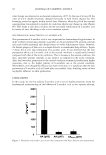
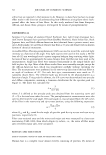
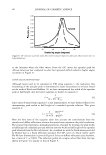
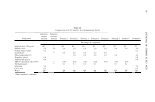
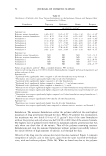
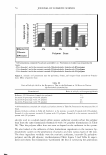
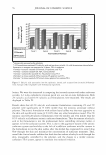
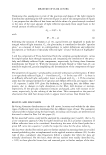
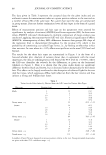
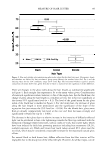
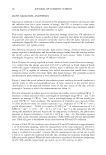
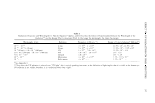
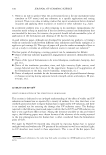
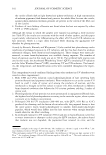
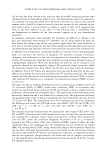
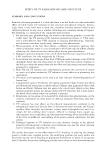
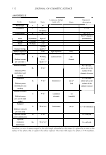
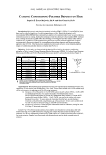
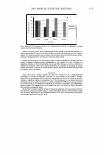
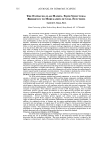
24 JOURNAL OF COSMETIC SCIENCE Table I Values for the Mechanical Properties of Thermally Treated Hair Initial Extension to Load at Work to Total Post-yield modulus break break 20% work modulus (GN/m2) (%) (GN/m2) Olm2) 01m2) (GN/m2) Untreated hair 3.09 50.00 0.191 607163 1979180 0.301 Curled hair 3.07 47.34 0.203 621560 1931227 0.386 hair fibers were mounted for the fatigue experiment in TRI's hair fatigue tester, in which the cycling speed was set at the rate of 2.3 Hz with a load of 40 g. The fatigue failure data, treated according to the Weibull statistics (1), yield a hazard parameter known as characteristic life. Mathematically it represents the number of cycles necessary to break -63% of the test specimens. Damage results in a reduction of characteristic life. Figure 7 compares the characteristic life (0) of dry untreated and conditioner-treated hair fibers before and after curling for five minutes with a curling iron. Surprisingly, an effect of thermal treatment could be established. Hair fibers clearly showed a higher charac teristic life (0) after thermal treatment with the curling iron, indicating improved fatigue resistance. It is possible that this is due to some crosslinking in the interior of the hair fiber as a result of dehydration at high temperature. The presence of the conditioning compounds appears to enhance this thermally induced crosslinking in the form of salt linkages and hydrophobic bonding, leading to a significant increase in fatigue resistance (characteristic life {0]). The improvements in fatigue properties of an ionomeric polymer by the introduction of ,-. 30000 e JI Before Curling ■ After Curling � 25000 :J fJ 20000 ·c: 15000 fJ 10000 5000 0 Untreated 1xPQ-10 10xPQ-10 1xCETAB 10xCETAB Hair Treatment Figure 7. Comparing characteristic life (0) of dry untreated and conditioner-treated hair fibers before and after prolonged curling for five minutes under normal tension with a curling iron.

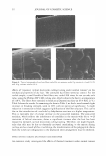
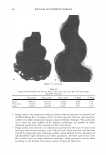
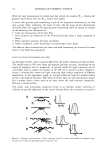
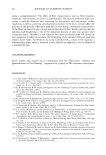
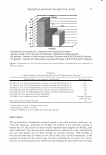
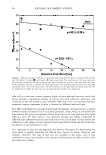
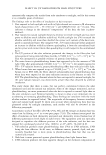
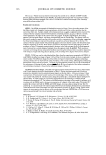
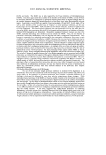
THERMAL TREATMENTS WITH A CURLING IRON 25 crosslinks in the form of salt linkages is quite well known (2). Even though we have not examined the heat-curled/conditioner-treated hair in the SEM, relevant work of others (3) suggests that the cuticle-cracking tendency is significantly reduced by conditioning agents. Recently published work (4) on the effect of conditioning compounds on the scale-lifting behavior of the cuticle supports this concept further. MECHANISMS OF HYGROTHERMAL DAMAGE The stresses acting on a hair fiber draped on a heated mandrel like the curling iron are shown in Figure 8, where the hair fiber is shown schematically at high magnification. Under dry conditions, the outside of the fiber is under tension and the inside is under compression. Dehydration due to heat makes the f/m contact area rigid and brittle so that an attempt at straightening it can generate radial cracks in the fiber. The cuticle cells are curved. The force of compression tries to flatten them, and brittleness leads to the formation of axial cracks. This is shown in Figure 8, displaying a cross section through the center line (black dashed line). Wetting of the fiber plasticizes the keratin, and the fiber deforms much more easily and to a greater extent than in the dry condition. Endocuticular material is softened to an Tension Compression Neutral Plane Fi gur e 8. Stresses acting on a hair fiber draped on a heated mandrel like the curling iron.
Purchased for the exclusive use of nofirst nolast (unknown)
From: SCC Media Library & Resource Center (library.scconline.org)