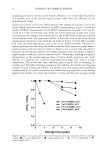
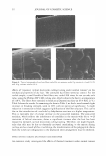
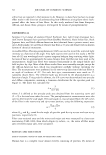
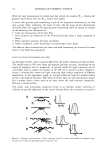
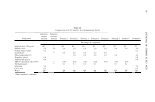
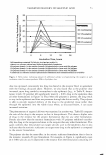
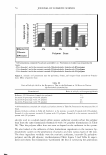
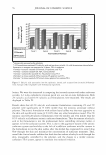
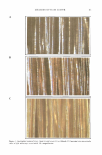
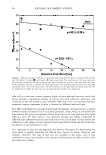
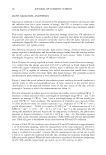
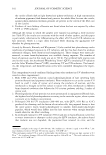
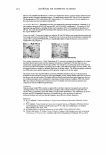
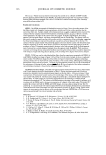
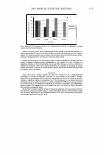
6 JOURNAL OF COSMETIC SCIENCE control the characteristics of the enediol group, especially the hydroxy group attached to C3 in the 1-ascorbic acid molecule, we introduce the concept of ionic shielding, which is applied generally to the swelling behavior of hydrogels in an ionic medium condition (23-25). In Scheme 2, the ionic shielding process of 1-ascorbic acid is represented schematically. When the ionic strength of the solution is increased, the counterions have a tendency coward binding co the species charged oppositely, which is responsible for the ion-ion interaction. The counterions include charged ionic species such as, Na + , K+, Ca2 + , Mg2+ , Cu2+, and Al3 + . (In chis study, we selected Mg2+ as a counterion.) The ionic strength in the system can be controlled by varying the ionic species and their concen tration. It can then be said chat the oxidation of 1-ascorbic acid co dehydro-1-ascorbic acid is possibly hindered. In this study, the effectiveness of ionic shielding on the stability of 1-ascorbic acid was examined by considering the medium's pH. Figure 1 shows the long-term stability of simple L-ascorbic acid aqueous solutions with the ionic strength at a high temperature, Figure 2. OM photographs for w/o/w double emulsions: (a) w/o/w double emulsions not contammg L-ascorbic acid (b) w/o/w double emulsions containing 3 wt% L-ascorbic acid in the internal aqueous phase.

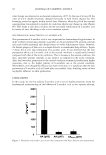
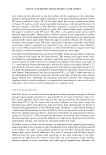
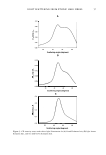
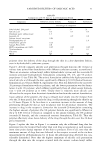
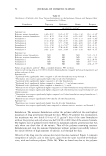
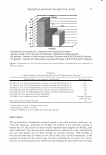
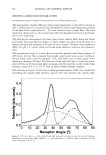
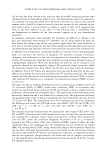
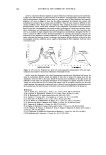
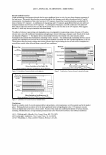
STABILIZATION OF 1-ASCORBIC ACID 7 40°C. In Figure 1, it is verified that the increase in the ionic strength contributed significantly to the improvement of 1-ascorbic acid's stability in the aqueous solution. When the pH of the solution was adjusted to 7, 1-ascorbic acid could retain its initial molecular characteristics for a long time, compared with the case of a low pH. It is quite different from the conventional results (9,26). In most instances, 1-ascorbic acid is more stable at a low pH. Therefore, it is recommended that for the stabilization of 1-ascorbic acid, the system should have a low pH. However, judging from our concept and experimental result, a large amount of hydrogen ion generated at low pH simply shields the ionized 1-ascorbic acid (L-ascorbate ion). In our system, 1-ascorbic acid showed a better stability at pH 7. Moreover, when the ionic strength was strengthened suffi ciently, only a little deformation of L-ascorbic acid was observed. It appears that the ionic shielding generated by the ion-ion interaction was fortified because the dissocia tion of the sodium counterion takes place readily, compared with that of the hydrogen counterion. STABILIZATION OF L-ASCORBIC ACID IN w/o/w DOUBLE EMULSIONS Characterization of w/o!w dottble emttlsions. In this study, a system for the stabilization of 1-ascorbic acid was constructed by considering the ionic shielding effect in w/o/w double emulsions. Figure 2 shows an OM image of w/o/w double emulsions containing 3 wt% 1-ascorbic acid in the internal aqueous phase. In this OM image, it is reasonable to say that a stable w/o/w double emulsion was formed in the size range of 10-20 µm, with the - ::, ( -E Cl) (.J C ca .c 0 en (c) .c ca Cl) (b) ca Cl) (a) 4 5 6 7 8 9 10 RT Figure 3. HPLC measurements for the 1-ascorbic acid-loading w/o/w double emulsions for different systems: (a) right after the preparation of 1-ascorbic acid-loading double emulsion (b) 1-ascorbic acid loading double emulsion (pH 7) after 10-week storage at 40°C (c) 1-ascorbic acid-loading double emulsion (pH 2) after 10-week storage at 40°C. In this case, the concentration of 1-ascorbic acid in the w/o/w double emulsions was fixed at 3 wt%.
Purchased for the exclusive use of nofirst nolast (unknown)
From: SCC Media Library & Resource Center (library.scconline.org)