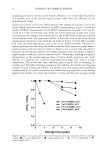
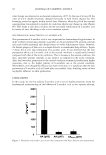
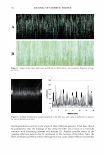
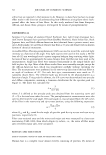
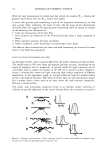
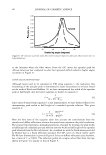
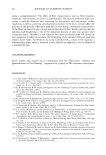
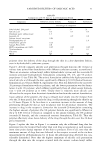
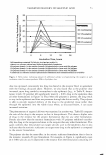
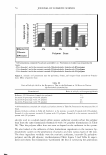
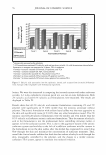
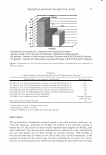
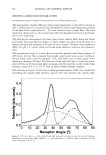
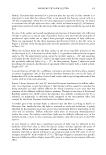
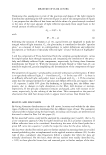
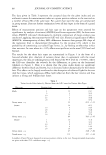
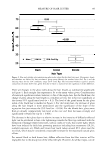
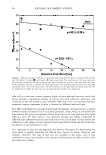
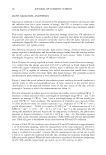
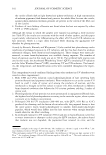
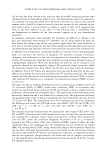
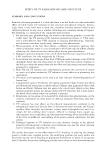
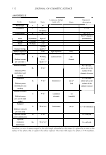
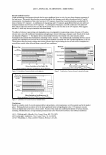
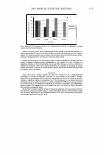
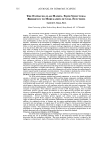
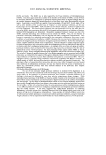
70 60 ,c 50 a, MEASURE OF HAIR LUSTER ..................... ,____1 -----.---f ____, ....... -·,____I --� ____,1 ··. 0.001 : 40 ........................... _________________ _ 0 CJ 30 20 ■ Mean D Std.Err. I 95% Conf.Rg. black brown Hair Type blonde 89 Figure 3. Box-and-whisker plot summarizing gloss index values for the three hair types. Data points, boxes, and whiskers are defined by their arithmetic group mean (Mean), the standard error (Std. Err.), and the limiting value for the 95% confidence range (95% Conf. Rg). The horizontal whiskers signify a specific comparison of means (LSD test), given with the a-value to characterize the significance of the difference. There are changes in the gloss index along the hair length, as summarized graphically in Figure 4. Each straight line represents a fit to the mean values given. Considerations of statistical significance relate, however, to fits of the single data. For the black hair, the change of gloss along the hair length is a tendency at best, but in fact not significant at the chosen 95% significance level (a = 0.2). The level of the grand mean for the gloss index of the black hair is marked in Figure 4. For the brown hair, the decrease of gloss along the hair length is more pronounced and the significance of the slope of the regression line just misses the 95% level (a = 0.054). For the blonde hair, gloss starts from an already comparatively low level at the root and then decreases strongly and significantly towards the tip (a 0.001). The decrease in hair gloss due to a relative increase in the intensity of diffusely reflected light can be attributed to hair color lightening towards the fiber tip combined with the formation of damage-related structures, such as cracks or voids, that scatter light, which have been induced by daily hair grooming practices including heat treatments (20,23), sunlight exposure, etc. Black and brown hair reach values around 65% gloss near the root ends, which may be considered a reasonable estimate for the maximum natural gloss of hair. For natural black or dark brown hair, diffuse reflection from the fiber interior will be negligible due to the absorption of the refracted light. However, for all hair types, cuticle

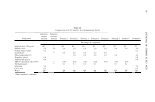
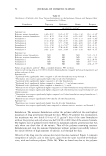
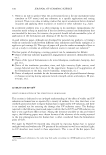
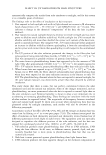
90 JOURNAL OF COSMETIC SCIENCE 70 ■ 0 black 60 ■ 0 ■ ';;?. 50 y= 62.3 -0.28 X .5 40 C • 20 y= 35.8 -1.07 X • 10L---____..__________.______..._____.__�_.______.______, 0 5 10 15 20 25 30 35 Distance from Root [cm] Figure 4. Means for the gloss index GL at various positions along the hair, given as distance from the hair root for black (0), brown (■), and blonde ( ♦) hair, respectively. The solid lines are the linear regression lines through the data for brown and blonde hair. Filled symbols are used for those cases where the slope of the regression line has a relevant statistical significance. The equations that are given on the graph specifically relate to the individual results. The horizontal line on the right marks the group mean (60.2%) for black hair (see Table I), where the decrease along the hair length is not significant. cells will as a rule not contain pigment. Light is hence refracted into the cuticle and passes through a substantial number of cuticle cells with reflection, refraction, and scattering at the cell interfaces until ultimate reflection at the cuticle/cortex interface generates a major component of what is observed as diffusely reflected light. This effect will further be intensified if, through hair damage, delamination has occurred between cuticle cell layers (19,23) or if, more generally, cracks, voids, or inclusions have been formed. The gloss measurement of hair, which due to its color does not allow light reflection from the fiber interior, thus provides through the diffuse component of reflected light information on the structural status of its cuticle layer. In this context the differences in the change of gloss along the hair length for the black and the brown hair (see Figure 4) are interesting to note. It is important to note that the approach, described in this paper, for determining the gloss index is equally applicable for African hair, despite its strong ellipticity and curliness. However, this type of hair was not included in the study, since it was considered as being less suitable in the context of determining the effects of hair color and along-hair changes.
Purchased for the exclusive use of nofirst nolast (unknown)
From: SCC Media Library & Resource Center (library.scconline.org)