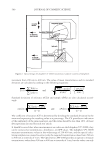
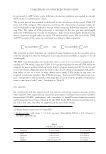
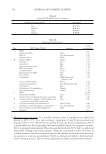
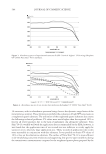
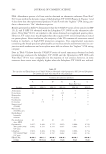
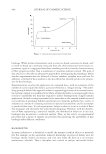
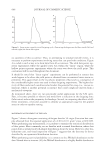
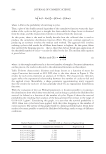
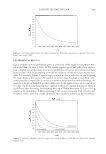
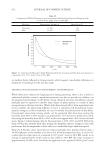
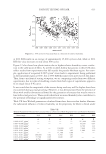
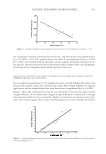
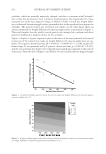
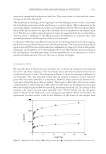
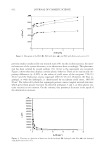
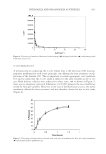
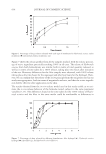
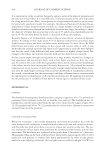
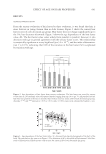
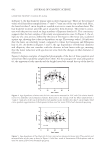
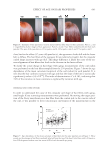
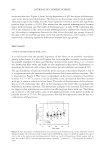
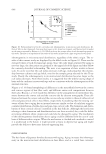
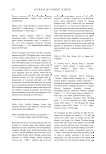
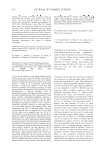
JOURNAL OF COSMETIC SCIENCE 622 eyelashes, which are naturally negatively charged, and this is consistent with Coulomb’s law in that the electrostatic force is directly proportional to the magnitude (10). Since uncoated iron oxide has a negative charge, as shown in Table I, much less weight differ- ence is observed by mascara application, presumably due to the repulsive force against the eyelashes. The particle cluster size of treated iron oxides, on the other hand, shows an inverse proportion to weight difference by mascara application, as presented in Figure 4. This result implies that the smaller coated particles are arranged in a uniform and dense pattern, building up a gradual volume on the eyelashes. Figure 5 displays a logistic regression plot of the effect of the zeta potential and particle cluster size of the treated iron oxides on weight difference by mascara application on eye- lashes. The equation determined was W = 0.0443Z – 0.000932P + 11.2 (W: weight dif- ference (mg) Z: zeta potential (mV) P: particle cluster size (nm) p = 0.000 R2 = 0.913), and the zeta potential was shown to be relatively more signifi cant compared to the particle cluster size. From the data of Figure 5 and Table I, we can conclude that the biggest weight Figure 4. Correlation between particle cluster size of iron oxide and weight difference by mascara applica- tion on eyelashes (n = 27). Figure 5. A logistic fi tting graph of the effect of zeta potential and particle cluster size of treated iron oxides on weight difference by mascara application on eyelashes (n = 27).

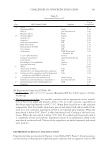
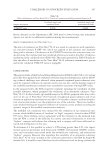
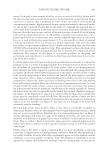
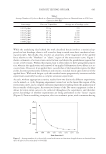
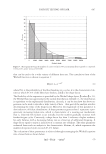
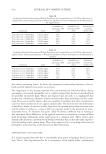
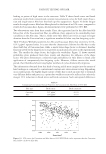
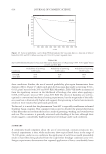
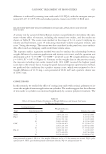
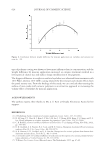
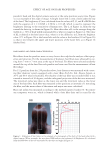
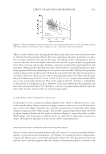
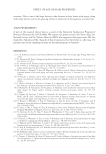
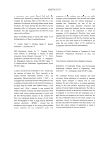
CATIONIC TREATMENT OF IRON OXIDES 623 difference is achieved by treating iron oxide with 10% PQ-6, with the strongest zeta po- tential (63.437 ± 1.217 mV) and smallest particle cluster size (1099.3 ± 84.6 nm). RELATIONSHIP BETWEEN WEIGHT DIFFERENCE BY MASCARA APPLICATION AND SENSORY TEST SCORES A sensory test by a panel of thirty Korean women was performed to determine the opti- mum volume effect of mascara, including the treated iron oxides, and the results are shown in Table II. The scores were marked in the range of 0–14, score 0 implying no volume and bad texture, score 14 indicating maximum volume and great texture, and score 7 being the average. The texture was also considered in the panel test, since undesir- able effects such as clumping could result from volume alone. The response surface regression method was used to analyze the relationship between weight difference by mascara application and sensory test scores, and the equation was determined as S = −0.3353W2 + 8.396W − 40.48 (S: score W: weight difference (mg) p = 0.001 R2 = 0.873) (Figure 6). Contrary to the weight data in the previous result, the mascara including iron oxide treated with 10% GHC received the highest panel score due to the texture factor. Using the panel data and response optimization method, we predicted the conditions for a perfect sensory score, which was estimated to be a weight difference of 12.34 mg, a zeta potential of 48.01 mV, and a particle cluster size of 1186.3 nm. CONCLUSIONS In this research, we studied the effect of coating iron oxide with cationic polymers to in- crease the weight of mascara application on eyelashes. The results suggest that the adhesion of iron oxide to eyelashes was increased signifi cantly by cationic polymer treatment. The Table II Effect of Cationic Polymer Treatment on Weight Difference and Sensory Test Scores by Mascara Application Coating material Weight difference (mg) Sensory test scores Type Concentration (%) None 0 7.673 ± 0.111 5.667 ± 0.884 PQ-6 3 8.973 ± 0.068 6.333 ± 0.758 5 15.123 ± 0.136 9.333 ± 0.802 10 15.843 ± 0.060 8.333 ± 0.480 GHC 3 11.350 ± 0.461 12.333 ± 0.711 5 11.913 ± 0.178 12.667 ± 0.661 10 12.517 ± 0.333 13.333 ± 0.607 PQ-10 3 9.090 ± 0.187 7.333 ± 0.547 5 10.573 ± 0.095 9.667 ± 0.844 10 11.230 ± 0.099 12.000 ± 0.743 Data presented as mean ± SD (n = 3 for weight difference and n = 30 for sensory test scores). PQ-6: poly- quaternium-6. GHC: guar hydroxypropyl trimonium chloride. PQ-10: polyquaterium-10.
Purchased for the exclusive use of nofirst nolast (unknown)
From: SCC Media Library & Resource Center (library.scconline.org)