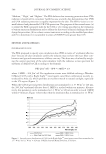
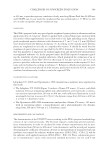
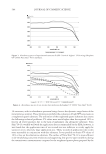
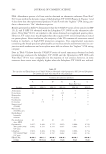
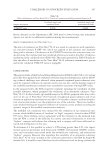
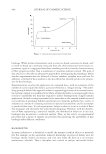
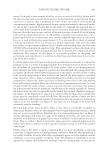
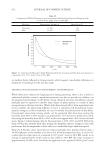
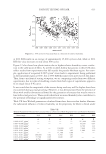
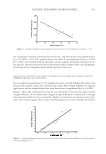
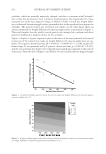
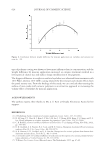
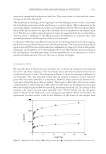
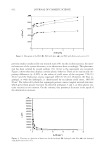
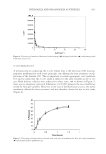
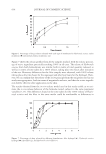
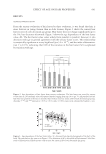
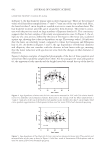
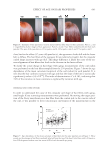
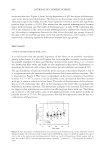
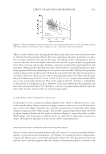
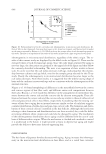
JOURNAL OF COSMETIC SCIENCE 644 transverse direction. Figure 8 shows the age dependence of η2, the degree of inhomoge- neity in microstructural distribution. These points are the average value for each panelist. Data points again vary widely, but the linear regression line has a statistically signifi cant positive slope (p-value = 0.030). This means that the internal inhomogeneity becomes larger with increasing age. The index of determination r2 is only 0.058, indicating that 6% of the variation in the cross-sectional inhomogeneity is explained by variation with age. According to comparisons between the data of two decennial age groups, however, the data of the 10s and 60s and those of the 20s and 60s showed p = 0.021 and p = 0.011, respectively, indicating signifi cant differences between these age groups. DISCUSSION CAUSE OF LUSTER DECREASE WITH AGING It is well known that the parallel alignment of hair fi bers of an assembly contributes greatly to hair luster. It is also well known that increasing fi ber curvature interferes with the parallel alignment of hairs and therefore decreases hair luster. Keis et al. (15) have also shown that fi ber twists and kinks are also important to hair luster. Furthermore, to determine the luster of curly or frizzy hair tresses special techniques are required (16). The age dependence of hair luster and the mean curvature of hair fi bers (Figures 3 and 7) is in agreement with the known relationship between hair luster and hair curvature. This is illustrated in Figure 9. Hair luster is dependent on the mean curvature of hair fi bers (p-value = 6.7 × 10⁻¹¹), and so it can be said that as the curvature of the fi ber increases with age, it causes a reduction in hair luster. The index of determination of this relation- ship is 0.176, indicating that 18 % of the variation in the luster (ΔL) is explained by variation in the mean curvature. The data points in Figure 9 are scattered. This data scat- ter suggests that other factors are involved in affecting hair luster with age. The lifting up of cuticles at the hair surface, gray or less-pigmented hairs, and a porous medulla are possible reasons (1,17–19). For aged persons, the dull hair appearance may be due to a combination of these factors. Figure 8. Age dependence of inhomogeneity in microstructural distribution,η2, for 82 randomly selected Japanese females. η2 is the ratio of the averaged value of FWHM that relates to the IF tilt angle in the convex side to that in the concave side (see Experimental). Solid line: result of linearization. Filled squares with an error bar: mean ± SD of each decennial age group. Asterisks * represent p 0.05 obtained by Student’s t-test.

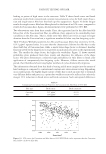
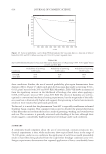
EFFECT OF AGE ON HAIR PROPERTIES 645 There is some evidence that non-pigmented hairs (gray hairs) are coarser and more wavy (1,20) than heavily pigmented hairs. The ratio of panelists who have gray hairs, as a mat- ter of course, increases with age in this study. According to this consideration, the in- crease in the hair curvature might come from the increase in gray in heavily pigmented hairs. The curvature values were, therefore, separately evaluated for pigmented hair and gray hairs. Many panelists had had their hair colored, but we could distinguish gray hairs from pigmented hairs by examining the root part of the hair fi ber. Thirty-seven panelists had gray hairs in the ten fi bers selected from the top of their head for the measurement of curvature. The mean values of curvature for the pigmented hairs (252 fi bers) and the gray hairs (107 fi bers) were 0.39 ± 0.14 cm−1 and 0.33 ± 0.15 cm−1, respectively, and the differ- ence is not statistically signifi cant. This result suggests that the curliness is independent of the existence of pigments in hair. However, it has been shown that hair pigment and hair color increase hair luster (21) therefore, a decrease in pigmentation must account for part of the decrease in luster that we observed upon aging. CONSIDERATION ABOUT ORIGINALLY CURLY HAIR In this paper we have examined ordinary Japanese hair, which is characterized by a rela- tively straight shape. Shape variation on aging, however, seems to occur in the hairs hav- ing a more curly shape originally. It is a future research issue to determine fi ber shape change on aging in other ethnic groups. The widely ranging longitudinal shape observed in aging Japanese females in this study, as shown in Figure 6, varies from fi ber to fi ber. With aging, even Caucasian or African hairs are expected to show more variation in shape, although this hypothesis should await further experimentation. INTERNAL STRUCTURE IN IRREGULARLY CURLED HAIR BY AGING Figure 10 shows the relationship between the curl radius (= 1/curvature) and the inhomo- geneity in microstructural distribution, η2. Figure 10 includes the data of three ethnic origins and Merino wool, as has been presented earlier (10). All data points follow one smooth curve, and this suggests that the curliness of human hair fi bers is related to the Figure 9. The relationship between the hair luster value and the mean curvature. The measured panelists and the hair fi bers are the same as those in Figures 3 and 7. Solid line: result of linearization.
Purchased for the exclusive use of nofirst nolast (unknown)
From: SCC Media Library & Resource Center (library.scconline.org)