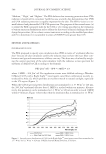
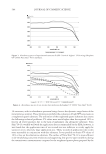
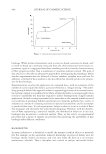
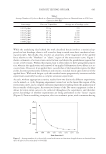
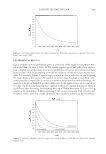
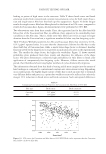
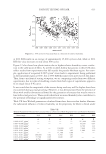
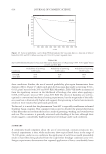
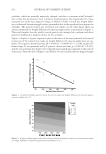
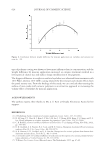
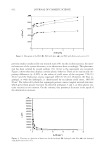
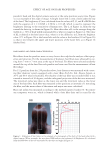
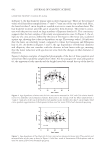
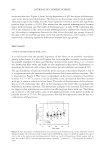
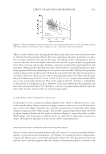
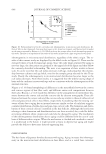
JOURNAL OF COSMETIC SCIENCE 646 inhomogeneity in microstructural distribution, regardless of the ethnic origin. The re- sults of this current study are displayed by the fi lled circles in Figure 10. These are the averaged values of each decennial age group. Since the curly shape generated by aging is not very large, the data points are grouped at the upper left of the fi gure and they follow the currently described relationship. The inset is an expansion of these results in linear scale. It can be seen that the curl radius decreases with age, indicating that the relation- ship between curliness and age holds, even for the sample group selected for this X-ray study. Clearly the inhomogeneity in microstructural distribution becomes larger as the curl radius decreases. From these results, it is suggested that the widely varying shape of hairs and the curliness increase with age and are consistent with the inhomogeneity of the internal structure. Nagase et al. (9) found morphological differences in the macrofi brils between the convex and concave regions of hair fi ber curls, and different amino acid compositions between them also. Bryson et al. (22) found this difference in the arrangement of intermediate fi la- ments between the convex side and the concave side by electron tomography. These dif- ferences between the convex side and the concave side are similar to those of orthocortical cells and paracortical cells in wool fi bers, respectively. Considering that the varying cur- vature of hair due to aging has an internal structure similar to that of curly hair suggests a similar distribution of ortho-type and para-type cortical cells. The formation and distri- bution of these cortical cells are controlled in the hair follicles. Although the key factors relating to their formation and distribution have not been revealed, they could be differ- ent among different ethnic origins and could also be changed by aging. The mechanism of the inhomogeneous distribution due to aging could be different from the case of curly hairs of different ethnic origins. When the mechanism is clarifi ed and a method to control it is understood in the future, it might provide a means to depress hair aging and might provide the ability to have more lustrous-appearing hair. CONCLUSIONS The hair luster of Japanese females decreases with aging. Aging increases the inhomoge- neity in the microstructural distribution in hair fi bers, and as a result hair curvature Figure 10. Relationship between the curl radius and inhomogeneity in microstructural distribution, η2. Data of African hair (diamond), Caucasian hair (open circle), Asian hair (square), and Merino wool (triangle) are the same as reported by Kajiura et al. (10). Filled circles are the average values of each decennial age group in this study. The inset is an expansion of the results of this study in linear scale. Ages are given for each point.

EFFECT OF AGE ON HAIR PROPERTIES 647 increases. This is one of the large factors in the decrease in hair luster with aging, along with other factors such as the graying of hair or reduction of the pigment in some hairs. ACKNOWLEDGMENTS A part of the research shown here is a result of the Industrial Application Proposal of SPring-8 (Proposal No.2007A1886). We express our appreciation to Dr. Naoto Yagi, Dr. Katsuaki Inoue, and Dr. Noboru Ohta of JASRI, who supported the experiment. We also thank Ms. Fukuda and Mr. Taguchi of Kao Corporation for their help in collecting 132 panelists and in the sampling of hairs for the measurement of diameter. REFERENCES (1) C. R. Robbins, Chemical and Physical Behavior of Human Hair, 4th ed (Springer-Verlag, New York, 2002). (2) N. Naruse and T. Fujita, Change in the physical properties of human hair with age, J. Am. Geriatr. Soc., 19, 308–314 (1971). (3) H. Ootsuka and T. Nemoto, Study on Japanese hair, Koshokaishi, 12, 192–197 (1988). (4) M. P. Birch, J. F. Messenger, and A. G. Messenger, Hair density, hair diameter and the prevalence of female pattern hair loss, Br. J. Dermatol., 144, 297–304 (2001). (5) M. Tajima, C. Hamada, T. Arai, M. Miyazawa, R. Shibata, and A. Ishino, Characteristic feature of Japanese women’s hair with aging and with progressing hair loss, J. Dermatol. Sci., 45, 93–103 (2007). (6) T. Brosche, S. Dressler, and D. Platt, Age-associated changes in integral cholesterol and cholesterol sulfate concentrations in human scalp hair and fi nger nail clippings, Aging Clin. Exp. Res., 13, 131–138 (2001). (7) J. Wills, S. Dolphin, L. Albiston, P. Parmar, G. E. Westgate, and G. J. Harrap, Free internal lipids in hair from pre- and post-menopausal woman, IFSCC Magazine, 7, 293–297 (2004). (8) Y. Masukawa, H. Tanamachi, H. Tsujimura, A. Mamada, and G. Imokawa, Characterization of hair lipid images by Argon sputter etching–scanning electron microscopy, Lipids, 41, 197–205 (2006). (9) S. Nagase, M. Tsuchiya, T. Matsui, S. Shibuichi, H. Tsujimura, Y. Masukawa, N. Satoh, T. Itou, K. Koike, and K. Tsujii, Characterization of curved hair of Japanese women with reference to internal structures and amino acid composition, J. Cosmet. Sci., 59, 317–332 (2008). (10) Y. Kajiura, S. Watanabe, T. Itou, K. Nakamura, A. Iida, K. Inoue, N. Yagi, Y. Shinohara, and Y. Amemiya, Structural analysis of human hair single fi bers by scanning microbeam SAXS, J. Struct. Biol., 155, 438–444 (2006). (11) K. Inoue, T. Oka, T. Suzuki, N. Yagi, K. Takeshita, S. Goto, and T. Ishikawa, Present status of high fl ux beamline (BL40XU) at SPring-8, Nucl. Instr. Meth. Phys. Res. A, 467, 674–677 (2001). (12) Y. Amemiya, K. Ito, N. Yagi, Y. Asano, K. Wakabayashi, T. Ueki, and T. Endo, Large-aperture TV detector with a beryllium-windowed image intensifi er for x-ray diffraction, Rev. Sci. Instrum., 66, 2290– 2294 (1995). (13) Y. Kajiura, S. Watanabe, T. Itou, A. Iida, Y. Shinohara, and Y. Amemiya, Structural analysis of single wool fi bre by scanning microbeam SAXS, J. Appl. Cryst., 38, 420–425 (2005). (14) A. Mamada and K. Nakamura, A study of the volume and bounce decrease in hair with aging using bending elasticity measurements, J. Cosmet. Sci., 58, 485–494 (2007). (15) K. Keis, R. Ramaprasad, and Y. K. Kamath, Studies of light scattering from ethnic hair fi bers, J. Cosmet. Sci., 55, 49–63 (2004). (16) R. McMullen and J. Jachowicz, Optical properties of hair—Detailed examination of specular refl ection pattern in various hair types, J. Cosmet. Sci., 55, 29–47 (2004). (17) S. Nagase, S. Shibuichi, K. Ando, E. Kariya, and N. Satoh, Infl uence of internal structures of hair fi ber on hair appearance. I. Light scattering from the porous structure of the medulla of human hair, J. Cosmet. Sci., 53, 89–100 (2002).
Purchased for the exclusive use of nofirst nolast (unknown)
From: SCC Media Library & Resource Center (library.scconline.org)