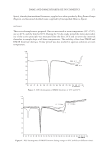
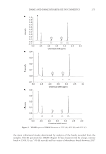
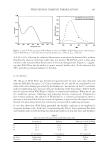
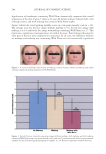
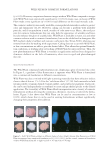
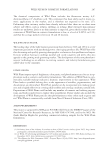
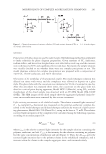
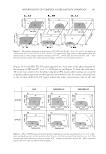
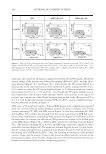
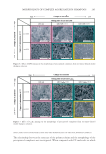
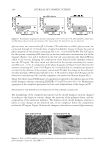
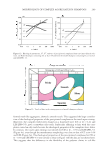
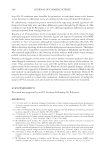
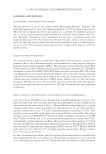
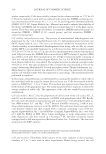
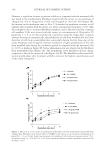
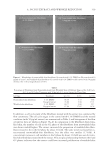
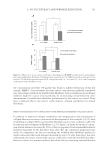
JOURNAL OF COSMETIC SCIENCE 296 glucose units are connected by β-1,4 bonds, CD molecules in which glucose units are connected through α-1,6 bonds have a higher bendability. Figure 8 shows the partial phase diagrams of the systems containing CD at α = 0.38 and LES/LPB. The CP region for the system containing LES alone lay on the low surfactant concentration side of the diagram (Figure 11a), and it widened on the low salt concentration side when LPB was added to the system, bringing the composition of the diluted model shampoo solution into the CP region. The same trend was observed for the system containing less cation- ized CD at α = 0.30. A comparison of the phase diagrams in Figure 8 with those for the systems containing CC at α=0.38 (Figure 4a–c) revealed that no complex precipitation occurred in the dilution of the systems containing CD when the charge on the surfactant micelles was high. LPB mixing with CD at α = 0.38 tended to widen the CP region on the lower salt concentration side, and the complexes coacervated in dilution (Figure 8b,c). Figure 9a,b shows typical SEM images of complexes precipitated in the dilution process of the model shampoo solutions containing LES/LPB=3/1 and CD at α=0.38, 0.30. Membranous aggregates of the complexes precipitated in both cases independently of the charge on CD. MECHANISM OF THE MORPHOLOGY FORMATION OF THE COMPLEX AGGREGATES The morphology of the complexes precipitated in the model shampoo solution changed according to the degree of cationic charge, the structure of the polymer chains, and the composition of the surfactant mixtures. The dilution of the model shampoo solution is likely to cause changes in the dissolved state of the complexes before the composition reaches the CP region. Figure 10 shows the changes in the relative scattered light intensity, Figure 8. Partial phase diagrams for systems containing 0.1wt% CD at α=0.38, LES and LPB as surfactants, and Na2SO4 as salt at varied concentrations. The region above the dotted line was not observed. Figure 9. Effect of CD bendability on the morphology of the precipitated complex from ten-times-diluted model shampoo. Surfactant: LES/LPB=3/1.

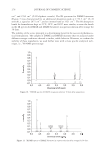
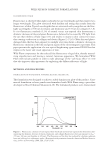
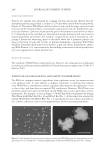
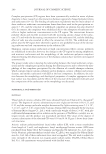
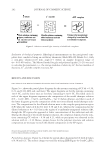
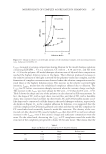
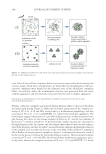
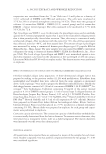
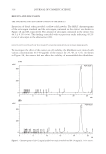
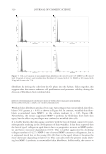
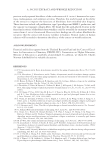
MORPHOLOGY OF COMPLEX AGGREGATES IN SHAMPOOS 297 Icomplex, measured at varying compositions during dilution for the model shampoo solutions containing LES/LPB = 3/1 as a surfactant, CC with α = 0.38 and 0.21, and CD with α = 0.30 as the polymer. All model shampoo solutions were of 1ϕ until their compositions reached the highest dilution ratios in the fi gure. Their dilution produced increases in the relative intensity of the light scattered by the polymer–surfactant complex, and the formation of complex coacervates was observed when the solution composition was be- yond those at the highest dilution ratios. The increase in the relative scattered light intensity, Icomplex, means that the solubilized complexes adhered due to dilution. The Icomplex for CC before coacervation sharply increased when the cationic charge was high. The increase in the Icomplex was more abrupt for CD at α = 0.30 than for CC at α = 0.38. Table I shows the shape and size of the polymer in salt solution by SLS measurement. In fact, the shape of CC, with a rigid chain, was rod-like, and that of CD, with a bendable chain, was contracted and coil-like. In other words, CC and CD favorably assume a rod- like shape and a contracted coil-like shape in the model shampoo solution, respectively. As shown in Figure 11, in the complex adhesion by dilution, it is suggested that the coil-like complexes for CD densely gathered each other and that the rod-like complexes for CC cross-linked and essentially formed a mesh-like structure. The density of the con- tracted coil-like chain for CD caused a higher Icomplex than that of CC as well as an abrupt increase in the Icomplex, even if the cationic charge and surfactant composition were the same. On the other hand, decreasing the Icomplex in CC complexes caused the mesh-like structure of the complexes precipitated to form. CC became looser. That means that the Figure 10. Change in relative scattered light intensity of the solubilized complex with increasing dilution ratio. Surfactant: LES/LPB=3/1. Table I Shape and Radius of CC and CD in 3wt% Na2SO4 Solution α Shape Radius (nm) CC 0.38 Rod 116 0.21 Rod 122 CD 0.30 Coil 36
Purchased for the exclusive use of nofirst nolast (unknown)
From: SCC Media Library & Resource Center (library.scconline.org)