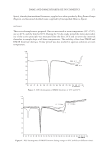
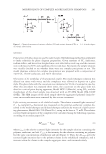
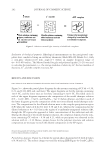
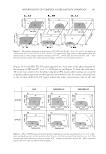
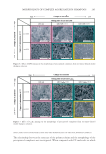
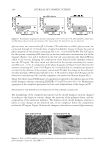
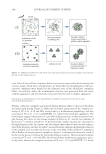
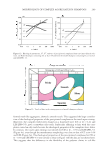
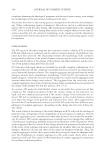
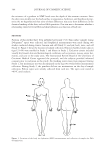
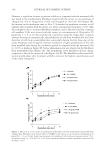
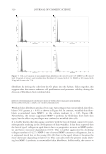
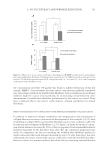
JOURNAL OF COSMETIC SCIENCE 298 cross-links of the rod-like complexes before coacervation were reduced by lowering the cationic charge. From these considerations, we found that the morphologies of the pre- cipitated complexes were formed by the adhesion state of the solubilized complexes before coacervation, where the membranous structure was generated from the dense complex aggregates and the mesh-like structure from the looser complex aggregates. RHEOLOGICAL PROPERTIES OF THE PRECIPITATED COMPLEXES AND THE TOUCH OF HAIR IN THE RINSING PROCESS Polymer–surfactant complexes precipitated during dilution adhere to hair and determine its texture upon rinsing. Figure 12 shows the viscoelastic parameters for the complex con- sisting of CC at α =0.38 and LES, which leads to a membranous morphology, and that consisting of CC at α = 0.21 and LES/LPB=3/1, which forms mesh-like aggregates. The former fi gure suggests the presence of a gel-like bridging structure in the precipitated com- plex because the curves for the storage modulus of elasticity, G′, and the loss modulus of elasticity, G″, crossed at around ω = 10 [rad/s] and the complex viscosity, η∗, decreased on the high frequency side. In contrast, the latter fi gure shows that η∗ was low and indepen- dent of the frequency and that G′ and G″ increased linearly, showing the fl uid-like character of the complex. It is clear that the decrease in the cross-links of the rod-like CC complex is full of fl uidity in the precipitated complexes. Figure 13 schematically shows the touch of the hair in the process of rinsing for the model shampoo solution. The precipitated complex consisting of CC at α = 0.38 and LES, which formed dense membranous aggregates, gave a sticky touch, whereas the complex consisting of CC at α = 0.21 and LES/LPB=3/1, which Figure 11. Difference between CC and CD in the coacervation process of cationic polymer and of anionic micelles in the dilution process.

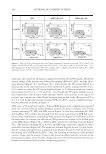
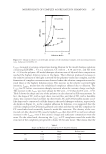
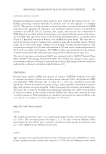
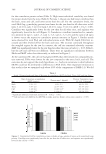
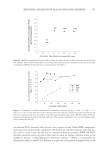
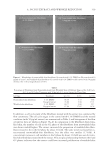
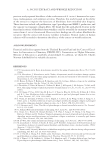
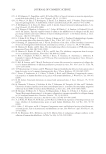
MORPHOLOGY OF COMPLEX AGGREGATES IN SHAMPOOS 299 Figure 12. Rheologcal parameters, G′, G″, and η∗, of precipitated complexes from ten-times-diluted solu- tions. (a) Model shampoo containing CC at α=0.38 and LES (b) model shampoo containing CC at α=0.21 and LES/LPB=3/1. Figure 13. Touch of hair in the rinsing process of model shampoo solution. formed mesh-like aggregates, showed a smooth touch. This suggested the large contribu- tion of the rheological properties of the precipitated complexes to the touch upon rinsing. Moreover, the complex with lower charges in a dispersed state (CC at α = 0.21 and LES/LPB=5/5) gave a somewhat oily touch. Surfactants adhering to hair with the com- plexes caused an oily touch because the rheological properties of the complexes were lower. In contrast, the touch upon rinsing was smooth for CD at α = 0.38 and LES/LPB=3/1 (Figure 4a), even though the membranous morphology was close to that of CC at α=0.38 and LES (Figure 6a). The rheological properties of the precipitated complexes for CD at α = 0.38 and LES/LPB=3/1 were similar to those in Figure 12b (the data are not shown here). This suggests that the differences in the fl exibility of the polymer chains in coil-like
Purchased for the exclusive use of nofirst nolast (unknown)
From: SCC Media Library & Resource Center (library.scconline.org)