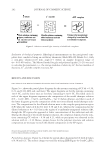
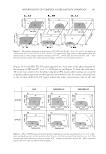
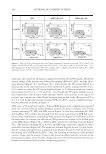
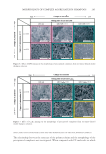
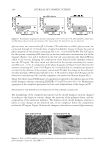
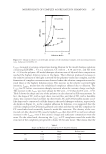
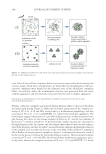
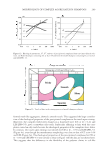
JOURNAL OF COSMETIC SCIENCE 300 complexes determine the rheological properties and the touch upon rinsing, even though the morphologies of the precipitated complexes are the same. Practically, the touch in the rinsing process corresponds to the wet feel after shampoo- ing. Other conditioning agents in shampoos, like silicon, and in a conditioners have greater effects on the feel after drying. The membranous morphology in the complexes of CC led to a stiff feel after drying when much of the complex adhered to the hair. To realize a good dry feel, the control of morphology in the complexes and the adjustment of synergism between the precipitated complexes and other conditioning agents would be important. CONCLUSIONS The CP region in the phase diagrams that contained cationic cellulose (CC) or dextran (CD) and added anionic surfactant and the relative scattered intensity of solubilized com- plexes have been observed. The relationship between the morphology of the complexes precipitated by dilution of the model shampoo solution and the touch on hair has been studied, and the effects of the charges of the polymer and added surfactant and the struc- ture of the polymer chain have been discussed. CC molecules with rigid chains are favorable for rod-like complex conformation. It is considered that the rod-like complexes cross-linked and coacervated in the dilution pro- cess of the model shampoo solution. The complex aggregates precipitated from the model shampoo solution had a membranous morphology if both the CC and surfactant were highly charged a mesh-like structure with openings was created and the aggregates were loosened when both charges were reduced. This suggested that the cross-links in the complex aggregates were reduced with decreasing charge and showed no precipitation if the charge of the polymer was low (for instance, if α = 0.1). In contrast, CD molecules with fl exible chains are favorable for contracted coil-like complexes. No complex precipitated when the anionic charge on the surfactant was high, and the complexes precipitated if the anionic charge of the surfactant was re- duced. CD led to membranous complex aggregates in the model shampoo solution even when the charges of the polymer and surfactant were lower. This suggested that the rod-like CC molecules and contracted coil-like CD molecules form different mor- phologies of complex aggregates, depending on the charge and structure of the poly- mer chains. The touch of hair in the rinsing of the model shampoo with CC refl ected the rheological properties that corresponded to the morphology of the precipitated complexes. The CC complex aggregates gave a smooth touch when they showed a loose mesh-like morphol- ogy. In contrast, CD complex aggregates gave a smooth touch even though they exhibited a membranous morphology, probably because of the fl exibility of the CD polymer. These results suggested that the control of the charges of both the polymer and surfactant and of the choice of the polymer structure is important for excellent effects in the rinsing of shampoo. Moreover, silicone and other oils are mixed in shampoos nowadays. Thus, the complex aggregates involve these agents when they precipitate from the shampoo solu- tion. The morphology of complex aggregates in this work would closely relate to the deposition of silicone. The control on the morphology of complex aggregates is important for excellent conditioning effects.

MORPHOLOGY OF COMPLEX AGGREGATES IN SHAMPOOS 301 ACKNOWLEDGMENTS The authors express their sincere appreciation to Dr K. Sugiyama, Director Executive General Manager of Research & Development Headquarters, Lion Co., and N. Yamamoto, Director of Functional Materials Research Laboratories, Lion Co. REFERENCES (1) E. D. Goddard, “Polymer/Surfactant Interaction in Applied Systems,” in Cosmetic Science and Technology Series, Vol. 22. Principles of Polymer Science and Technology in Cosmetics and Personal Care (New York, Marcel Dekker, 1999), pp. 181. (2) B. Idson, “Polymers as Conditioning Agents for Hair and Skin,” in Cosmetic Science and Technology Series, Vol. 21. Conditioning Agents for Hair and Skin (New York, Marcel Dekker, 1999), pp. 251. (3) E. D. Goddard, T. S. Phillips, and R. B. Hannan, Water soluble polymer–surfactant interaction—Part I, J. Soc. Cosmet. Chem., 26, 461–475 (1975). (4) E. D. Goddard and R. B. Hannan, Polymer/surfactant interactions, J. Am. Oil Chem. Soc., 54, 561–566 (1977). (5) C. U. Patel, Anti-static properties of some cationic polymers used in hair care products, Int. J. Cosmet. Sci., 5, 181–188 (1983). (6) Y. Suzuki and K. Yahagi, Dynamic and qualitative evaluation of combing force on human hair, J. Soc. Chem. Jpn., 27, 11–19 (1993). (7) Y. Hukuchi and U. Tamura, Instrumental methods for evaluating perceptible effects of shampoo and rinse on human hair, Fragrance J., 17, 30–38 (1989). (8) N. Ohyama, S. Kobayashi, Y. Kakizawa, and M. Miyuki, Effects of physical properties of anionic surfactant– cationic polymer complexes on the feel of rinsing shampoo, S.C.C.J, 43rd Symp., Japan, 1998, p. 31. (9) K. Hayakawa and J. C. T. Kwak, Surfactant-polyelectrolyte interactions. 1. Binding of dodecyltrime- tylammonium ions by sodium dextran sulfate and sodium poly(styrenesulfonate) in aqueous solution in the presence of sodium chloride, J. Phys. Chem., 86, 3866–3870 (1982). (10) K. Ohbu, O. Hiraishi, and I. Kashiwa, Effect of quaternary substitution of hydroxyethylcellulose on binding of dodecyl sulfate, J. Am. Oil Chem. Soc., 59, 108–112 (1982). (11) K. Shirahama and M. Tashiro, Binding of 1-decylpyridinium bromide to poly(vinyl sulfate), Bull. Chem. Soc. Jpn., 57, 377 (1984). (12) J. Liu, N. Takizawa, K. Shirahama, H. Abe, and K. Sakamoto, Effect of polymer size on the polyelectrolyte- surfactant interaction, J. Phys. Chem. B., 101, 7520–7523 (1997). (13) P. Hansson and M. Almgren, Interaction of CnTAB with sodium (caboxymethyl)cellulose: Effect of polyion linear charge density on binding isotherms and surfactant aggregation number, J. Phys. Chem., 100, 9038–9046 (1996). (14) P. L. Dibin, C. H. Chew, and L. M. Gan, Complex formation between anionic polyelectrolytes and cationic/nonionic mixed micelles, J. Colloid. Interface Sci., 128(2), 566–576 (1989). (15) C. Wang and K. C. Tam, New insights on the interaction mechanism within oppositely charged poly- mer/surfactant systems, Langmuir, 18, 6484–6490 (2002). (16) C. Wang and K. C. Tam, Interaction between polyelectrolyte and oppositely charged surfactant: Effect of charge density, J. Phys. Chem. B., 108, 8976–8982 (2004). (17) M. S. Vethamuthu, P. L. Dubin, M. Almgren, and Y. Li, Cryo-TEM of polyelectrolyte-micelle com- plexes, J. Colloid. Interface Sci., 186, 414–419 (1997). (18) F. Yeh, E. L. Sokolvo, A. R. Khokhlov, and B. Chu, Nanoscale supramolecular structures in the gels of poly(diallyldimethylammonium chloride) interacting with sodium dodecyl sulfate, J. Am. Chem. Soc., 118, 6615–6618 (1996). (19) M. Miyake and Y. Kakizawa, Study on the interaction between polyelectrolytes and oppositely charged ionic surfactants. Solubilized state of the complexes in the postprecipitation region, Colloid Polymer. Sci., 280, 18–23 (2002). (20) E. P. Geiduschek and A. Holtzer, Application of light scattering to biological systems: Deoxyribonu- cleic acid and the muscle proteins, Adv. Biol. Med. Phys., 6, 431–551 (1958). (21) P. S. Leung and E. D. Goddard, Gels from dilute polymer/surfactant solutions, Langmuir, 7, 608–609 (1991). (22) E. D. Goddard, P. S. Leung, and K. A. P. Padmanabhan, Novel gelling structures based on polymer/ surfactant systems, J. Soc. Cosmet. Chem., 42, 19–34 (1991). (23) M. Huldén, Hydrophobically modifi ed urethane-ethoxylate (HEUR) associative thickeners. 1. Rheol- ogy of aqueous solutions and interactions with surfactants, Colloids Surf. A, 82, 263–277 (1994).
Purchased for the exclusive use of nofirst nolast (unknown)
From: SCC Media Library & Resource Center (library.scconline.org)